

In Oliver Hermanus’s “Living” (2022), we witness a remarkable cultural translation that spans continents and decades. The film, starring Bill Nighy in a masterfully restrained performance, reimagines Akira Kurosawa’s 1952 masterpiece “Ikiru,” itself inspired by Leo Tolstoy’s “The Death of Ivan Ilyich.” This layered adaptation creates a fascinating meditation on bureaucracy, mortality, and the search for meaning in one’s life.
I watched this movie last Monday, January 6, and since I couldn’t come up with any New Year’s resolutions, I figured I’d use this movie as a bit of a wake-up call during that time of year when SAD usually kicks in, leaving me feeling as bare as a dormant tree. It will serve as a reminder that there is more to life than killing time and adjusting your reactions to whatever is thrown at you.


The film transposes Kurosawa’s narrative from post-war Tokyo to 1950s London with remarkable precision. The setting shift illuminates fascinating parallels between Japanese and British societies – both deeply hierarchical, bound by tradition, and struggling with the weight of their own formalities. Where Kurosawa’s film depicted Japanese bureaucracy through the lens of post-war reconstruction, Hermanus explores British civil service during the dawn of the welfare state.
The film’s portrayal of working life in 1950s London is meticulously crafted. The film’s opening credits sequence serves as a masterful visual overture to its themes of conformity and class structure. Shot from above, we witness a mesmerizing choreography of dark-suited men crossing London Bridge, their bowler hats creating a hypnotic pattern of black circles moving in mechanical precision. This aerial view transforms individual civil servants into an abstract pattern – a visual metaphor for the system’s absorption of individual identity.
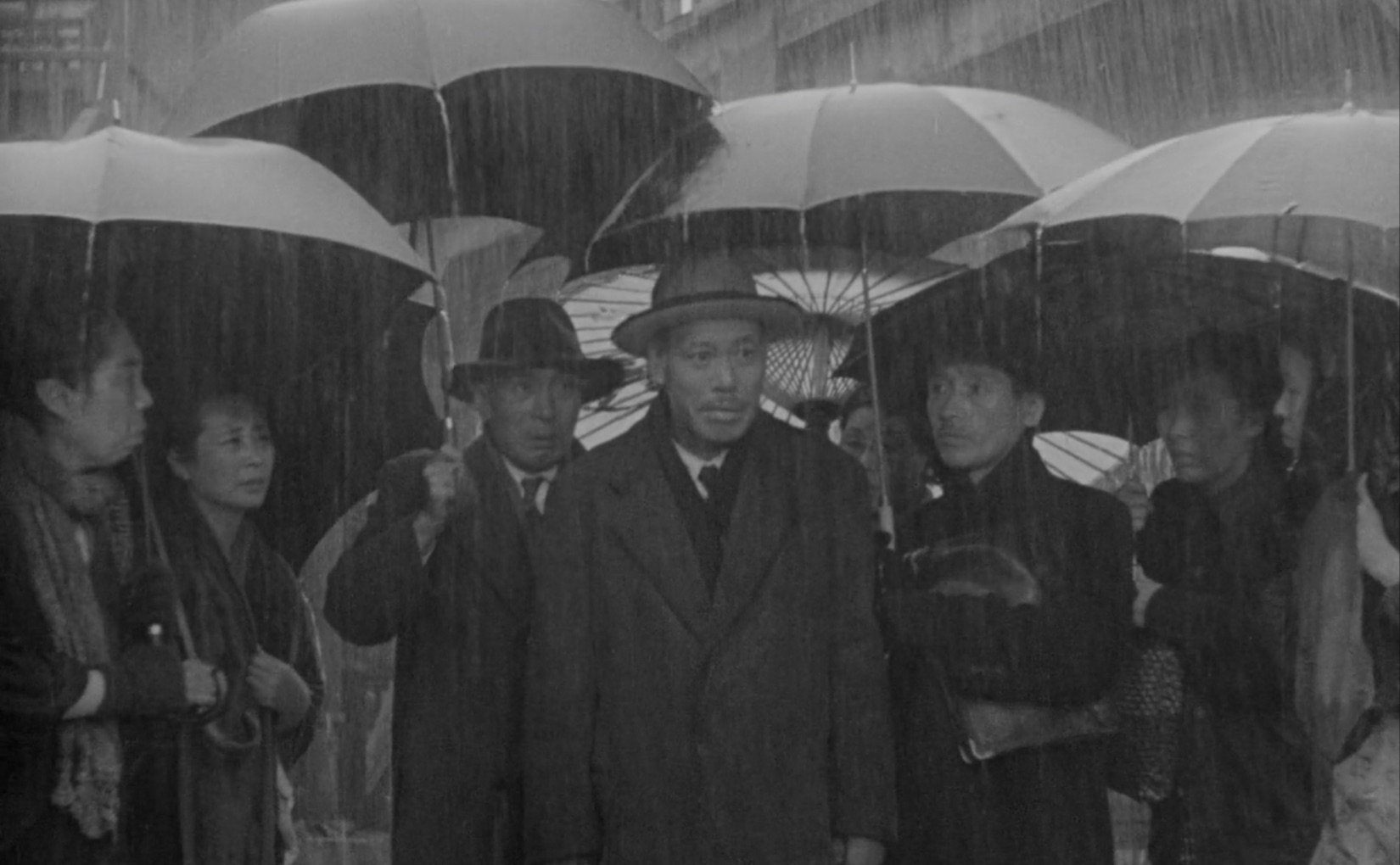
The sequence pays homage to the famous “Umbrella Scene” in Kurosawa’s “Ikiru,” but recontextualizes it for 1950s London. Where Kurosawa used umbrellas to suggest the anonymity of bureaucratic life, Hermanus employs the bowler hat – a quintessentially British symbol of middle-class respectability. The camera’s careful composition turns these hats into a kind of musical notation, with the men’s movements creating a visual rhythm that echoes the mechanical nature of their working lives.
The credits themselves, appearing in a clean, period-appropriate typeface, float above this sea of conformity. Their precise placement and timing work in concert with the movement below, creating a multi-layered opening that establishes both the film’s aesthetic restraint and its concern with systems and structures.
As the sequence progresses, we begin to distinguish Mr. Williams among the crowd – a feat that becomes significant only in retrospect, as we watch him gradually break free from this uniformity throughout the film. The way he emerges from this abstract pattern of hats and suits foreshadows his journey from anonymity to individuality.
The Public Works department where Mr. Williams (Nighy) serves as a senior civil servant becomes a microcosm of British society. The carefully arranged desks, the ritualistic shuffling of papers, and the precise adherence to tea times all speak to a system where order masks stagnation.

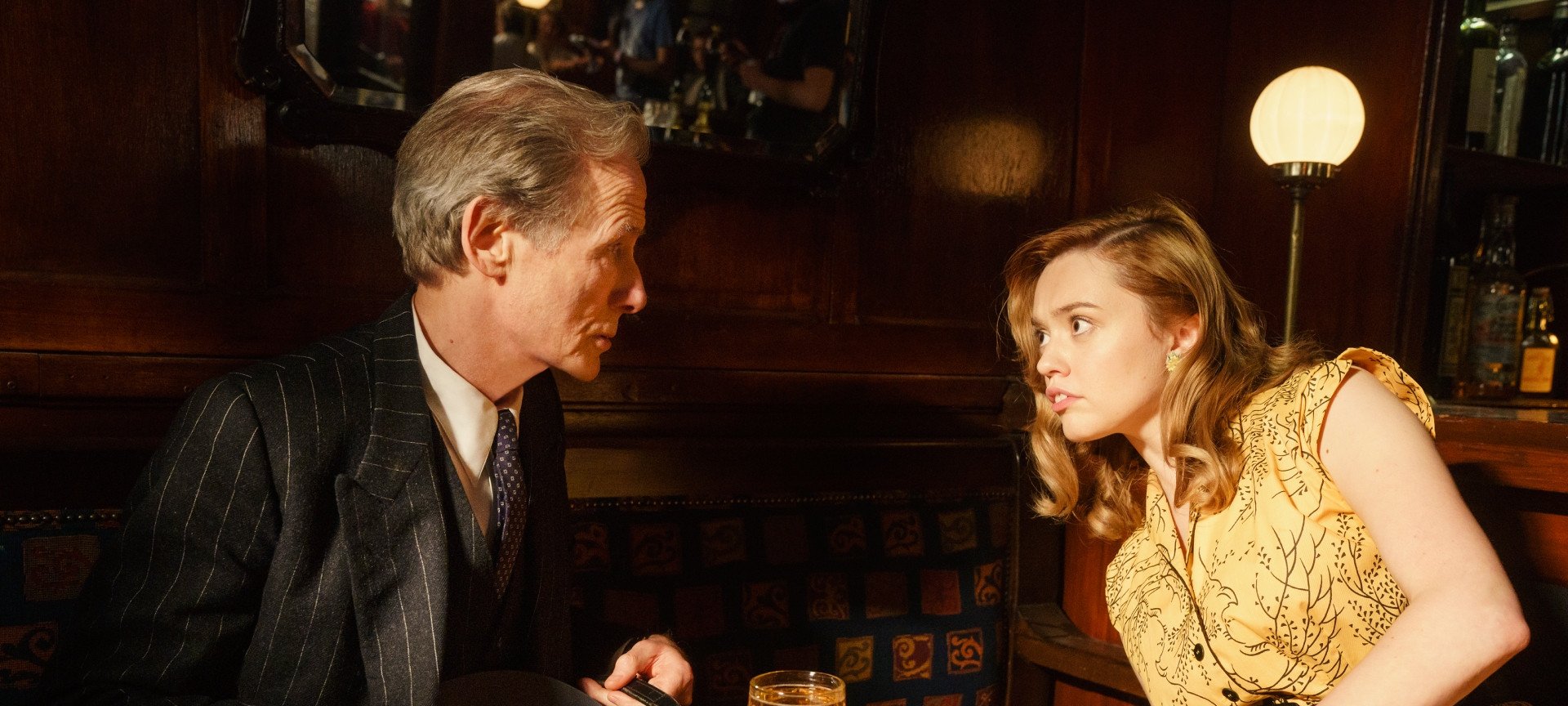
Costume designer Sandy Powell crafts a visual hierarchy that speaks volumes about social status and personal transformation. The film opens with a sea of identical bowler hats and dark suits flooding London Bridge – a powerful image of conformity within the civil service. Mr. Williams’s bowler hat serves as a symbol of his position and the rigid system he inhabits. When illness forces him to leave it behind, its absence marks the beginning of his transformation.
The subsequent adoption of a Borsalino hat represents more than a mere change in headwear. The Italian-made fedora, with its softer lines and continental associations, symbolizes Mr. Williams’s gradual liberation from the constraints of his former life. This subtle costume change speaks to a broader rebellion against the suffocating propriety of British bureaucracy.

The precision in costume extends beyond headwear. The gradual loosening of Mr. Williams’s tie, the eventual unbuttoning of his collar, and even the slight dishevelment of his usually impeccable suit all chart his journey from rigid conformity to a more authentic existence. These changes are particularly striking against the unchanged appearance of his colleagues, who remain locked in their sartorial prison.
Wearing Existence: Costume as Existential Metaphor
The costume design in both “Ikiru” and “Living” serves as a powerful visual metaphor for the existential journey that Tolstoy first explored in “The Death of Ivan Ilyich.” Each film uses clothing to express both the weight of social conformity and the gradual awakening to authentic existence, though they do so through distinctly different cultural vocabularies.

The Uniform of Non-Existence
In both films, the protagonists’ initial costumes represent what Tolstoy called a life lived “most ordinarily” – a form of spiritual death disguised as propriety:
– Watanabe’s dark suits and hat in “Ikiru” reflect the standardization of post-war Japanese bureaucracy, where Western business attire represented both modernization and loss of traditional identity
– Mr. Williams’s bowler hat and precisely tailored suit in “Living” embody the British civil service’s rigid hierarchy and emotional suppression
These initial costumes serve as armor against life itself, much as Ivan Ilyich’s dedication to propriety served as a shield against authentic experience.

The Gradual Undressing of the Soul
Both films use subtle changes in costume to chart their protagonists’ awakening:
In “Ikiru”:
– Watanabe’s gradual dishevelment mirrors his breaking free from social constraints
– His hat, initially perfectly positioned, begins to sit askew
– The loosening of his tie reflects his loosening grip on social conventions
– His final appearance in the swing scene, where his clothing moves freely in the snow, suggests a return to childlike authenticity
In “Living”:
– The loss of the bowler hat marks the first crack in Mr. Williams’s facade
– The Borsalino hat represents not just rebellion but a conscious choice of a new identity
– The subtle relaxing of his suit’s precision mirrors his internal liberation
– His final outfit maintains dignity while suggesting comfort in his own skin
The way each film handles this sartorial journey reflects deep cultural differences:
– Watanabe’s transformation involves a more complete dishevelment, reflecting Japanese culture’s understanding of liberation as a form of surrender
– Mr. Williams’s changes are more subtle, suggesting the British capacity for rebellion within conformity
– Both contrast with Tolstoy’s Ivan Ilyich, whose physical deterioration serves as the primary metaphor for his spiritual transformation
Class, Clothing, and Authenticity
Each film uses costume to explore how class structures inhibit authentic existence:
In “Ikiru”:
– The contrast between bureaucrats’ Western suits and the working-class traditional clothing

– The young office girl’s modern dress representing post-war freedom
– Watanabe’s final dishevelment as a rejection of class-based propriety
In “Living”:
– The precise gradations of suit quality marking civil service ranks

– The young woman’s colorful clothing suggesting life outside the system
– Mr. Williams’s Borsalino as a subtle sign of continental sophistication challenging British class rigidity
The Final Garment
Both films end with powerful costume statements:
– Watanabe dies in his loosened, snow-covered clothing, suggesting a final liberation from social constraints
– Mr. Williams’s final appearance shows him in his modified uniform – the Borsalino replacing the bowler – indicating that true liberation can occur within, rather than in rejection of, one’s social role
These costume choices echo Tolstoy’s message that awareness of death can lead to authentic life, but they do so through carefully chosen cultural idioms. The Japanese dishevelment and the British modified propriety represent different paths to the same truth: that genuine existence requires shedding, or at least transforming, the uniforms society demands we wear.
Beyond the Physical
In all three works, clothing serves as a metaphor for what Tolstoy called the “fictional life” – the life lived according to external expectations rather than internal truth. Both films use costume design to visualize what Tolstoy could only describe: the gradual awakening from this fiction to authenticity.

The genius of both adaptations lies in recognizing that this universal journey must be expressed through particular cultural languages of dress and deportment. In doing so, they make Tolstoy’s abstract existential concerns tangible and immediate, showing how the great questions of existence play out in the minute details of how we present ourselves to the world.
The Existential Thread: From Tolstoy to Kurosawa to Hermanus
At the heart of “The Death of Ivan Ilyich,” Tolstoy poses a devastating question: “What if my whole life has been wrong?” This existential inquiry echoes through both “Ikiru” and “Living,” each adaptation finding its own cultural language to explore this universal concern. The visual grammar of both films serves this central question, though they approach it through distinctly different cultural prisms.
Tolstoy’s novella examined this question through the lens of 19th-century Russian society, where Orthodox Christianity and aristocratic values shaped the understanding of a “proper life.” Kurosawa translated this inquiry into post-war Japanese society, where questions of purpose became particularly acute amid reconstruction and changing values. Hermanus relocates it to 1950s Britain, where class structures and emotional restraint created their own form of spiritual imprisonment.
In each iteration, the protagonist’s awakening to life’s true meaning is preceded by a recognition of social performance. Ivan Ilyich realizes his life has been lived “most simply and most ordinarily and therefore most terribly.” Kurosawa’s Watanabe finds that his decades of stamping papers have produced nothing of value. Mr. Williams discovers that his perfect embodiment of civil service propriety has been a form of living death.
Visual Languages of Awakening
Where Tolstoy used precise prose to dissect his protagonist’s spiritual crisis, both films employ careful visual strategies to externalize this internal journey:
– Kurosawa uses stark contrast and dramatic weather to reflect Watanabe’s emotional states, with snow and rain serving as powerful metaphors for cleansing and renewal.
– Hermanus employs the gradual softening of visual rigidity – from the geometric patterns of bowler hats to the free-flowing movement of children in the playground – to show Mr. Williams’s liberation from social constraints.
Both films share a crucial understanding: that the answer to Tolstoy’s terrible question lies not in grand gestures but in small, meaningful actions. Watanabe’s playground and Mr. Williams’s park represent more than public works projects – they are physical manifestations of their creators’ breakthrough to authentic living.
The Weight of Time
All three works deal poignantly with time’s passage:
– Tolstoy’s Ivan Ilyich realizes too late that his life has been misspent
– Kurosawa’s Watanabe races against time to complete his playground
– Mr. Williams’s measured transformation suggests that even a brief period of authentic living can redeem a lifetime of conformity
Cultural Translations of Truth
What makes both film adaptations remarkable is how they maintain Tolstoy’s essential truth while speaking through their own cultural idioms:
– Kurosawa expresses it through the lens of giri (duty) transformed into meaningful action
– Hermanus finds it in the British capacity for quiet revolution within seemingly rigid structures
Legacy and Memory
Each work concludes by examining how others remember the protagonist:
– Tolstoy’s mourners are primarily concerned with promotion opportunities
– Kurosawa’s bureaucrats briefly celebrate Watanabe before returning to their old ways
– Hermanus’s colleagues maintain their reserve, but with a new understanding glimpsed through their constrained emotions
Yet in all three versions, there’s a small group who truly understand the transformation they witnessed. This understanding becomes a kind of torch, passed from Tolstoy’s pages through Kurosawa’s lens to Hermanus’s camera – the possibility that one life, properly lived even for a short time, can illuminate the way for others.
In the end, “Living” accomplishes something remarkable: it takes Tolstoy’s existential question and Kurosawa’s humanist answer and filters them through the precise visual language of British society, creating something both culturally specific and universally resonant. Through its careful attention to visual detail – from the geometric patterns of bowler hats to the free movement of the final scenes – it shows how the great questions of existence can be explored through the smallest details of human behavior and social custom.
The film reminds us that the search for meaning, while universal, is always experienced through the particular – through specific hats and suits, through precise ways of moving through space, through culturally determined ways of showing or hiding emotion. In doing so, it achieves what great art should: it makes the universal deeply personal, and the personal universally understood, making you question (again) what is after all the purpose of living.
References and stills
Scene by Green Ikiru
Scene by Green Living

The Death of Ivan Ilyich (full text via University of Minnesota Twin Cities)
Learning about Movies episode 78
 Stories from A Closet of Errors