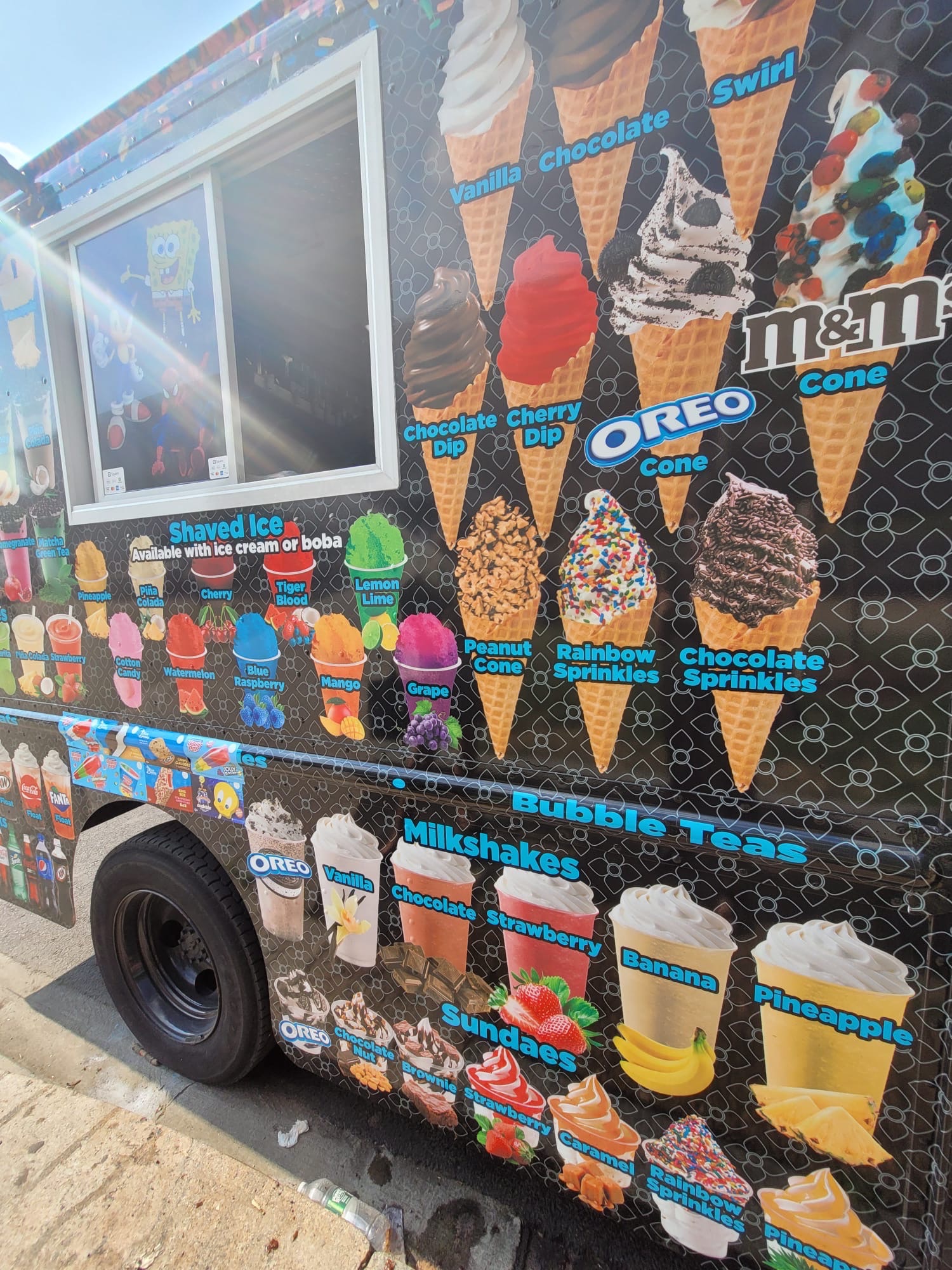
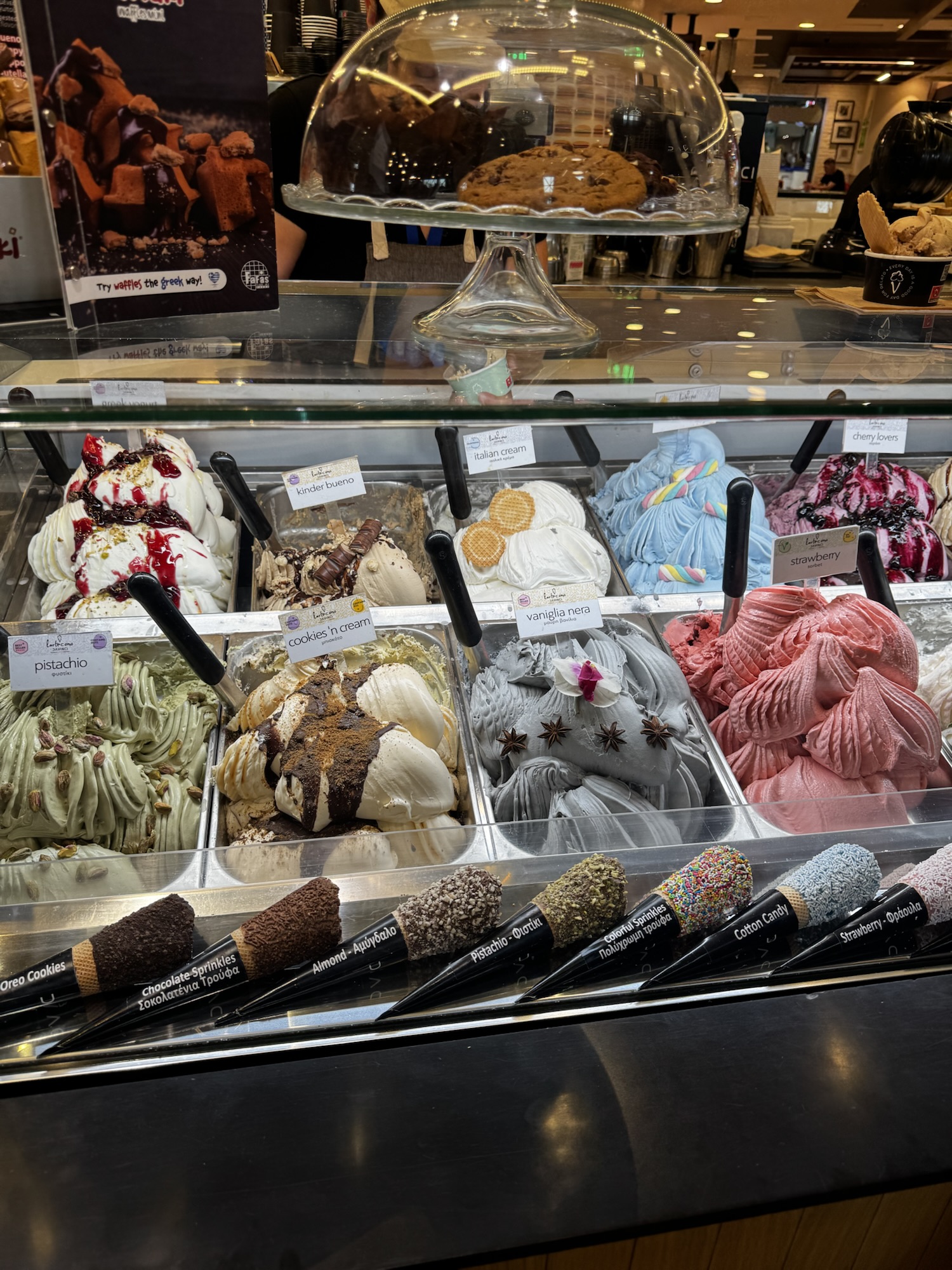
It wouldn’t matter if I got to a hundred picnics in after years; they wouldn’t make up for missing this one. They’re going to have boats on the Lake of Shining Waters—and ice cream, as I told you. I have never tasted ice cream. Diana tried to explain what it was like, but I guess ice cream is one of those things that are beyond imagination.
L.M. Montgomery, Anne of Green Gables (Chapter XIII)
Call the roller of big cigars, The muscular one, and bid him whip In kitchen cups concupiscent curds. Let the wenches dawdle in such dress As they are used to wear, and let the boys Bring flowers in last month's newspapers. Let be be finale of seem. The only emperor is the emperor of ice-cream.
Take from the dresser of deal, Lacking the three glass knobs, that sheet On which she embroidered fantails once And spread it so as to cover her face. If her horny feet protrude, they come To show how cold she is, and dumb. Let the lamp affix its beam. The only emperor is the emperor of ice-cream.
They are not human beings, they are human resources. They do not have names, they have productivity metrics. They do not have faces, they have employee ID numbers. They do not have hearts, they have performance indicators.
Eduardo Galeano’s poem “The Nobodies” pierces through the comfortable abstractions we use to distance ourselves from human suffering. In its stark repetition, it reveals how modern systems transform people into categories, individuals into statistics, and pain into acceptable externalities. But Galeano’s vision, written decades ago, has evolved into something even more insidious in our contemporary moment: we have built a machinery of indifference so sophisticated that it operates without malice, so efficient that it barely requires conscious cruelty.
The Architecture of Abstraction Modern society has perfected the art of making suffering invisible through layers of abstraction. We speak of “market corrections” rather than families losing their homes. We discuss “labor optimization” instead of communities destroyed by factory closures. We analyze “demographic transitions” while people flee wars we barely acknowledge. The language itself becomes a buffer, creating distance between decision-makers and consequences, between the comfortable and the expendable.
This linguistic sleight of hand serves a psychological function as much as a political one. When a pharmaceutical company prices medication beyond the reach of the dying, executives sleep soundly because they are “maximizing shareholder value.” When a social media algorithm amplifies hate speech because it drives engagement, engineers rationalize it as “user preference optimization.” The suffering is real, immediate, and measurable, but the responsibility is diffused through systems so complex that no individual feels accountable for the human cost.
The efficiency obsession that defines our era has transformed this indifference from a moral failing into a virtue. To pause and consider the human impact of our decisions is seen as inefficient, unprofessional, naive. The manager who agonizes over layoffs is less valuable than one who can execute them cleanly. The doctor who spends time comforting patients is less productive than one who processes more cases per hour. We have created incentive structures that systematically reward the suppression of empathy.
The Cruelty Inheritance But beneath these institutional failures lies something more troubling: the persistence of human cruelty across all attempts at moral progress. The armed conflicts ravaging our world today follow patterns established thousands of years ago. In Ukraine, Gaza, Sudan, Myanmar, and countless other places, human beings wake up each day and choose to inflict suffering on other human beings. They do so not despite their humanity, but because of it.
This cruelty is not random or inexplicable. It follows a logic as old as our species: the logic of payback, of transferred pain, of suffering seeking outlet. The person humiliated by their superior finds someone weaker to humiliate. The community traumatized by violence becomes willing to traumatize others. The nation that has been invaded becomes, when strong enough, an invader. We pass our pain down like an inheritance, each generation finding new ways to make others pay for what was done to them.
Modern life has not eliminated this dynamic but has made it more sophisticated. Our frustrations are more diffuse—traffic jams, automated phone systems, bureaucratic mazes, jobs that feel meaningless. None of it is dramatic enough to justify real rage, but it accumulates into a background resentment that seeks expression. The road rage incident, the cruel comment on social media, the casual workplace bullying—these are not aberrations but pressure valves in a system that generates more frustration than it knows how to process.
The Adaptation of Numbness Perhaps most disturbing is how indifference becomes a survival strategy. Healthcare workers learn not to get too attached to patients who might die. Social workers develop emotional barriers to protect themselves from the endless parade of human misery. Politicians master the art of discussing mass suffering in abstract terms because the alternative—feeling it all—would be paralyzing.
This numbness serves a function, but it comes at a cost. The protective callousness that helps us navigate a cruel world gradually becomes genuine indifference. The executive who starts by reluctantly cutting benefits to save the company ends up seeing employees as line items on a spreadsheet. The soldier who learns to dehumanize enemies to survive combat struggles to see civilians as fully human afterward.
The adaptation becomes the identity. We have built economic systems that reward this emotional numbness. The most successful leaders are often those who can make decisions without being burdened by empathy. They advance not despite their indifference to suffering but because of it. Meanwhile, those who remain sensitive to human cost find themselves at a systematic disadvantage, gradually filtered out of positions where they might make a difference.
The Persistence of Patterns Look at the armed conflicts tearing apart our world, and you see the same dynamics Galeano observed in economic exploitation applied to violence. The victims become statistics, their names unknown, their faces unseen. A hospital becomes a “military target.” A school becomes “collateral damage.” Children become “enemy combatants.” The same abstraction that turns workers into resources turns civilians into acceptable losses.
These conflicts reveal something uncomfortable about human nature: our capacity for systematic cruelty seems inexhaustible. We have international laws, human rights frameworks, global communication that makes suffering visible, and yet the violence continues. Each generation discovers new ways to inflict ancient forms of pain. The tools evolve—from swords to drones—but the willingness to use them against other humans remains constant.
What makes this particularly disheartening is how quickly victims can become perpetrators. The oppressed, when they gain power, often replicate the systems that oppressed them. The colonized become colonizers. The abused become abusers. The pattern suggests that cruelty is not a deviation from human nature but an expression of it, waiting to emerge whenever conditions permit.
The Illusion of Progress We tell ourselves stories about moral progress, about civilization advancing toward greater compassion and justice. And there is truth in these stories—slavery is now universally condemned, democratic ideals have spread, human rights discourse has global reach. But these advances exist alongside unchanged patterns of cruelty and indifference. We have become more sophisticated in our methods, more subtle in our violence, more efficient in our exploitation.
The plantation becomes the sweatshop. The colonial administrator becomes the international development expert. The inquisitor becomes the algorithm that decides who gets healthcare. The forms change, but the fundamental dynamic persists: some humans deciding that other humans are expendable in service of larger goals.
Perhaps the most honest conclusion is that the brief periods of peace and cooperation in human history are the anomalies, not the norm. The moral frameworks we construct—religions, philosophies, legal systems—are elaborate attempts to contain something that remains fundamentally unchanged within us. They work, sometimes, for some people, in some places, for limited periods. But they are always fighting against gravity.
The Acceptance of Limits There is something oddly liberating in accepting the persistence of human cruelty rather than continuing to believe it can be eliminated. If indifference and violence are permanent features of human society rather than problems to be solved, then the question becomes not how to create a perfect world but how to minimize harm in an imperfect one.
This acceptance does not mean resignation. It means working within reality rather than against it. Building systems that assume humans will sometimes be cruel rather than systems that assume they won’t. Creating redundancies and safeguards that limit the damage any individual or group can inflict. Recognizing that moral progress is temporary and fragile, requiring constant maintenance rather than being a permanent achievement.
Galeano’s nobodies are still with us, multiplied by technology and globalization. They work in factories we never see, fight in wars we barely acknowledge, suffer from diseases we could cure but choose not to fund. They remain nobody not because we cannot see them but because seeing them clearly would require us to confront uncomfortable truths about ourselves and the systems we maintain.
The machinery of indifference grinds on, fed by our small cruelties and large abstractions, our inherited pain and systemic incentives. It operates with or without our consent, but never without our participation. We are all complicit, and we are all victims, caught in patterns older than civilization and seemingly more durable than any attempt to break them.
Perhaps wisdom lies not in the impossible dream of ending human cruelty but in the more modest goal of reducing it where we can, acknowledging it where we cannot, and refusing to let our necessary numbness become complete blindness. The nobodies are still nobody, but at least we can choose whether to keep pretending we don’t see them.
The nobodies (Los nadies) by Eduardo Galeano, from the book El libro de los abrazos, 1989.
Fleas dream of buying themselves a dog, and nobodies dream of escaping from poverty, that one magical day good luck will soon rain, that good luck will pour down, but good luck doesn’t rain, neither yesterday nor today,nor tomorrow, nor ever, nor does good fall from the sky in little mild showers, however much the nobodies call for it, even if their left hands itch or they get up using their right feet, or they change their brooms at new year. The nobodies: the children of nobody, that masters of nothing, The nobodies: the nothings, those made nothing, running after the hare, dying life, fucked, totally fucked: who are not, although they were. Who speak no languages, only dialects. Who have no religions, only superstitions. Who have have no arts, only crafts. Who have no culture, only folklore. Who are not human beings, but human resources. Who have faces, only arms. Who don’t have names, only numbers. Who don’t count in world history, just in the local press’s stories of violence, crime, misfortune and disaster,. The nobodies who are worth less than the bullets that kill them.
Sueñan las pulgas con comprarse un perro y sueñan los nadies con salir de pobres, que algún mágico día llueva de pronto la buena suerte, que llueva a cántaros la buena suerte; pero la buena suerte no llueve ayer, ni hoy, ni mañana, ni nunca, ni en lloviznita cae del cielo la buena suerte, por mucho que los nadies la llamen y aunque les pique la mano izquierda, o se levanten con el pie derecho, o empiecen el año cambiando de escoba. Los nadies: los hijos de nadie, los dueños de nada. Los nadies: los ningunos, los ninguneados, corriendo la liebre, muriendo la vida… Que no son, aunque sean. Que no hablan idiomas, sino dialectos. Que no profesan religiones, sino supersticiones. Que no hacen arte, sino artesanía. Que no practican cultura, sino folklore. Que no son seres humanos, sino recursos humanos. Que no tienen cara, sino brazos. Que no tienen nombre, sino número. Que no figuran en la historia universal, sino en la crónica roja de la prensa local. Los nadies, que cuestan menos que la bala que los mata
I lose track of time—not just the hours in a day, but the architecture of time itself. Days blur into weeks, weeks into months, and suddenly I’m looking back at years that feel like they happened to someone else, in some other lifetime I can barely access. It’s not simply forgetting; it’s a deeper disorientation, an inability to place the events of my life on any coherent timeline.
This temporal blindness has been building gradually, like fog rolling in so slowly you don’t notice until the familiar landmarks of memory have disappeared. Most of my days feel interchangeable now, lacking the distinct markers that once helped me navigate the story of my own life. Without these anchors, time becomes elastic and strange—months can feel like weeks, years like months, and recent events feel ancient while distant memories seem immediate.
But some moments still cut through the haze with startling clarity. Travel creates these temporal anchors naturally—the sensory richness of new places, disrupted routines, the way my brain has to pay attention when everything is unfamiliar. So do moments of intense freedom and comfort, those rare times when I feel most myself, when social expectations fall away and I’m doing exactly what I want without compromise. And certain people, too, become markers in time—those who draw out different parts of me or create space for conversations that feel like they matter.
What strikes me about these clear moments is their common thread: they’re all times when I feel fully alive and present, when I’m engaged rather than going through motions. They represent pockets of authentic experience in an otherwise routine existence. The tragedy isn’t that I can’t remember what happened—it’s that so much of what happens doesn’t feel worth remembering.
Perhaps the gradual erosion of temporal landmarks isn’t just about aging or the sameness imposed by modern life. Maybe it’s about how rarely we allow ourselves to be fully present, how infrequently we create conditions for the kind of aliveness that makes moments stick. Time may not actually be speeding up—we might just be sleepwalking through most of it, leaving behind a wake of forgettable days that our minds, quite reasonably, choose not to preserve.
The solution isn’t necessarily to manufacture constant novelty or drama. But recognizing what makes certain moments memorable—travel, freedom, meaningful connection—might offer clues about what our minds need to start forming temporal anchors again. Even small acts of presence and intention might help distinguish one day from another. They create the kind of memories that come with their time signatures intact.
The world is a beautiful place to be born into if you don’t mind happiness not always being so very much fun if you don’t mind a touch of hell now and then just when everything is fine because even in heaven they don’t sing all the time
The world is a beautiful place to be born into if you don’t mind some people dying all the time or maybe only starving some of the time which isn’t half so bad if it isn’t you
Oh the world is a beautiful place to be born into if you don’t much mind a few dead minds in the higher places or a bomb or two now and then in your upturned faces or such other improprieties as our Name Brand society is prey to with its men of distinction and its men of extinction and its priests and other patrolmen and its various segregations and congressional investigations and other constipations that our fool flesh is heir to
Yes the world is the best place of all for a lot of such things as making the fun scene and making the love scene and making the sad scene and singing low songs of having inspirations and walking around looking at everything and smelling flowers and goosing statues and even thinking and kissing people and making babies and wearing pants and waving hats and dancing and going swimming in rivers on picnics in the middle of the summer and just generally ‘living it up’
Yes but then right in the middle of it comes the smiling mortician
’T is you that are the music, not your song. The song is but a door which, opening wide, Lets forth the pent-up melody inside, Your spirit’s harmony, which clear and strong Sing but of you. Throughout your whole life long Your songs, your thoughts, your doings, each divide This perfect beauty; waves within a tide, Or single notes amid a glorious throng. The song of earth has many different chords; Ocean has many moods and many tones Yet always ocean. In the damp Spring woods The painted trillium smiles, while crisp pine cones Autumn alone can ripen. So is this One music with a thousand cadences.
I can’t find a definitive answer. There are some genres—just a few—that don’t speak to me, but almost all music transforms the often banal rhythms of everyday life into something cinematic and wonderful.
I like to think that I’ve got this incredible range that spans from the raw power of punk to the grandiose drama of opera, the passionate intensity of flamenco to the groove mastery of Prince’s funk.
I am drawn to music that has intensity and emotional authenticity. This could be delivered through a screaming guitar, a soaring aria, or Prince’s unmistakable groove. I suppose these seemingly different genres all share that transformative cinematic quality. Each one paints everyday life with bold, dramatic strokes – just in very different colors.
Despite all critical advice, I have finally decided to watch Joker: Folie à Deux and actually liked it.
“Joker: Folie à Deux” succeeds brilliantly, in my opinion, in presenting music not as traditional Broadway spectacle, but as something far more intimate and psychologically honest—the way a real person might slip into musical response when processing their world. The film uses its musical sequences to show how characters experiencing mental illness might perceive reality, with songs emerging organically from their psychological states rather than as theatrical showstoppers.
This approach places the film in fascinating company with movies like “All That Jazz” and “Dancer in the Dark,” where musical elements emerge from psychological necessity rather than theatrical convention.
Lars von Trier’s Dancer in the Dark (2000) is a heart-wrenching musical drama that uses music as a form of escapism for its protagonist, Selma (Björk), a factory worker who is slowly losing her sight. Selma’s internal soundtrack is a series of elaborate musical numbers that she imagines to escape the harsh realities of her life.
The film’s musical sequences are starkly different from its grim, handheld-camera visuals. When Selma sings, the world around her transforms into a vibrant, dreamlike stage, filled with synchronized dancers and sweeping orchestration. These moments are not just fantasies; they are Selma’s way of coping with her struggles and finding beauty in an otherwise bleak existence.
What makes Dancer in the Dark so powerful is the contrast between Selma’s internal soundtrack and the external world. The music is a refuge, a place where she can momentarily forget her pain. However, as the film progresses, the line between her fantasies and reality begins to blur, leading to a devastating climax.
In All That Jazz, music isn’t just a backdrop—it’s the heartbeat of Joe Gideon’s world. The film uses musical numbers as a way to externalize Joe’s thoughts, fears, and desires. These sequences are often surreal, blending fantasy and reality in a way that mirrors Joe’s fragmented state of mind.
One of the most striking aspects of the film is how it uses music to explore Joe’s inner conflicts. For example, the recurring song “Take Off With Us” from the fictional musical Joe is directing becomes a metaphor for his own life—glamorous on the surface but deeply chaotic underneath. The musical numbers are often grandiose and theatrical, reflecting Joe’s larger-than-life personality and his tendency to escape into his art rather than confront his personal demons.
The film’s climax, set to the song “Bye Bye Life,” is a masterful use of music as an internal soundtrack. As Joe lies on his deathbed, he imagines a final, elaborate performance where he bids farewell to his loved ones and his own life. This sequence is both heartbreaking and exhilarating, as it captures Joe’s acceptance of his mortality while celebrating his passion for performance. The music here isn’t just a narrative device; it’s a window into Joe’s soul, revealing his regrets, his pride, and his ultimate surrender.
Like Bob Fosse’s semi-autobiographical exploration of a mind fracturing into musical fragments, “Joker” uses music both as a representation of psychological breaking and as an attempt to make sense of a fractured self.
What makes “Joker: Folie à Deux” particularly compelling is its critical examination of how audiences consume and destroy the very authenticity they claim to seek. Arthur’s relationship with his audience is fundamentally parasitic—they don’t see him as a person, but as a performance, a symbol, or a projection of their own desires. Even his most intimate musical moments become public spectacle, transforming personal expression into consumable entertainment.
This stands in stark contrast to David Lynch’s “Wild at Heart,” where Sailor’s Elvis channeling serves a completely different function. When Nicolas Cage’s Sailor breaks into Elvis, he’s not seeking validation—he’s expressing something essential about himself that can’t be contained in normal conversation. His musical moments are defiantly authentic, performed for himself and Lula while remaining beautifully unconcerned with audience approval.
The difference is crucial: Sailor tries to explain who he is but ultimately doesn’t need the audience’s approval, while Arthur is trapped in the tragic paradox of only being allowed to exist as what people think he is. In “Wild at Heart,” performance becomes liberation; in “Joker,” it becomes another form of confinement.
Both films explore the concept of shared reality, but they reach opposite conclusions about its power. Sailor and Lula’s relationship in “Wild at Heart” can be understood as a kind of folie à deux—a shared delusion—but it’s ultimately the fairy tale reinterpretation that wins out. Their shared fantasy world isn’t madness; it’s a shield against the real madness surrounding them. Their love story becomes a survival mechanism, with their heightened, stylized worldview protecting them from genuine grotesquerie.
“Joker: Folie à Deux,” however, suggests that shared musical reality is ultimately illusory. By the end, there’s the devastating recognition that nothing was truly shared—just parallel solitudes briefly overlapping before dissolving into the resigned acceptance of “That’s Life.”
Most of us also turn to internal soundtracks to help us process emotions, express what we can’t verbalize, and transform mundane moments into something more meaningful. Whether consciously or not, we live with our own ongoing musical theater—often of questionable taste—that helps us make sense of our daily experiences.
The key difference between healthy and destructive musical thinking lies in agency and authenticity. When our internal soundtracks serve genuine self-understanding rather than performance for others’ consumption, they become tools for emotional navigation rather than traps of external expectation.
David Lynch’s work consistently championed individual authenticity against societal norms, seeing personal expression as a sacred, almost magical force capable of transforming reality through sheer commitment to one’s authentic self.
This offers a hopeful counterpoint to “Joker’s” more pessimistic view of how individual authenticity can be crushed under the weight of public perception and media consumption. Where Lynch sees individual expression as liberating, “Joker” presents it as tragically vulnerable to commodification and distortion.
Perhaps the most honest approach to our internal musical theater is to embrace it with both commitment and humor—acknowledging its questionable taste while recognizing its genuine power to help us navigate life’s complexities. We can choose to be more like Sailor, using our personal soundtracks as tools for authentic self-expression, or risk becoming like Arthur, trapped by others’ expectations of our performance.
Music isn’t just entertainment—it’s a fundamental way humans process reality, express emotion, and connect with both ourselves and others. Whether it becomes a source of liberation or confinement depends on whether we’re performing for ourselves or for an audience that may never truly see us.
In the end, we’re all living with our own internal musical theater. The question isn’t whether this is normal or healthy—it’s whether we can maintain agency over our own soundtrack while staying true to the complex, sometimes ridiculous, often beautiful music of being human.
A Personal Note: The Power of the Snakeskin Jacket
After watching “Wild at Heart,” (for the first time) I was so moved by Sailor’s unapologetic authenticity—his commitment to being exactly who he was, snakeskin jacket and all—that I convinced my mother to buy me my own snakeskin jacket. It wasn’t about cosplay or imitation; it was about understanding that sometimes we need external symbols of our internal commitment to authenticity.
Like Sailor’s jacket, which he describes as “a symbol of my individuality and my belief in personal freedom,” my jacket became a reminder that it’s possible to navigate the world on your own terms, with your own soundtrack, regardless of what others might think. Sometimes the most profound cinematic experiences aren’t just about understanding characters—they’re about finding the courage to become more authentically ourselves.
That jacket still hangs in my closet, a tangible reminder that the best films don’t just entertain us—they give us permission to live more boldly, more musically, and more true to our own questionable-taste internal theater.












 Stories from A Closet of Errors