

In the Mood for Love, 2000 – Wong Kar-Wai
Photo via kinoimages.com

In the Mood for Love, 2000 – Wong Kar-Wai
Photo via kinoimages.com
since United and SWISS lost my luggage in an overbooked flight between Denver and Chicago.
I have been trying not to be over dramatic about it and my incurable optimism has me thinking that it can still show up because it doesn’t really make any sense that a bag can just disappear without a trace.
The SWISS Baggage Service Team tells me that I have to wait. This is now high season, people are travelling everywhere for summer vacation and a lot of them are in the same situation or, maybe even worse, they got to the resort or city hotel where they planned to stay for a week or two and their bags didn’t get there, ruining their much needed and certainly deserved time away from the schedules of daily life.
At the SWISS Baggage Competence Centre, everyone is too busy to deal with me and my calls. Search will go on until approximately the 13th of July, someone wrote on the first email, and, as soon as we have news we will get in contact with you. They never did, so I called on the 15th and a very unpleasant and stressed out woman basically yelled at me for having the nerve to call about a carry on that, incidentally, I did not forget at some airport, but was actually lost because the flight was overbooked and I had to check it in at the gate because there was no space in the overhead compartments. How do you manage to lose a bag at the boarding gate is still a mystery to me.
The last emails I got from various people at the said baggage competence center, laconically informed me that [they] are sorry now it is by the end of July and that they will contact after the 31 July to advice you how to process for payment if bag not found. If the date is not changed again, I suppose August 1st will mark the beginning of yet another series of nonsensical electronic communication, since I do remember being told that I should be able to present receipts for the contents of my bag. Really? Do normal people actually keep receipts of everything they own and eventually pack? Or do they simply buy everything new before they travel and take care to keep a neat accounting file of source documents just in case their luggage disappears? I will not be able to present physical proof of the value of the contents of my bag. Does this mean that I will have no right to compensation? And then, after a business trip how does an airline compensate you for losing the results of your work? I suppose that’s not really their problem and all I am going to hear about it will probably be something along the lines of we really apologize and kind regards.
In the grand scheme of things, all this is, of course, very small and trivial, absolutely meaningless. I travel for work (mainly) and sometimes for fun. I am not forced to move by social, political or economic circumstances. I am not fleeing from wars and religious persecutions. I was not strip off by belongings and had to start from scratch rebuilding what has been taken away. No, an airline lost my luggage and I actually did not think that this would be possible since just about everything and everyone seems to be monitored and traceable.
I suppose, considering that evanescence does not seem feasible, my bag could, one day, be a minor star in “Baggage Battles” or just get bought in a low profile mystery luggage auction. I hope that this is what happens if I don’t get it back. I hope whoever gets it has the same fondness I had for my 70s DVF paisley print shirt dress. I hope he or she likes gold lurex tops and thinks that a pair on Armani black slacks are a foundation piece of every sensible wardrobe. I really hope that whoever gets my bag appreciates the silk tie I bought my dad as a present and mostly that he or she takes really good care of my favourite, battered beige studded leather jacket. Maybe he or she will even be kind enough to realize that my name and contact details are in there too.
References
The Things We Leave Behind

Becoming a character.
It was the first time, and it wouldn’t be the last.
who journeyed to Denver, who died in Denver, who came back to Denver & waited in vain, who watched over Denver & brooded and loned in Denver and finally went away to find out the Time, & now Denver is lonesome for her heroes,
Allen Ginsberg, Howl and Other Poems
I almost wish we were butterflies and liv’d but three summer days – three such days with you I could fill with more delight than fifty common years could ever contain.
John Keats
Sometimes a print on a piece of silk makes you contemplate life.
I was born in the Southern Hemisphere and live in Southern Europe although my current city is geographically “up North” and people here tend to passionately identify themselves as “northerners “.
For a while I lived in Brighton, also the South in the North and then moved to London and to a more northern lifestyle. I did identify with England mainly because of the music that nurtured me through my teenage angst and bouts of dramatic isolation from the rest of the world. I miss my English life often, I miss the politeness and the freedom of being foreigner but accepted, or at least tolerated. I even miss the pebble beaches and the custard and the days spent in libraries and trying to find a proper espresso. I miss wandering around with nowhere to go. I miss feeling lonely in London and still quietly happy. I miss the quirkiness and people not staring at you because you look different. I miss talking to street performers and photographing them. I miss spending a fortune at Joe’s Basement in Soho to get contacts printed.
I could have stayed. I left and felt that I really belonged there. Up North. I don’t. My landscape is now far from the green grass, blue eyes, grey sky and the gothic lines that I only revisit when travelling Northbound. Now I marvel at the marble collonades, the porches and patios and baroque pearls of the south. Red soil, black eyes, blue sky.
son dos pozos de estrellas tus ojos negros
Geographies aside, I’m intellectually from the North and culturally and emotionally from the South. Not the place. The set of values. The feeling. That different dimension where one floats and feels whole and at home in all “souths”. The olive tree souths, the palm tree souths and the fern souths. The Atlantic souths and the Indic souths, the Mediterranean and the Gulf souths. The carnation souths, the azahar souths, the magnolia-scented souths and the lavender souths. The jacaranda south. The iced tea souths and the wine and manzanilla souths. The beignet souths and the cannoli souths. The pistachio colored souths, the turquoise souths and the ochre souths. The south of Tango and the south of Blues. The rhythmic south. The south of Duende.
Llevo el Sur,
como un destino del corazon,
soy del Sur,
como los aires del bandoneon.
The Belles souths and the Amazons souths. The Maria souths and the Carmen souths and the Tallulah souths. The polite souths and the loud-mouthed souths. The south of dark hair and lustrous eyes and cadenced walks and throbbing charm. The south of apparent frailty and unbreakable strength.
The orange souths, the mango souths and the strange fruit souths.
The lazy, laughing South
With blood on its mouth.
The cruel south. Not a geography. A metaphor of all the pain in humanity. A testimony of decadence. The fatalist souths and the combative souths.
The emotional souths and the passionate souths. The souths of private virtues and public vices. The south of sin. The south of absolution.
The souths of Homer. The south of Faulkner. The souths of disquiet. The lazy Apollonian souths, the dancing, graceful, spontaneous, impulsive souths. The eternal midday, clear, still and in the moment South. The nostalgic, embracing South.
And still, the yearning for the lost South. “And there were other ways to live…”
Se você tem uma idéia incrível. É melhor fazer uma canção. Está provado que só é possível. Filosofar em alemão.
References (in a very random order)
Astor Piazolla, Caetano Veloso, Camaron de la Isla, Jorge Luis Borges, Eugene Walter, Langston Hughes, Agustina Bessa-Luís, Fernando Pessoa, Susan Sontag, William Faulkner, Billie Holiday, Oswald Spengler, Nietzsche
and, sometimes, it never stops
Sometimes I feel so bad, so bad
O. died yesterday. Last time I saw him was in 2013 after a long hiatus in our conversations on art and music and books. We met at a conference on photography and it was like our conversation had never really gone mute.
If you look into someone’s face long enough, eventually you’re going to feel that you’re looking at yourself
We promised to reconnect and go out for coffee, rekindle our platonic passion for Auster and New York and let our words wander to beautiful spaces. We never did. We exchanged texts wishing each other a happy new year and thought we would have time to keep our promises.
Every life is inexplicable, I kept telling myself. No matter how many facts are told, no matter how many details are given, the essential thing resists telling. To say that so and so was born here and went there, that he did this and did that, that he married this woman and had these children, that he lived, that he died, that he left behind these books or this battle or that bridge – none of that tells us very much.
Even if we know it’s a part of life, death is inexplicable as well. O. died yesterday. His heart just stopped on the same day of his birthday. The day he had given up celebrating a long time ago. Mr. Vertigo left the same day he arrived. Like a time traveller.
The emptiness inside your body grows lighter than the air around you. Little by little, you begin to weigh less than nothing. You shut your eyes; you spread your arms; you let yourself evaporate. And then, little by little, you lift yourself off the ground.
Like so.
References
Prince
Paul Auster, Mr. Vertigo
Paul Auster, The New York Trilogy
Photo: Central Park CC0 Public Domain
For a few moths, after I hurt my knee doing a “remate” during a rehearsal for a flamenco show, I was afraid of stairs. For a few months, every step required thinking. Walking downstairs was especially difficult, the rule that tells you to walk up as a little kid would do, doesn’t really apply when going down. The movement becomes mechanized and painful. The rhythmic fluidity of walking down is gone and you are left with a bust metronome that can’t actually keep the time.
Being somewhat of a drama queen, I thought this was going to last forever. I tried to reinvent myself as some kind of replicant, to come up with a cyberpunk character to match my armor knee brace. For three months or so I looked like an extra on The Matrix and even though I felt vulnerable and generally afraid of stairs, escalators and crowded places, wearing a medical device as a fashion statement felt empowering. I don’t even know if people stared, it didn’t matter if they did. I suppose that’s what “power dressing” means, to me at least.
Every day I would go out to work in my warrior costume and every day at 12 I would go to physiotherapy and would have to climb up and down the hospital staircases as a form of exercise. As much as this was a daily routine, seeing it in a metaphorical way is almost unavoidable. Steps as obstacles to be surpassed, stairs as progression and stairs as regression. In this case coming down just took a lot longer than a real fall.
The fact that I got hurt to the sound of La Leyenda del Tiempo strikes me as both ironic and enlightening. I hurt myself for not paying attention to what I was doing while feeling the music that gives life to a wonderful poem that makes life sound as a mad galloping spiral staircase in constant movement. All of a sudden I was back down at the starting step trying to convince myself that it wasn’t as serious as it looked, a few days of ice packs and everything would be back to normal.
It was serious, and it involved convincing my restless self that it was a step at a time kind of situation and still, from certain angles, all staircases are spirals of infinite movement, how do you to get back in when understanding how you have managed to fall out is difficult enough?
I admire dancers. I admire the ability to make your body tell stories, the beauty of carrying within you the world, of stopping time.
Some days I wake up and pretend to be a dancer.
And then I remember, my past really is everything I failed to be.
And I realize it is also the courage of being yourself trough impersonation on stage that leaves me in awe.
References
Fernando Pessoa / Bernardo Soares
The Book of Disquiet

…and run ……… in the future
References
Soundgarden
the beauty and nobility, the august mission and destiny, of human handwriting.
George Bernard Shaw
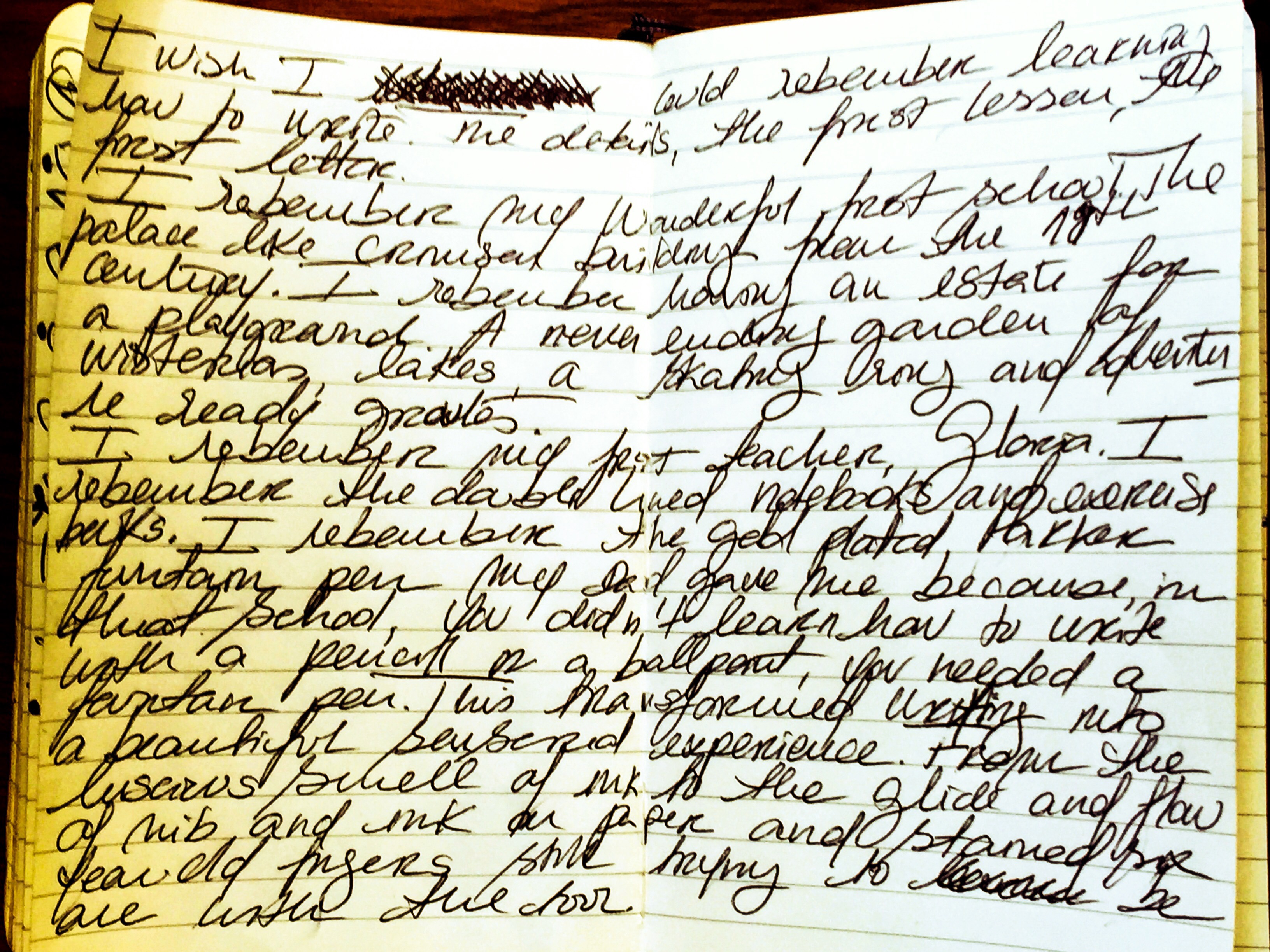
Like seeing a photograph of yourself as a child, encountering handwriting that you know was once yours but that now seems only dimly familiar can inspire a confrontation with the mystery of time.
Francine Prose

She may have looked normal on the outside, but once you’d seen her handwriting you knew she was deliciously complicated inside.
Jeffrey Eugenides
After reading a few posts and articles on the power of uniform dressing, last week I decided to only wear black dresses to experiment with sartorial disappearance. Apparently, taking the choice away of getting dressed in the morning will make you a more stable, in control, smarter and productive person. Probably more successful and happier too.
This was, quite obviously, the wrong experience for me. Black is actually not a uniform as far as I am concerned . All its nuances and textures and different associations make it versatile and welcoming and experimental. Just the opposite of a uniform. As much as I like black dresses and have a closet full of them to prove it, I found it extremely boring to put on the same thing everyday. Boring might be efficient and productive but this doesn’t seem to be what I’m interested in becoming.
I do understand the allure of having a streamlined, organized home / closet but I’m not, no matter how hard I try a minimalist. This doesn’t mean that I’m obsessed with fast changing fashion trends or fast fashion fixes. By now, about 70% of my wardrobe is vintage or secondhand because I do love clothes a lot more than I am interested in fashion. I might be obsessed with my possessions but mainly because I got a lot of them from my grandmother, my great aunt and my mother. They tell, at least partially, the story of who I am.
For some, settling into an everyday uniform means that you have finally understood who you are and what outfit goes with that while becoming incredibly stylish. I do agree with Valerie Steel that the idea that clothes are supposed to express your true identity is “almost laughably naive, clothes are a mask,a persona you put on. You present an aspect of yourself, not the core. Anyway, what would the core be? It’s a rather horrific thought.”
I need the choice, even if it’s a waste of energy and mental power. I need to be able to decide who I want to be in a given day and I need to be able to have fun with that. The normalizing discourse of uniform dressing/ capsule wardrobe sounds too much like a managerial trend applied to everyday life, transforming it into some kind of efficient unidimensional space and that’s also rather horrific. Foucault argues that through surveillance our bodies are made docile by institutions and become subject to mass standards of behaviour, these standards of behaviour (or ‘discourses’) are then internalized by individuals and govern the ways in which we use and understand our bodies. He also suggests, however, that people can act on their bodies in different ways and resist these normalizing discourses.
References
Valerie Steele
Foucault,M. (1977) Discipline and Punish
I am a frivolous person and I have often felt guilty about it mainly because I fear that most people would understand that as meaning that I am a shallow person. Most of my time seems to be occupied with aesthetic considerations or concerns of some kind. Most of the space I live in is organized accordingly. Every morning I go out hoping that what I have chosen to wear will contribute to make the day a little more beautiful, a little less real (I suppose that’s where the love of vintage clothes comes from). Every evening I want to come back home to the same kind of fantasy. I watch movies and plays looking for the kind of visual and emotional grandeur that can make one forget that there’s some kind of reality out there. I read books to be seduced by the music in words and I like music because it embodies all the beauty I find in movies and books.
Form always seems to overcome purpose and content.
Except when it comes to people. Their content is what sustains their form. And still, I also tend to understand human relationships as an aesthetic ideal in the sense that they should be a pursuit of pleasure and an avoidance of pain. I like people. I like watching them, I like talking to them and getting to know their stories and I feel mesmerized by the things they know and the lives they lived.
I am terribly shy so I never start conversations with strangers but I do engage in them often and listen.
There was someone from Belgium sitting next to me on a flight to Lisbon and he told me how he hadn’t spoken to his family in over twenty years because he had taken his dad to court over child support money. There was an elegant lady in the subway in New York who collected ancient tiles and a kid from Spain who talked for over seven hours during a flight between Johannesburg and Madrid and street artists in London and drag queens in Porto and soccer fans in Zambia and the regal looking lady in Houston during intermission at the ballet. She was a widow and her son was working for an oil company in Nigeria. Maybe we could go to the ballet together the following week. I would not be in Houston anymore. And the Brazilian girl that had been left at the altar and was trying to forget that she was hurt and afraid of flying while the plane was getting ready to land.
And, if they asked me, I could go on and almost write a book with all the moments some stranger decided to confide in me. Sometimes I talk and understand how liberating it is to be your vulnerable self with someone you know will not cross paths with you ever again. And you go on for hours sitting across a perfect stranger in some Lower East Side bar after checking some independent production of Hamlet and talk about all your unfulfilled dreams and what your fear and how finding Shakespeare has changed your life.
These are the moments of bliss that truly feel they could be enough for a whole lifetime and shield me when the world just seems to hurtful to endure. I am one of those. Deeply hurt by the trivial, the rudeness and mainly by the pain of others, of strangers, by the injustice, by whatever dehumanizing force seems to be operating on any given day.
“Yet, taught by time, my heart has learned to glow for other’s good, and melt at other’s woe.”
And my heart also got used to marvel at others, to shudder, tremble and thrill with the same pleasure and emotion it felt coming face to face with Hopper’s “New York Movie” or driving to Jarrett’s “Köln Concert”.
Works of art, Martha Nussbaum says, “give us insight into how other people live and feel, how they strive for happiness, and how conditions of many types affect them. [And] that is crucial for living any sort of decent life.”
References
Marcel Proust
Dinah Washington
Fyodor Dostoyevsky
Homer
Martha Nussbaum
I have been absolutely terrified every moment of my life – and I wish I could say that I’ve never let it keep me from doing a single thing I wanted to do. I have. Once you let fear get possession of your soul, it does not readily yield its place to another sentiment. Then you just realize you have to fight yourself and let everything happen to you, Beauty and terror. Just keep going. No feeling is final. I go back to a gin infused advice over “I am sailing” announcing the final round at Peter’s, years ago. Don’t think. And I realize I do appreciate the unknown, the feeling of jumping before looking. I learnt that through facing the fear of traveling alone. I prefer it like that now. No longer fearing freedom. For a few days. I do not fear mistakes. I do fear perfection and the fearlessness will come when I stop waiting for the right day to go up or down in my own way. I fear wasted time.
References
Georgia O’Keeffe
Leo Tolstoi
Rainer Maria Rilke
Jim Morrison
Pink Floyd
Photo via Pinterest
The process of deciphering and expressing a sense of who we are happens in tandem with deciphering and expressing when and where we are .

In the summer of 1988 we went to Cheltenham for an intensive English language course. I stayed with Cathy and Howard and my brother stayed with another family so we wouldn’t disturb the immersive quality of the course. I remember Cheltenham as the England in the movies. I remember that Cathy and Howard’s house was “colour coded”, each room had its own colour. My room was pink and their wonderful living room was red. Red carpets, red sofa, red furniture and red wallpaper.
This was my second time in England. I had been to London with my parents when I was 14 or 15 and could not control my excitement at having a place to go with the language I felt in love with in school and getting the Smiths “The queen is dead” before it went on sale in Portugal. 
There is a phrase: ‘the sweet smell of success’. And I can only tell you, I’ve had two experiences of that and it just smells like Brighton and oyster bars and things like that.
In August 1992 I visited Brighton with my parents to get things ready to start studying at Sussex University in the Fall. This is still the city that lives in my heart. My city. 
Life was completely different now. A full time student with a library schedule and tutorial classes. Now, I was in charge and it wasn’t as easy as I had imagined. Still, this is the city where, in a way, I grew up and everything was a promise of change. 
And then I moved to London. I doubt it if I will ever feel the kind of freedom and happiness and warm loneliness and sense of belonging I felt in this place. London was my moveable feast and wherever I go for the rest of my life, it will stay with me.

In 2002 I came back. So did others. Some of us just couldn’t handle it and decided to head back to London. I have tried to justify my choice of coming back many times, knowing that in reality that choice wasn’t actually mine. I arrived at the same conclusion every time. Choosing to be who you really are takes a lot of courage.
References
Susan B. Kaiser
Laurence Olivier
Ernest Hemingway

 Stories from A Closet of Errors