
Two things we must therefore root out: fear of distress in the future and the memory of distress in the past. The one concerns me no longer. The other concerns me not yet.
Seneca
Made with Gemini
Two things we must therefore root out: fear of distress in the future and the memory of distress in the past. The one concerns me no longer. The other concerns me not yet.
Seneca
Made with Gemini
There are books that entertain us, books that educate us, and then there are books that find us exactly when we need them most. For me, that book was “Les Malheurs de Sophie” by Comtesse de Ségur—a slim volume about a mischievous little French girl whose disasters somehow made perfect sense to a kid who never quite fit the mold.
Sophie was gloriously, unapologetically flawed. She cut her own hair with disastrous results. She melted her favorite wax doll into puddles. She fed her goldfish bread until they died, convinced she was being kind. She broke things, lost things, and approached the world with a curiosity that invariably led to chaos.
Reading about Sophie’s misadventures felt like looking into a mirror—not because I was destructive, but because I recognized that particular brand of being misunderstood. Sophie’s logic made sense to her, just as my own odd thoughts and interests made sense to me. The adults in her world sighed and shook their heads, much like the grown-ups in mine did when I asked too many questions or got excited about things other kids found boring.
What struck me most wasn’t Sophie’s misbehavior, but her earnestness. She wasn’t trying to be difficult—she was genuinely trying to figure out how the world worked, often with spectacularly wrong conclusions. Her attempts at helpfulness backfired. Her creative solutions created bigger problems. Sound familiar to anyone who’s ever felt like they’re speaking a different language than everyone else?
Comtesse de Ségur didn’t write Sophie as a cautionary tale or a perfect little angel. She wrote her as a real child—impulsive, curious, sometimes selfish, often confused, but fundamentally good-hearted. For a kid who felt like their own thoughts and reactions were somehow “wrong,” Sophie was revolutionary. Here was a character who made mistakes not out of malice but out of a different way of seeing the world.
Yes, “Les Malheurs de Sophie” was written as a moral tale for children, complete with consequences for poor choices. But what I absorbed wasn’t the moralizing—it was the acceptance. Sophie was loved despite her flaws. Her stepmother, Madame de Réan, was patient and kind. Even when Sophie’s plans went awry, she wasn’t rejected or labeled as “difficult.” She was guided, corrected, and most importantly, understood.
This was radical for a child who often felt like an inconvenience, whose questions were too complex, whose interests were too intense, whose emotional reactions seemed too big for the situations that prompted them. Sophie’s world had room for misfits. It suggested that being different wasn’t a character flaw to be fixed, but simply another way of being human.
Sophie stumbled through her childhood making mistake after mistake, but she was never written off. Her curiosity, even when it led to disaster, was treated as a fundamental part of who she was.
For kids who feel like they’re always getting it wrong—who are too loud or too quiet, too interested in the wrong things, too sensitive or not sensitive enough—Sophie’s story offers a different narrative. It says that the children who don’t fit neatly into expected boxes aren’t broken; they’re just Sophie-shaped instead of conventional-shaped, and that’s perfectly fine.
Sometimes the books that save us aren’t the ones with grand adventures or profound wisdom. Sometimes they’re the quiet stories about girls who cut their own hair badly and love too hard and make beautiful messes of simple tasks. Sometimes they’re about finding yourself in a character who proves that being odd isn’t a failing—it’s just another way of being wonderfully, complexly human.
Years later, I discovered that Sophie’s story had found another voice entirely. Clarice Lispector’s “Os Desastres de Sofia” deliberately borrows its title from the Comtesse de Ségur’s work, creating a literary dialogue across centuries and cultures. But where Ségur’s Sophie was a child navigating social expectations through innocent mischief, Lispector’s Sofia embodies something far more complex—the devastating intensity of a nine-year-old girl who terrorizes her teacher not out of malice, but out of a desperate, unconscious attempt to wake him up to life itself.
Lispector’s Sofia sits in the back row, speaks loudly, stares defiantly, and disrupts her teacher’s lessons with the same earnest confusion that characterized her French predecessor. But this Sofia operates on a deeper psychological level—she acts “moved by a binary impulse of rage and love, in the confused hope of awakening him to life”. She sees through to her teacher’s cowardice, his retreat from living, and her child’s wisdom compels her to try to save him, even though she doesn’t understand what she’s doing or why.
The parallel between these two Sofias reveals something profound about the archetype of the misfit child. Both represent children whose inner logic operates differently from social expectations, but where Ségur’s Sophie learns to conform, Lispector’s Sofia remains uncompromisingly true to her authentic self, even when it leads to psychological devastation. The Brazilian Sofia’s story ends not with moral lessons learned, but with the recognition that some kinds of wisdom—the kind that sees too clearly—come at a terrible price.
Reading Lispector’s take on Sofia later in life illuminated something I hadn’t fully grasped as a child: that the discomfort other people feel around “difficult” children isn’t always about the child’s behavior—it’s often about the truths the child unconsciously exposes. Both Sofias, in their different ways, hold up mirrors that adults find uncomfortable to look into.
This literary conversation between the two Sofias suggests that the experience of being an outsider child isn’t just about personal struggle—it’s about carrying a different kind of perception that the world both needs and resists. The French Sophie learns to channel her uniqueness into acceptable forms; the Brazilian Sofia shows us what happens when that channeling fails, when the child’s vision remains too pure, too uncompromising.
For those of us who grew up feeling like we saw the world through a different lens, both Sofias offer validation: the first showing us we can belong while remaining ourselves, the second honoring the parts of us that perhaps never quite learned to fit, that remained forever a little too intense, a little too perceptive, a little too willing to speak uncomfortable truths.
Summer, 1992. I was leaving my boyfriend’s house to head home. The night air held that particular warmth of early summer evenings—the kind that makes you believe everything is possible. I imagine I was thinking about England, where I’d soon be studying. Perhaps I was daydreaming about the perfect life that seemed to be unfolding before me. It was full of love. I was utterly in love.
And then, nothing.
The next moment in my memory is waking up in a hospital bed, looking at a woman I couldn’t recognize—my own mother. They tell me I flew 80 meters across the street when the car hit me. The driver never stopped. Never looked back to see the aftermath of their impact, both the physical body they’d broken and the future they’d altered.
I’ve had to reconstruct this night through police reports and courtroom testimonies. Witnesses described what I cannot remember. It’s disorienting to have such a significant moment of your life exist only in the accounts of strangers. It’s as if the narrative of my life has a tear in it, edges that don’t quite meet.
This was the summer before England. Before university. Before what should have been the beginning of everything.
What followed was not the perfect life I had meticulously planned. Looking back now, I see how that night became the first domino in a long sequence of self-destruction. The person who flew across that street never quite landed. Or perhaps she landed as someone else entirely.
I’ve spent years trying to understand why surviving led to destroying. Was it the traumatic brain injury altering something fundamental in my decision-making? Was it the brush with mortality that made me reckless? Or was it simpler than that—the realization that control is an illusion, that perfect lives don’t exist, that plans are just elaborate wishes?
The driver who hit me took many things. My memories of that night. My sense of safety. My trajectory. But perhaps the most significant thing they took was my belief in the orderly progression of life—that good choices lead to good outcomes, that we are the architects of our futures.
I’ve come to understand something else in the years since. That perfect life I thought I was destroying after the accident? It was never real. It was never possible. It existed only in the mind of a young woman who hadn’t yet learned that life isn’t a straight line but a series of collisions—some literal, some figurative—that push us in unexpected directions.
Sometimes I wonder who I would have become without that night. Would the perfect life have unfolded as planned? Or would some other moment have become my pivot point?
These questions have no answers. There is only this life—the one that began again in a hospital bed, looking at a mother I couldn’t recognize, piecing together a new understanding of myself from the fragments that remained.
It wasn’t the summer I expected. It wasn’t the life I planned. No bones were broken but something else was shattered.
More than silence was needed,
what was needed was at least a screaming fit,
a nervous breakdown, a fire,
doors slamming, a rushing about.
But you said nothing,
you wanted to cry, but first you had to straighten up your hair,
you asked me the time, it was 3 p.m.,
I don’t remember now which day, maybe a day
when it was I who was dying,
a day that had begun badly, I had left
the keys in the lock on the inside of the door,
and now there you were, dead (dead and even
looking dead!), gazing up at me in silence stretched out on the road,
and no one asked a thing and no one spoke aloud.
Manuel António Pina, translated by Alexis Levitin
I first found this poem while browsing books at a FNAC store in downtown Porto. It stuck with me because, while in high school, a colleague was run over. Another girl and I called a friend who lived near her family (pre-cell phone era). He went to get her mum and meet us at the hospital. When they finally arrived, this boy was furious. The girl’s mother had told him to wait while she did her hair and makeup.
If you don’t know the kind of person I am
and I don’t know the kind of person you are
a pattern that others made may prevail in the world
and following the wrong god home we may miss our star.
For there is many a small betrayal in the mind,
a shrug that lets the fragile sequence break
sending with shouts the horrible errors of childhood
storming out to play through the broken dyke.
And as elephants parade holding each elephant’s tail,
but if one wanders the circus won’t find the park,
I call it cruel and maybe the root of all cruelty
to know what occurs but not recognize the fact.
And so I appeal to a voice, to something shadowy,
a remote important region in all who talk:
though we could fool each other, we should consider—
lest the parade of our mutual life get lost in the dark.
For it is important that awake people be awake,
or a breaking line may discourage them back to sleep;
the signals we give—yes or no, or maybe—
should be clear: the darkness around us is deep.
A Ritual To Read To Each Other by William Stafford
I have also learned to appreciate The Doors , Joy Division, David Sylvian, The Cocteau Twins and Nick Cave. Extreme music eclecticism germinated.
One house has become all penance,
the other indulgence.
You struggle to resist
what has grown to feel illicit,
an appetite, threatening obsession,
for delectation.
What grows on trees tastes unfinished,
an imitation of artifice.
What court determined
that sweetness be earned?
Some chef with too much power
once called mixing salt and sugar
a form of barbarism.
His decree, like any fashion,
should have evaporated,
but someone recorded it,
so centuries, a continent, away,
your whole body hesitates
to sweeten, even slightly,
chicken soup or broccoli.
There’s enough complication
in houses, in nations.
His laws are as good as blue.
The offender isn’t you.
By Adrienne Su
Other than The Stranger by Albert Camus that I have first read when I was 12 and had to re-read years later, for obvious reasons, I do not tend to return to books I’ve already read unless I’m reading for work.
If I had to choose one to go back to, I would probably settle on Tokyo Doesn’t Love Us Anymore by Ray Loriga.
Published in 1999, this prescient work examines themes that have only grown more relevant: the fragility of memory, the construction of identity, and our desperate attempts to escape emotional pain.
The unnamed protagonist works as a traveling salesman for a corporation that manufactures and distributes memory-erasing drugs. He traverses a near-future landscape of international cities—Tokyo, Barcelona, Los Angeles—selling his wares to those desperate to forget traumas, heartbreaks, and regrets. As he helps others erase their pasts, he increasingly samples his own product, gradually eroding his own identity in the process.
What makes Loriga’s narrative particularly compelling is how it positions memory erasure not as science fiction but as a logical extension of our pharmaceutical culture. The protagonist doesn’t view himself as peddling something extraordinary, but rather as providing a service comparable to antidepressants or sleep aids—just another chemical solution to human suffering.
The novel poses a profound question: If we are, essentially, the sum of our memories, what happens when we selectively delete parts of our past? The protagonist’s steady deterioration as he abuses memory-erasing drugs illustrates the devastating consequences. Without the anchoring force of his personal history, he drifts through existence as a hollow shell, unable to form meaningful connections or understand his own desires and fears. Loriga’s spare prose mirrors the protagonist’s fractured psyche, leaving readers to question: If we erase our pain, what remains of our humanity?
At its core, Tokyo Doesn’t Love Us Anymore is a meditation on memory’s role in shaping identity. Loriga asks: Are we more than the sum of our experiences? The novel’s dystopia isn’t ruled by tyrants but by a collective yearning to numb the soul. Memorama, the drug, becomes a metaphor for modern escapes—social media, substances, consumerism—that promise freedom but deliver alienation.
Tokyo is both setting and symbol. Loriga paints it as a glittering ghost town, where skyscrapers pulse with artificial light but human connection flickers out. The protagonist wanders through love hotels, karaoke bars, and rain-soaked alleyways, each locale steeped in loneliness. Unlike the chaotic vitality of real-world Tokyo, this city feels like a screensaver—vivid yet void. It’s a backdrop that recalls Blade Runner’s dystopia but feels eerily adjacent to our tech-saturated present.
Our salesman is no hero. He’s a hollow man, a mirror for the reader’s complicity in systems of escape. His internal monologue—terse, fragmented—reveals a soul gasping for meaning. When he muses, “I sell what I need most,” we glimpse Loriga’s critique of capitalism’s cycle of creation and consumption. The character’s anonymity amplifies his universality: he could be anyone, anywhere, trading fragments of self for fleeting peace.
In 2025, as AI filters our realities and “digital detox” enters the lexicon, Tokyo Doesn’t Love Us Anymore reads like a prophecy. It challenges us to ask: What do we lose when we prioritize comfort over growth? The novel doesn’t offer answers but lingers like a phantom limb, reminding us that pain and joy are inseparable threads in the fabric of self.
Ray Loriga’s book is not a love letter to Tokyo but a requiem for the modern soul. It’s a slim, sharp novel that cuts deeper with each read, leaving readers to wonder: Would I take the pill? As you close the book, Tokyo’s neon fades, but the question remains, glowing in the dark.
My father who, for my 10th birthday, gave me a 500 page book on the “History of Men in the last two million years “ so I could satisfy my curiosities and go on learning.
My mother who made me believe that even with clipped wings I could fly.
My grandparents who granted me free access to every book in the house with no concern whatsoever if what I was reading was age appropriate or not.
My great aunt, the delicate, elegant and joyful lady that I did not become.
My uncle who made me admire the preciseness and perfectionism that I don’t have in me. He was also patient enough to teach me Argentinian tango.

Ms Gloria, my first grade teacher who taught a whole class of six year olds to write their first words with a fountain pen.
Sister Clara Lucia who desperately tried to have us all speak the “Queen’s English”
Teresa my high school philosophy teacher who opened the door to the infinite universe of abstract thought
Manuela my philosophical theories professor at university who, in her 60s, dressed in jeans and silk blouses with plunging necklines and no bra and showed us that sensuous and intellectual could be synonymous.
C. Vieira, professor of European studies who tried to teach us that we should never walk down the stairs. I remember this often when I’m tempted to get into arguments.
Eugenie, the French teacher who declared that life is unjust. It does tend to be.
Marthinus, who was not my professor but gave me books and, tried to make me feel as South African as he once has tried to feel Portuguese.
Orlando who sat with me for long coffees and introduced me to magic realism.
Cesário who taught me to use a photometer and to develop photos and allowed me to entertain the idea that one day I could be a new Cartier-Bresson.
Dorinho who showed me who I could be.
Robby, who saw the restlessness and from whom I learned the importance of staying defiant.
Professor Gironès an eloquent humanist whose devotion for classical culture and the Mediterranean always made me look for the common within the different.
Ivo, Diana, Ernesto and Catarina, the patient, neurotic, perfectionist and passionate dance teachers that helped me discover my dramatic persona.
Anthony, the mentor, the role model, the compass whose idea of me was way too generous. As he was. The one who unfortunately was gone too soon and left without me having the opportunity to live up to be the person he thought I was.
Virgílio, the RFI journalist who wanted me to understand that I should not speak as fast as I think. Like in dance, it is the pause that says it all.
…the calling of the teacher. There is no craft more privileged. To awaken in another human being powers, dreams beyond one’s own; to induce in others a love for that which one loves; to make of one’s inward present their future; that is a threefold adventure like no other.
George Steiner, Lessons of the Masters (The Charles Eliot Norton Lectures)
Since I can remember having some sort of conscious thought, my favorite activity has been daydreaming. I would love to engage more with it? Absolutely. Should I? Most probably not. I tend to use it as a way of escaping the weight of the days, even if, sometimes, it has helped me come up with brilliant, in my opinion, ideas.
Being still was not a problem when I was a kid. I enjoyed being alone and left to my own devices. Either forced by the inevitability of growing up into an accountable and acceptable adult or by the contextual speed of life, being still became a problem and, being present became something to be learnt again.
Talent or no talent , dancing— and choosing a form of dance as technically demanding as Flamenco — has slowly helped me regain a sense of connection.
Dancing unites body and mind through movement, requiring presence in a way that’s both physical and emotional. When you’re fully engaged in dance, you’re experiencing yourself as a whole being rather than fragmented parts. In the present.
At the still point of the turning world. Neither flesh nor fleshless;
T. S. Elliot, excerpt from
Neither from nor towards; at the still point, there the dance is,
But neither arrest nor movement. And do not call it fixity,
Where past and future are gathered. Neither movement from nor towards,
Neither ascent nor decline. Except for the point, the still point,
There would be no dance, and there is only the dance.
Burnt Norton, (Four Quartets)
Happy World Poetry Day!
I stumbled upon this quote by Béla Tarr on A Bitter Sweet Life:
I don’t care about stories. I never did. Every story is the same. We have no new stories. We’re just repeating the same ones. I really don’t think, when you do a movie that you have to think about the story. The film isn’t the story. It’s mostly picture, sound, a lot of emotions.
And, I remembered that one of the first movies that made me feel the same was Peter Greenway’s The Pillow Book, beautiful to behold and impossible to forget. I can’t remember the story but I do remember feeling spellbound by its visual poetry and the idea of being a living book. Greenway employs multiple aspect ratios, picture-in-picture compositions, and superimposed calligraphy that transforms the screen into a living, breathing manuscript. Bodies become canvases, and ink becomes an extension of desire. The film’s approach to visual composition mimics the practice of calligraphy itself—disciplined yet sensual, structured yet flowing with emotion.

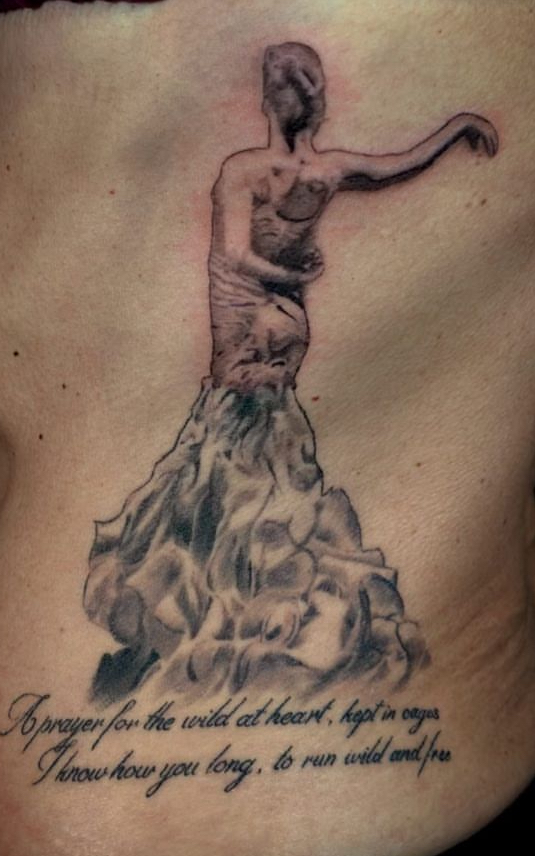

It took me another 10 years to get my first tattoo and it was not a written one. I had a leopard done in Johannesburg because I was born in South Africa and the leopard is one of the Big 5. When I finally decided to have something written, I was in San Diego in 2014. For a full 5 hours or so, someone patiently wrote Macbeth’s soliloquy in Act 5 Scene 5 on the right side of my rib cage. Surprisingly, there was no pain. The tattooer, who was very young, asked why I had chosen such a strange thing. I wanted to be constantly reminded of the fleeting nature of life and meaning, I said.
After I got divorced, Richard II was written on my right tight under the leopard. I wasted time and now doth time waste me.
My last one was done in 2024, a very common tattoo written under a flamenco dancer on my left rib cage. Tennessee Williams’ first verses of A Prayer for The Wild at Heart. The tattoo artist thought that having the whole poem would be over the top.
I wanted to show, even though they are not visible, that for me there’s nothing more important than literature. Particularly the one exploring human struggles, mortality, and the desire for freedom.
The “Pillow Book” connection made perfect sense now – like the film, I was using my body as a canvas for meaningful text. Yes, I could use paper, but text on skin becomes something more intimate and embodied than words on a page. I also see them as a way of relating my reminder’s of life’s impermanence and the tension between duty and desire to the struggles of everyone else.
I am now thinking of getting a tattoo of goddess Athena. I have to find suitable words.
There. There you are. You have just dropped a marker pin on your body, to reclaim yourself, to remind you where you are: inside yourself. Somewhere. Somewhere in there
Caitlin Moran, How to Be a Woman
I have a hard time saying goodbye to all the Summers in my life.
I wish I could carry all my summers with me. Both metaphorically and literally.
in time of daffodils(who know the goal of living is to grow) forgetting why, remember how in time of lilacs who proclaim the aim of waking is to dream, remember so(forgetting seem) in time of roses(who amaze our now and here with paradise) forgetting if, remember yes in time of all sweet things beyond whatever mind may comprehend, remember seek(forgetting find) and in a mystery to be (when time from time shall set us free) forgetting me, remember me
E.E. Cummings
As most people, I own too many things. I could, obviously, live without most of the things I have. And I have tried, once when I was moving to a new flat, I gave away most of my possessions. This was, in some way, liberating although I’m not quite sure if I was trying to set myself free or was just to lazy to take everything with me.
I often read (diagonally)the good advices on decluttering and while browsing through this “Letting Go of Sentimental Objects Is Hard. Here’s How to Start.”, this caught my attention:
He eventually realized that he was clinging to things that reminded him of people, places and experiences from his past.
“I wanted to make room for my future,”
From house move to house move I always kept steam trunks, books, photos, my grandmother’s wedding blouse and her dresses, the cake figurine of her wedding (1949) cake my great aunt wedding dress, my grandfather”s camera and photometer, birthday cards, note written by friends, sketches made by friends who have, unfortunately, died, theatre and concert tickets, my journals, my first pair of shoes bronzed in South Africa, teddy bears, notebooks and pens and pencils.
Learning to love differently is hard,
love with the hands wide open


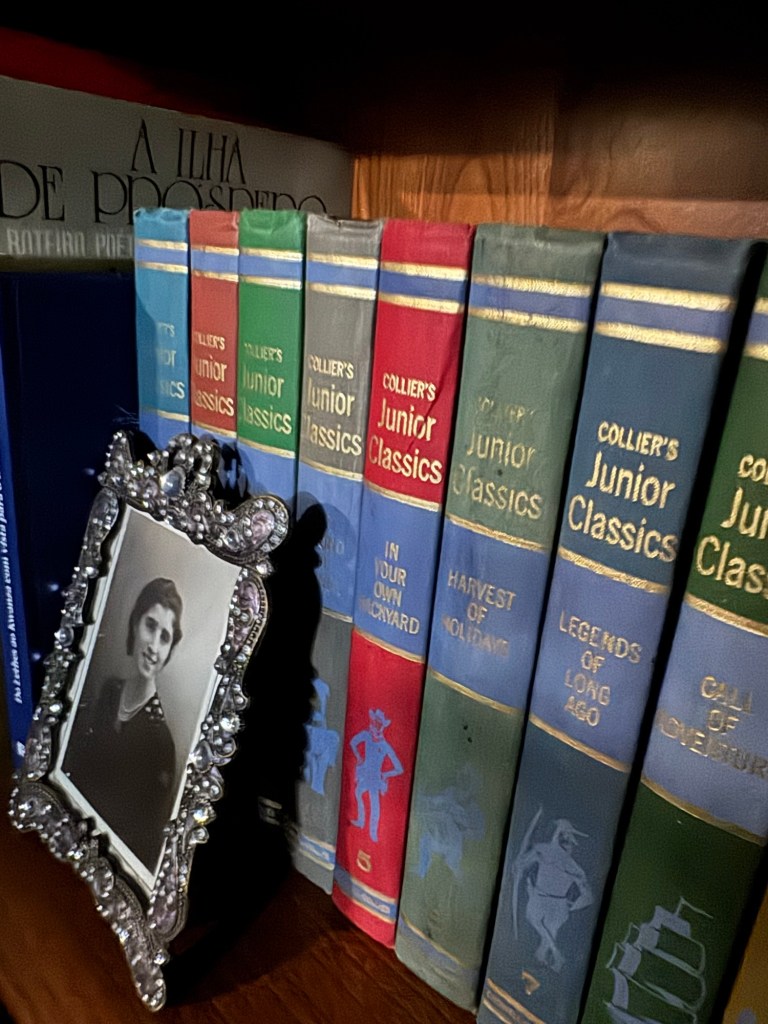


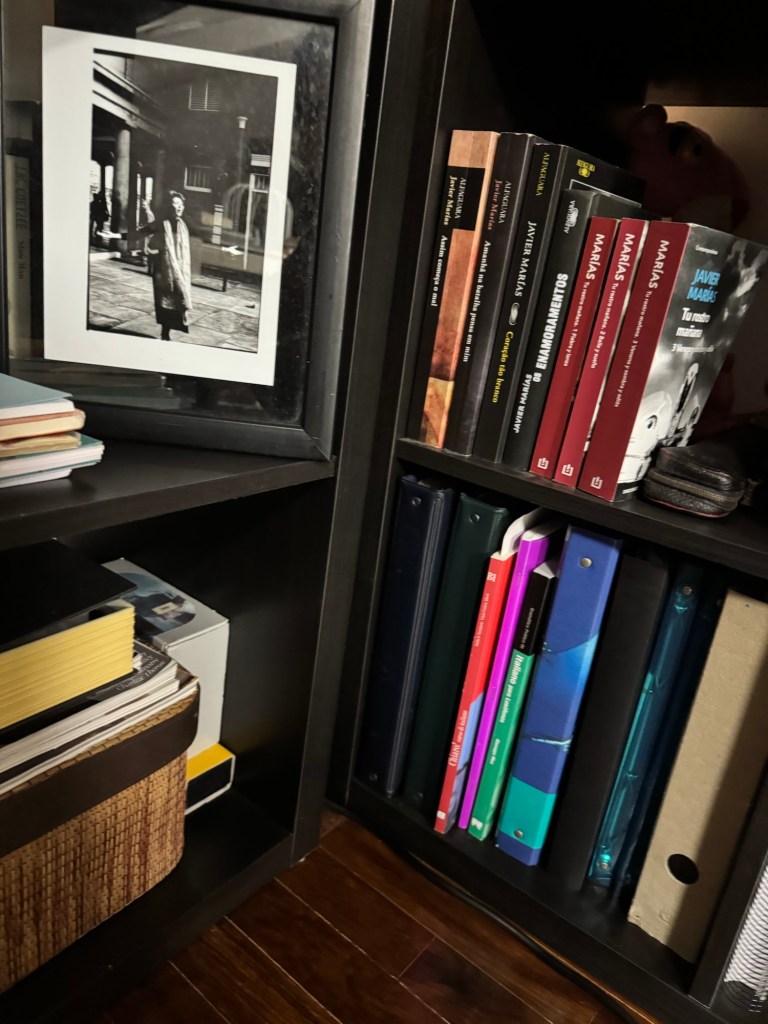
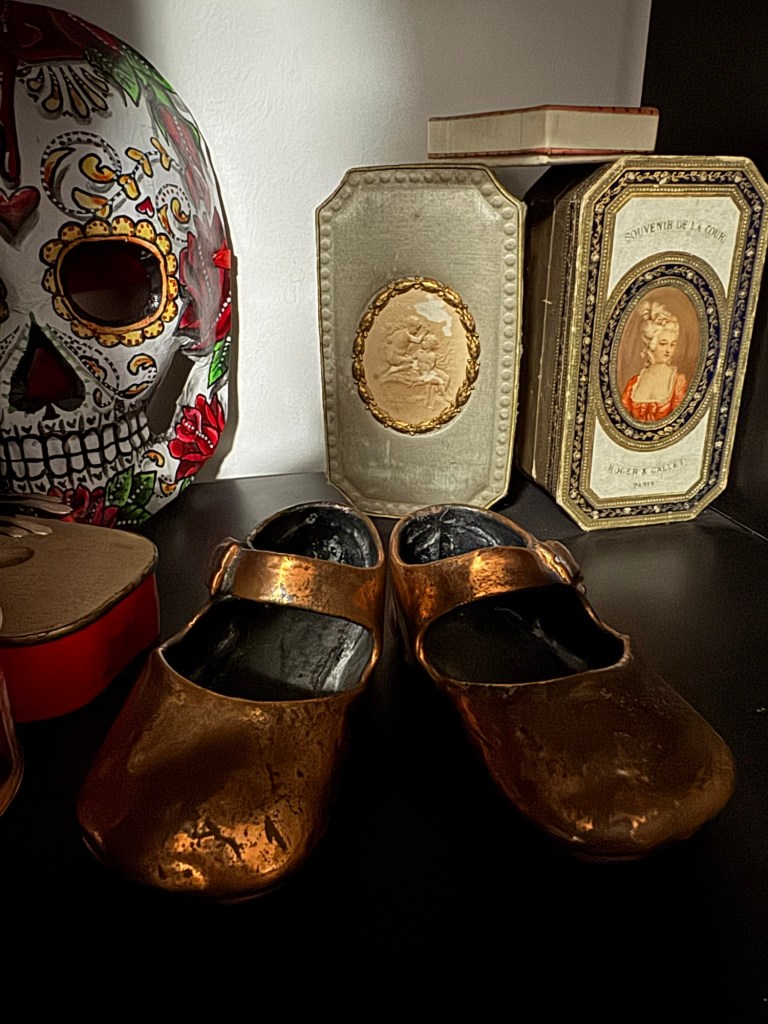


I suppose this answers the question, What are three objects you couldn’t live without? I just can’t bring them down to three.
I know “our memories live inside us, not in our things” but I still feel there’s a beautiful thread connecting everything I’ve kept to my personal history, relationships, and creative life. They are tangible links to my ancestry.
I’ve kept things that embody memory, relationship, and meaning rather than items of mere convenience or fleeting value. For some, they’re probably just clutter anyway. For me, these objects help tell the story of who I am and of the life of those who came before me. I have a hard time imagining a future without room for the past.
References: To have without holding by Marge Piercy
I do not know how I got here. Time is a difficult concept for me and, I really do not know the answer to how do significant life events or the passage of time influence my perspective on life.
I remember a few negative experiences from my childhood but can’t be really precise on the when; up to now I have been fortunate enough not to loose my parents, getting divorced felt more like a failure than a significant life event, most probably because getting married felt like a mistake. This, my therapist says, suggests a kind of emotional self-protection, a way of minimizing the impact of what could have been a deeply transformative experience. Perhaps this speaks to a broader coping mechanism – the ability to reframe potentially painful experiences in a way that doesn’t allow them to become definitional moments.
Loosing my grandmother was hard but I can’t remember the exact year, 2011, maybe. In November 2014 I was alone in Vietnam for work and, on the 16th I received a text message saying that my great aunt (my grandmother’s sister) had died. I can’t remember what the movie on the hotel TV was but the final credits rolled in to the sound of Into My Arms. Violeta, who was also there for work as well and whom I had never met before, and have never seen again but 10 years on still says I’m her “One Night Best Friend Forever” spent the whole day and evening with me the next day wandering the streets, parks, shops and cafés of Hanoi. We spent same time at a particular coffee shop watching life happen on the other side of the street while the radio played a Vietnamese rendition of Seasons in the Sun.
If I could, I’m pretty sure I can’t, speak of myself as a “curator”, I would say that my memories seem to be curated not by chronological accuracy, but by emotional resonance. The day in Hanoi, the loss of my great aunt, these moments have been preserved with a kind of tender, even if painful, clarity.
The inaccuracy of our memories—where dates and childhood experiences are unclear—indicates that we perceive time differently, more instinctively than in a straight line. We don’t recall events in order but through how they made us feel. Memories linger not due to exact times, but because of their ability to change us.
I don’t know if I have changed but I did learn that I too have the ability to be vulnerable, to allow a stranger to witness my grief, and to be remarkably open to human connection.
I have also learned how to find beauty in uncertainty, meaning in transient connections. The Vietnamese rendition of “Seasons in the Sun” playing while life unfolded on a street in Hanoi became a metaphor for what I think is my approach to existence – finding poetry in unexpected moments, creating meaning from seemingly random encounters.
I haven’t created a clear plan for my life and I, definitely don’t have everything figured out. When I’m being kind to myself, I think of my experiences as improvisational music. Maybe because I am too lazy to do it differently, I have accepted that it’s not about sticking to a script; it’s about discovering harmony in unexpected moments and finding meaning in random encounters. The strangers who are briefly but unconditionally there for me and the music that captures emotions too complex for words – these are the true landmarks of my journey.
Sonnet 30: When to the sessions of sweet silent thought
BY WILLIAM SHAKESPEARE
When to the sessions of sweet silent thought
I summon up remembrance of things past,
I sigh the lack of many a thing I sought,
And with old woes new wail my dear time’s waste:
Then can I drown an eye, unus’d to flow,
For precious friends hid in death’s dateless night,
And weep afresh love’s long since cancell’d woe,
And moan th’ expense of many a vanish’d sight;
Then can I grieve at grievances foregone,
And heavily from woe to woe tell o’er
The sad account of fore-bemoaned moan,
Which I new pay as if not paid before.
But if the while I think on thee, dear friend,
All losses are restor’d, and sorrows end.
In 1937, the Soviet Writers’ Union instructed its members to sign a manifesto supporting the death penalty for General Yona Yakir and Marshal Mikhail Tukhachevsky, who were accused of conspiracy. During the Union’s congress, when Pasternak refused to sign this manifesto, everyone thought he would be arrested. When he stood up to speak at the congress, he only said “30” and 2,000 people stood up and recited Sonnet 30. This story is told by George Steiner here, because knowing a poem by heart is a form of resistance (like in Fahrenheit 451). During the years when Mandelstam was imprisoned (he died during this time), his wife, Nadezhda, memorized and taught others everything he had written so that after Stalin’s death, she could finally publish it.
Nadezhda (Надежда) is the Slavic and original form of my name. It means “hope.”
This is a powerful story about literary resistance in the Soviet era. The name Nadezhda is particularly meaningful in this context – the concept of hope was especially significant during the dark periods of Soviet repression. Nadezhda Mandelstam’s act of preserving her husband’s poetry through memorization became one of the most famous examples of maintaining cultural memory under totalitarianism. Her memoir “Hope Against Hope” is considered one of the most important accounts of life during the Stalinist period.
Nadezhda (Надежда) holds deep cultural and spiritual significance in Slavic culture, particularly in Russian tradition. Let me elaborate:
In religious context, Nadezhda is one of the three theological virtues celebrated in Orthodox Christianity, alongside Vera (Faith) and Lyubov (Love). This trinity is so important that there’s a feast day (September 30) celebrating Saint Sofia and her three daughters named after these virtues. The story of their martyrdom has made these names particularly meaningful in Orthodox Slavic culture.
The concept of hope (nadezhda) appears frequently in Russian literature and poetry. For example, in Pushkin’s works, hope is often portrayed as a light in darkness, reflecting the Russian cultural understanding of hope as a sustaining force during difficult times. This resonates deeply with how the name was embodied by Nadezhda Mandelstam.
In everyday Russian culture, the name is often shortened to Nadya (Надя), which maintains its warm, positive associations while being more informal. The name was particularly popular during the Soviet era, perhaps as a reflection of people’s need for hope during challenging times.
Interestingly, in Slavic naming traditions, names were often chosen for their protective or aspirational qualities. Giving a child the name Nadezhda was seen as bestowing them with the quality of hope itself, making them both a bearer and symbol of hope for their family and community.
There’s also a fascinating linguistic aspect: the word nadezhda is related to the Old Church Slavonic word “надѣяти” (nadeyati), meaning “to lay upon, to rely on.” This etymology suggests that hope in Slavic culture isn’t just about optimism for the future, but about having something solid to rely on – a more grounded, resilient kind of hope.
Or, quoting Nick Cave in Faith, Hope and Carnage, ‘Hope is optimism with a broken heart’.

Karlsruhe hauptbahnhof, June 2018










 Stories from A Closet of Errors