I first started buying vintage and second-hand clothes while I was studying in England, when I moved back to Porto, after spending a couple of months in Mozambique, I met Orion (António Júlio). I remember him driving some sort of purple American convertible when I was still in high school and being mesmerized at this dark glamorous kind of Gothic urban cowboy and his entourage. Entering Amsterdam Underground, at the time on the first floor of the (now) iconic Centro Comercial Stop , I felt like an intruder arriving home. I was not Gothic, or underground but the empathy and the sense of belonging was immediate. I have spent many hours there, preparing for possibilities, sharing outrageous eccentric dreams and plans to transform a dormant city into a rainbow, checking architectural plans for his castle up North, admiring the stained glass that would decorate the windows, lusting after the Afghan rug coat that survived the 70s pilgrimage to Kathmandu and, again, missing a life that had not been mine.
In 2012 António Júlio died. Orion didn’t because constellation stars never burn out.
Being unique and unrepeatable, António Júlio had this ability to jumpgenerations, to go against the norm, to insist, to create diversity by making our urban routes amazing, and surprising . It is the sum of lives like this, in different areas, which make the wealth of cities
Fátima I met when her store, Rosa Chock Vintage, looked like a psychedelic cloud at Rua Oliveira Monteiro, close to my former high school. I bought an amazing green 80s batwing leather jacket that still lives in my closet and gets a lot of compliments every time I wear it. “It looks so vintage” said the girl behind the counter at the coffee shop. Well, it actually is.
Fátima’s store then moved to Rua do Almada at the center of Porto’s new life but it kept it’s difference. It was never about following the retromania hype of curated new stores made up to look old and selling imaginary “retro vintage” items.
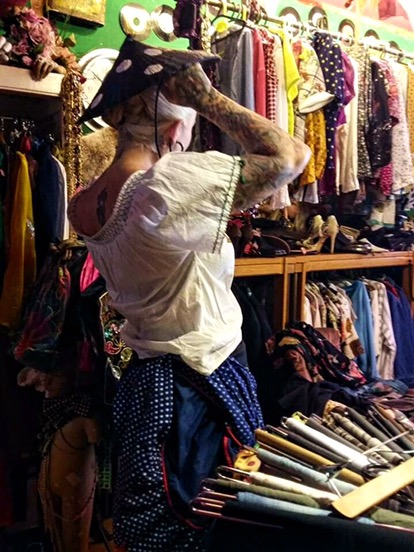
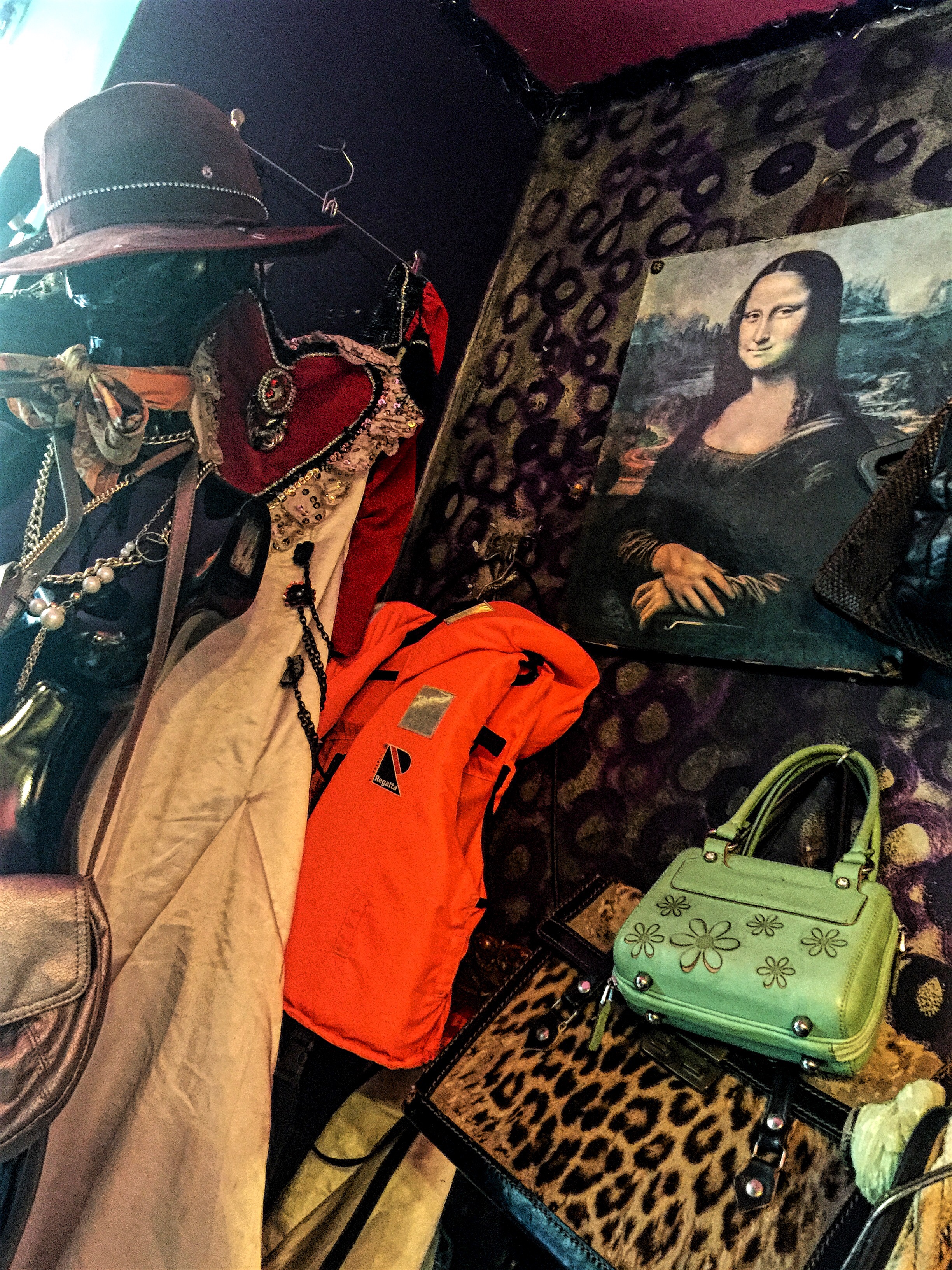
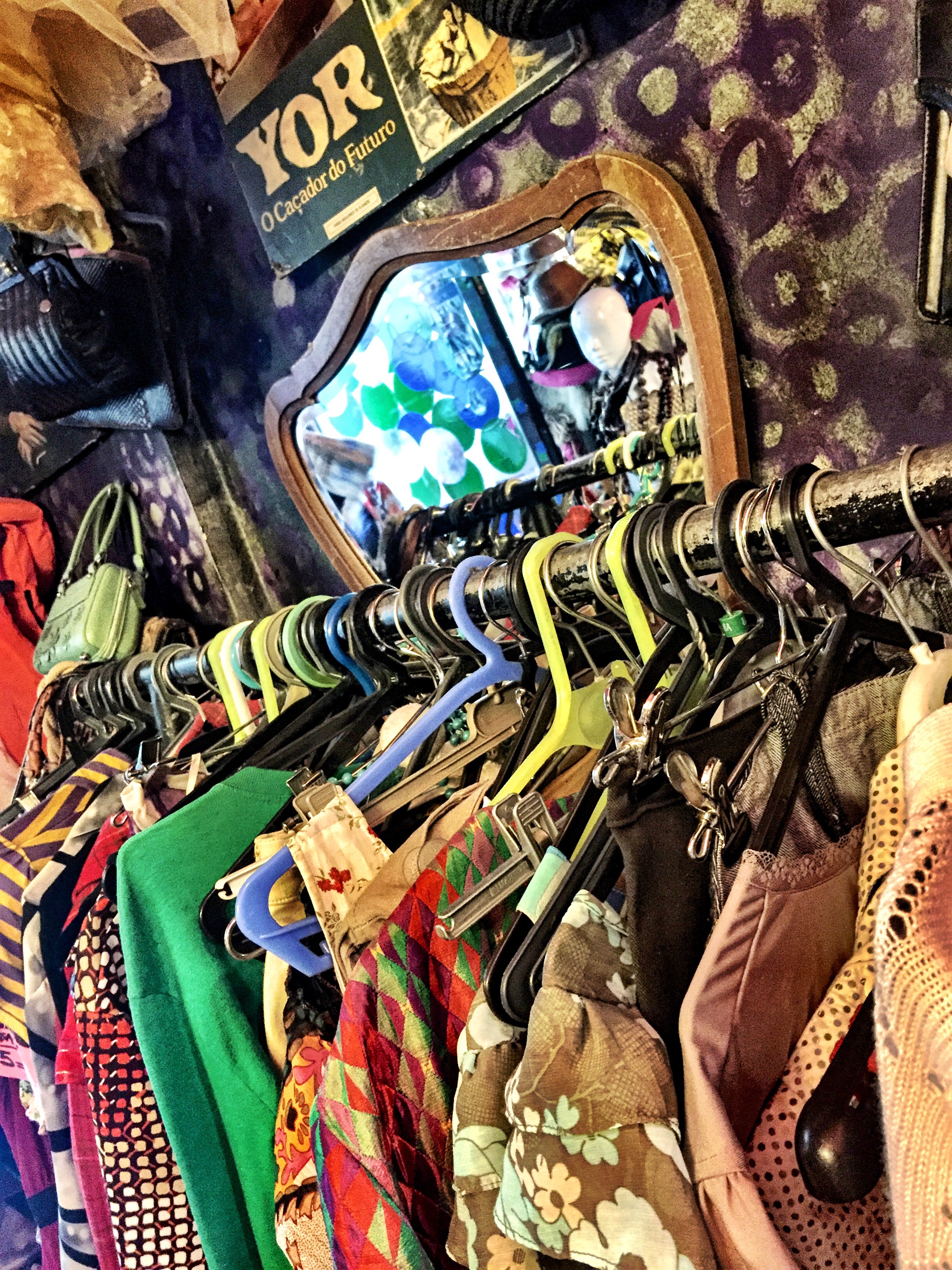
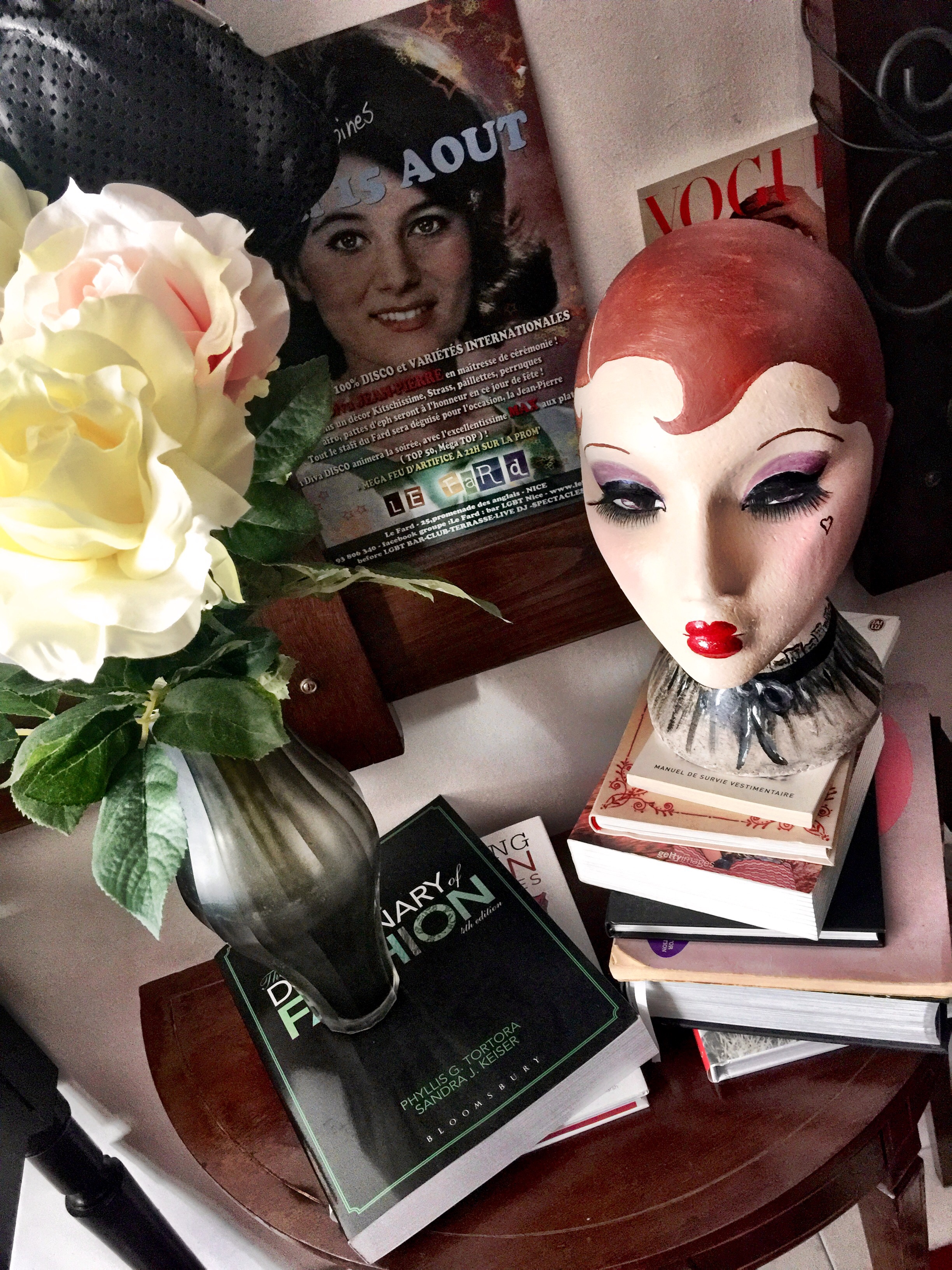
Fatima’ s store, now at Rua Formosa, is curated to the T. Curated for each individual that crosses her door and shares her love for detail and her passion for clothes with history ready to be used in new life stories. Curated for treasure hunters who enjoy the apparent chaos of the hundreds of scarves and necklaces and dresses and sequined tops and ruffles and leopard prints and stuffed animals and the old movie advertising posters bought from Orion.
Curated for all of us that still believe that a wardrobe door can be opened to enter a different dimension.
Fátima is a true vintage dealer who has worked with clothes all her life. She knows what she is selling, she knows the history, the context and she knows that clothes are never just clothes. Like Gaultier, she knows that they are about “what you look like, which translates to what you would like to be like.”
A common friendship and a common sense of loss make me feel at home with Fátima at her larger than life albeit tiny shop but it is her expert eye, her understanding of how to match the right piece to what I have dreamed for myself that keeps me coming back. And this always feels like the truth.
If they asked me, I could probably write a book on my mistakes. Not that it would amount to a very interesting read. But then, I take a long time to admit mistakes and I am not ready to talk about most of them, let alone willing to write them down.
My “Closet of Errors” is an attempt to come to terms with some of those mistakes by honoring them as intentional, mostly because my closet is full of witnesses.
In the Summer of 1992, I went to León in Spain for a paid work placement wit immigrant communities. I used part of the money I got to buy this Junior Gaultier jacket on sale. It was a super sale. It cost me 2.500 pesetas, something like €15 today or, if you are to believe that some online vintage listings are accurate, €500. This witness still lives in my closet. I think I bought it because it was an unmissable opportunity to own a Gaultier piece (even if it was a little too small and it makes raising my arms a tad impossible) and because, in some way, it resonated with a watching, and loving, “Little House on the Prairie” when I was a kid. I think I haven’t worn it for at least fifteen years but it is not going to be easy to let this one go.
Having grown out of “Little House on the Prairie” and after a few years studying in the UK, my next Gaultier was a nod to Punk aesthetics and an attempt to keep some kind of Britishness with me. It’s now the property of someone living in New York. I though I was ready to let it go because I was selling it someone who would love it as much as I did. I wasn’t and I have the feeling that I didn’t sell it to the right person. I never got any feedback apart from the one in my mind telling me that, even though my unworn wardrobe can be an investment with an interesting return, it’s really not about the money. It is always about the lives I have lived wearing a particular piece, the lives I planned on living when I bought some other.
I planned, or better yet, I daydreamed a lot, and, in the process, started to choose the wardrobe to go with all the fabulous things I would be and for the grandiose life I would live. I have always missed places in time that I didn’t know and prepared for them. I dreamed of being an aristocratic bohemian in Marrakesh, a flaneur who spent the time reading books and being intellectually brilliant and aesthetically striking.
Our lived lives might become a protracted mourning for, or an endless tantrum about, the lives we were unable to live. But the exemptions we suffer, whether forced or chosen, make us who we are.
Adam Phillips
I prepared myself to go live in Ibiza and lounge by the sea in never ending parties.
I was even ready to go dancing at Studio 54.
I got ready to be a rock star wearing silver leather jackets, or maybe be a bass player for Lenny Kravitz in fringed suede pants.
I got ready for all the fantasy going around in my mind. I prepared myself for a life of eccentricity and adventure. I groomed myself to be someone else. In the process, I forgot to get ready for real life.
The witnesses to my mistakes that still live in my closet are now stories written on small papers that accompany the items I’m ready to let go or in somewhat bigger posts when they tell the stories of a life that I can’t leave behind. They are the witnesses to whom I am becoming. As Adam Phillips wisely puts it, “we share our lives with the people we have failed to be.” There’s no escaping this, “we are always haunted by the myth of our potential, of what we might have it in ourselves to be or do. So when we are not thinking, like the characters in Randall Jarrell’s poem, that “The ways we miss our lives is life,” we are grieving or regretting or resenting our failure to be ourselves as we imagine we could be. “
Coming to terms with my unlived life(s) has not been an easy process. Sometimes I get the chance to perform one of those imaginary parts for a moment and live out real scenes exactly as I imagined they would turn out. In January 2014, I dragged myself through the polar vortex and went to the opera at the Met. As I should, wearing my, never worn before or again, opera coat. I will most probably keep repeating mistakes and collecting witnesses to those repetitions.
If the unexamined life is not worth living, it’s equally true that the unlived life is not worth examining.
I spent most of the last month of June traveling and had the privilege of spending a few days in Valencia and of visiting the fabulous L’Iber, Museo de los soldaditos de plomo (Museum of Toy Soldiers). Housed in the magnificent, gothic style Palace of Malferit, once the residence of Don Juan Brizuela y Artés de Albanell, master of Alcolecha, and becoming, from 1690, the residence of the Marquis of Malferit, whose third holder, Salvador Roca y Pertusa Malferit, was made one of the “Grandees of Spain” by Carlos IV in 1803, L’Iber, holding 95.000 pieces and counting, is much more than the largest toy soldier museum in the world. As it often happens with places and spaces that make you believe that magic is real, L’Iber is the dream turned into reality of Álvaro Noguera Giménez, one of the founders of the Spanish newspaper El País, whose passion for shrunken treasures and private collection of miniatures made the museum a reality.
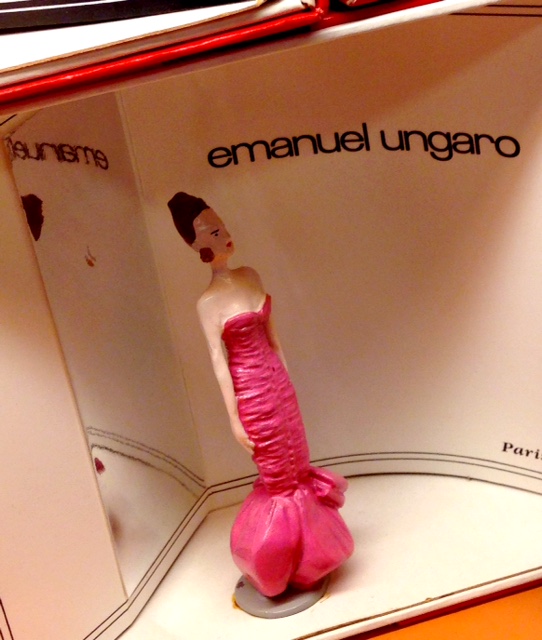
I had, unfortunately, a very limited time to visit L’Iber but was lucky enough to have someone call my attention to the “Fashion History” corner from which I had to be dragged from. My photos do not make any justice either to the museum collection or to the precious work of the Pixi atelier.
Poiret 1911
Created by Alexis Poliakoff , son of the painter Serge Poliakoff, second assistant to Claude Chabrol, Jacques Rivette and Jean-Luc Godard, painter, sculptor and master of a magic world of miniatures and lead figurines, Pixi was, from the beginning a revolutionary in the world of toy soldiers and lead figures dominated by army and war themes. Miniature soldier figurines found in Egyptian tombs have been dated to 2500 BC and were created for ritual purposes and not as playthings. Similarly, across Medieval Europe, generals and monarchs had miniature armies crafted for them in silver, porcelain, or wood for use during war-strategy sessions and only in the 18th century started being used as toys for the children of the affluent European aristocracy, evolving as toys throughout the 19th and 20th century and as objects of passion and fervent collections.
Rochas, 1934
From African Art to iconic cartoon and graphic novels characters and never forgetting the apparent triviality of our everyday life, Pixi has miniaturized everything and it’s Arts of Fashion: Haute Couture collection, that has me bound to the promise of going back to Valencia just to spend time at L’Iber, is truly a wonderful army of “fashion toy soldiers”.
Even though it has been coined to depict an economics concept, the phrase “small is beautiful” seems, in the words of John Mack, to be true. “Small is, indeed, very often, and by common consent, beautiful”. All miniatures result from technology and they achieve their “effect via the enchantment cast by [their] technical means, the manner of [their] coming into being, or rather, the idea one forms of [their] coming into being”.
All miniatures seem to have intrinsic aesthetic quality — and from what should they draw this constant virtue if not from the dimensions themselves?
The “diminutive tactility” of miniatures and their magnetic powers of fascination, allow us, even if we are not the intended audience or actor of a certain reality, to form our own constructions of reality. For Lévi-Strauss, “all works of art partake of the nature of miniatures or scale models (…) a work of art is a universe in miniature” one that lets us experience “a world in a grain of sand“.
I’m the worst procrastinator I know. I do write do to lists and visualize results and even tried to follow one or more of the popular productivity methods and tools out there and have read countless articles and posts on how to beat procrastination to no success.
Things linger until the last minute because “performing better under pressure” seems to be my favourite excuse. Things get done but the end result is seldom as good as it could or should be. My flat mate at university used to say I was a “perfectionist afraid of perfection”. This was, of course, only a polite or kind way of stating the obvious. I was, and still am, a typical procrastinator. I avoid what has to be done. I put off projects and beginnings because the optimal conditions are never present, they will materialize tomorrow. Or Someday, which, according to me, actually seems to be a weekday.
I am the kind of person that thinks I can do it all even if, at the same time, I am pretty sure that I am incapable of doing anything at all. Reading James Surowiecki’s article Later – What does procrastination tell us about ourselves?, I was thrilled to discover myself in one of the paragraphs:
Lack of confidence, sometimes alternating with unrealistic dreams of heroic success, often leads to procrastination, and many studies suggest that procrastinators are self-handicappers: rather than risk failure, they prefer to create conditions that make success impossible, a reflex that of course creates a vicious cycle.
Just like General McClellan, I excel at planning. Realizing – making those plans “real” – is not something that I feel confident enough to do. I tend to get lost in the wonder of new knowledge and the beauty of concepts. This was never as evident to me as when when I needed to write my PhD thesis. I had procrastinated ( a lot) during the dreaded writing phase of my master’s dissertation but managed to bring myself to do nothing else for a whole month and finish it. After all, the only “procrastination hack” that really works it’s the “just do it” one.
To know what you’re going to draw, you have to begin drawing…
Pablo Picasso
Unfortunately it was not that simple while attempting to write a lengthy, “formal document that argues in defence of a particular thesis”. I kept changing focus and approaches and adding material to my reading list and daydreaming about doing something else. One of my plans at the time was to become a découpage artist instead of continuing up (or down) an academic career path and for a few days I devoted myself to upcycling my Aldo wedge sandals into a pair of shoes that maybe Frida Kahlo would use. I’ve never been happier about the results of my action as inaction approach.
You can check the results of my procrastination or even take them home with you, here.
The cinema substitutes for our gaze a world more in harmony with our desire. This is the story of that world
Costume Designer Tanine Autré
Aristotelian tragedies might not need elaborate costumes. After all, sometimes what you do not wear speaks as loud as what you do.
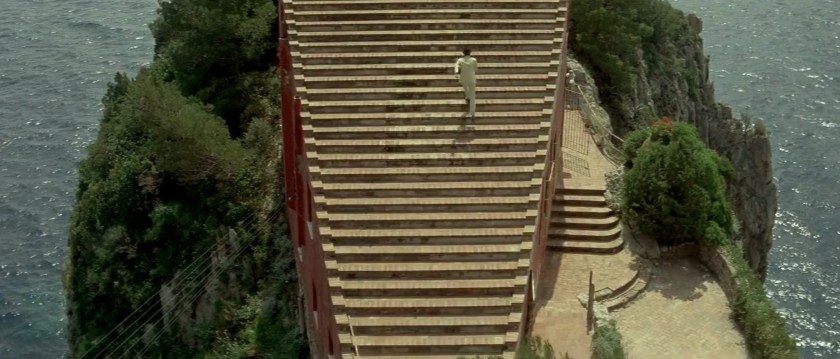
This week, inspiration seems to be simple, the always present, always perfect always modern Breton shirt. This week, more than ever, craving Summer by the harsh and timeless landscapes of Mediterranean sea.
This was the first film that made me feel I could (I needed to) live inside it.
You aspire to a world like Homer’s, but, unfortunately, that doesn’t exist
the smarter the clothes, the more dangerous the man, and the more damaged the clothes, the more vulnerable the man
Costume Designer Piero Gherardi, Academy Award for Best Costume Design (BW) 1961 and 1963 for 8½
Piero Gherardi, self-taught in art and architecture, created the overall look of La Dolce Vita. He was costume and set designer, as well as art director. This is a stylish film as a whole, as Gherardi placed equal emphasis on the costumes for both female and male leads. Every scene in La Dolce Vita strikes you as a beautifully styled photograph and the film still guides sartorial aspirations around the globe.
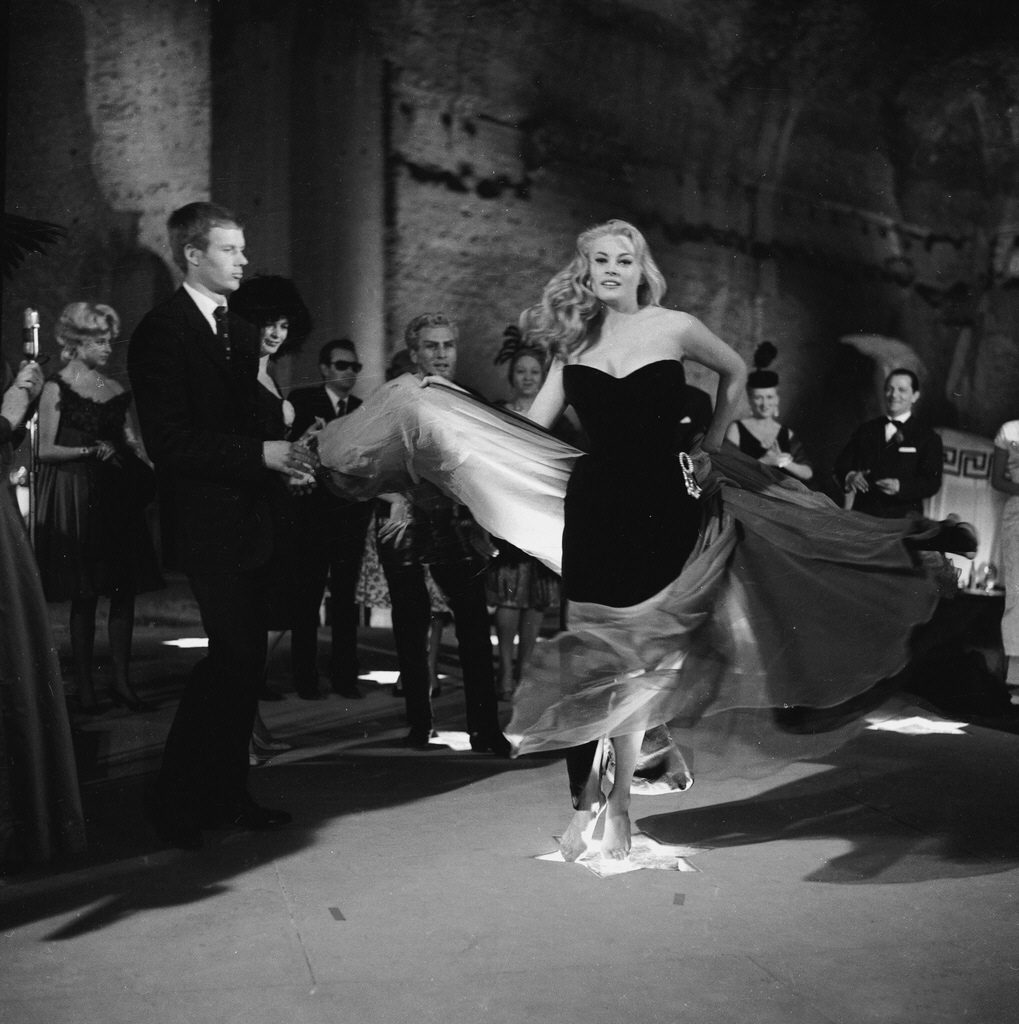
And aspire you do. To be ” the first woman on the first day of creation. [The] mother, sister, lover, friend, angel, devil, earth, home”. Of course much helped by the natural statuesque sensuality of Sylvia, costumes do play a decisive part on the construction this first Woman, the unattainable male fantasy.
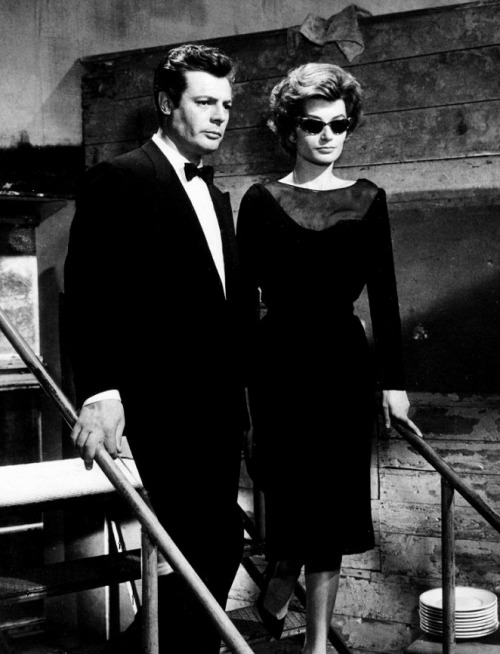
Much in the same way as they immortalized the sophisticated, frivolous elegance of the thrill seeking Maddalena. Has ennui ever looked more glamorous on-screen?
We need to live in a state of suspended animation like a work of art, in a state of enchantment. We have to succeed in loving so greatly that we live outside of time, detached.
In La Dolce Vita‘s mid-century Rome, Sylvia, Emma and Maddalena are each either proponents or victims of the media-hyped sweet life, with Sylvia as the celebrity symbol of fantasy, Maddalena as a habitual consumer of the trivial, and Emma as an outsider suffering the undesirability of being so.
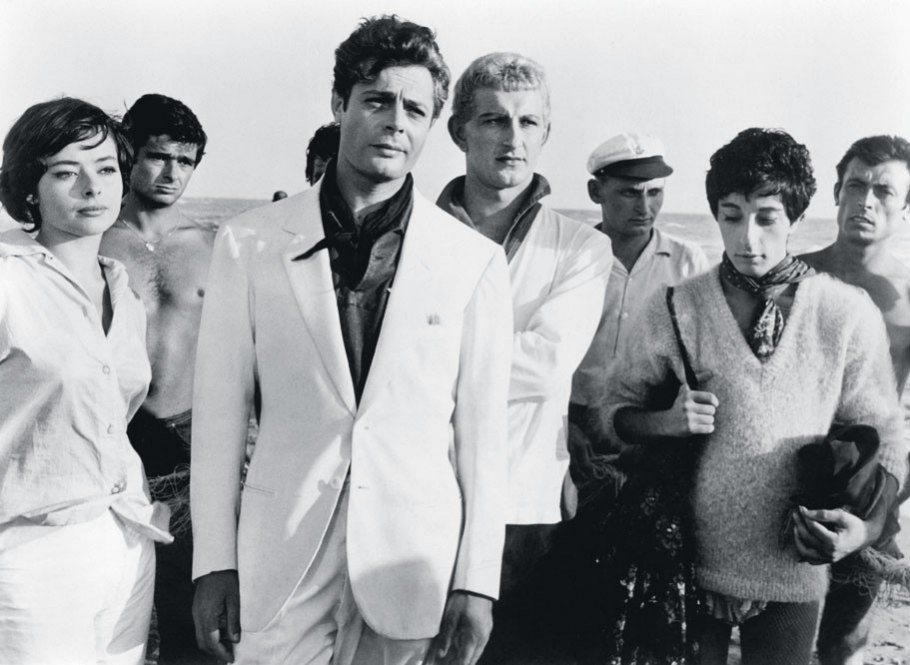
But this is unmistakably a movie about a man, a magnificently attractive one. La Dolce Vita confirmed Mastroiani, even if he rejected the title himself, as the ultimate Latin Lover. This Latin Lover appears as a cultural symbol of the Italian as “other”, the “imagined embodiment of the primitive, whose unrestrained and exotic passion directly affronts the more civilized and restrained Northern European or American Society”. This cultural symbol is also a cultural commodity, a “poster boy” for Rome as the hot spot of the rich, the famous and the beautiful, but also for the “European Don Giovanni and the Italian style based on the emergence of Italian fashion and design”.
Fellini and Gherardi present fashion and clothing as a “subtle critique of Italian masculinity”. Jacqueline Reich claims that Marcello, the journalist, is an anti-hero (inetto), ” a man in conflict with an unsettled and at times unsettling political and sexual environment” but always immaculately dressed, the embodiment of the cultural heritage of the bella figura, “reflecting a taste for public display of self-worth though appearance”.
Malossi (quoted by Reich) observes that “the Italian male literally puts on a show for the admiring public. Like the dandy, the bella figura parades his sense of style, his masculinity, and his sensuality, regardless of his social and economic status. Both individual and national identity are written on the body through clothing and grooming and paraded for the community”. I have only been to Italy for work a couple of time, and in Rome stayed only a few hours, enough to walk to the Fontana di Trevi and drive past the Coliseum but, the parading of well dressed men did really make a strong impression on me. Never before I had seen in practice this notion that “dressing well [is] both a privilege and a responsibility” and the conscious use of public space as stage and tailoring and suits as costumes.
In La Dolce Vita, Fellini, presents us with the “discontinuity between surface and substance. Marcello Rubini is dressed in the latest fashions but the costuming fails to mask his moral, spiritual and sexual failings”. Still, at the end, vulnerable and damaged in his white suit, Rubini is still showing us that, as claimed by Bruzzi, “masculinity is directly measured by narcissism”.
References
Jacqueline Reich, UNDRESSING THE LATIN LOVER Marcello Mastroiani, fashion and La Dolce Vita in Bruzzi and Gibson (2013) Fashion Cultures Revisited: Theories, Explorations and Analysis






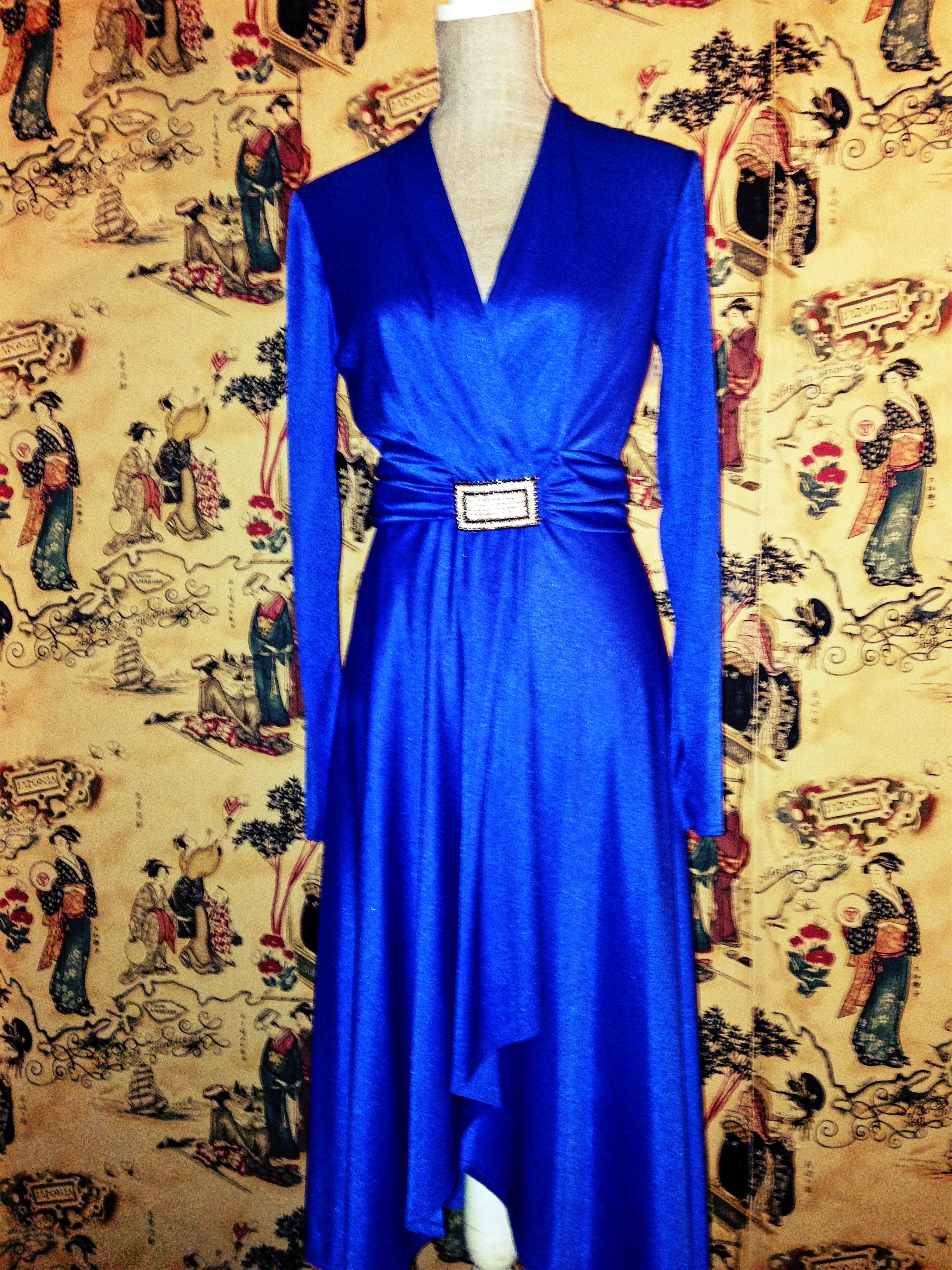 I got ready to be a rock star wearing silver leather jackets, or maybe be a bass player for Lenny Kravitz in fringed suede pants.






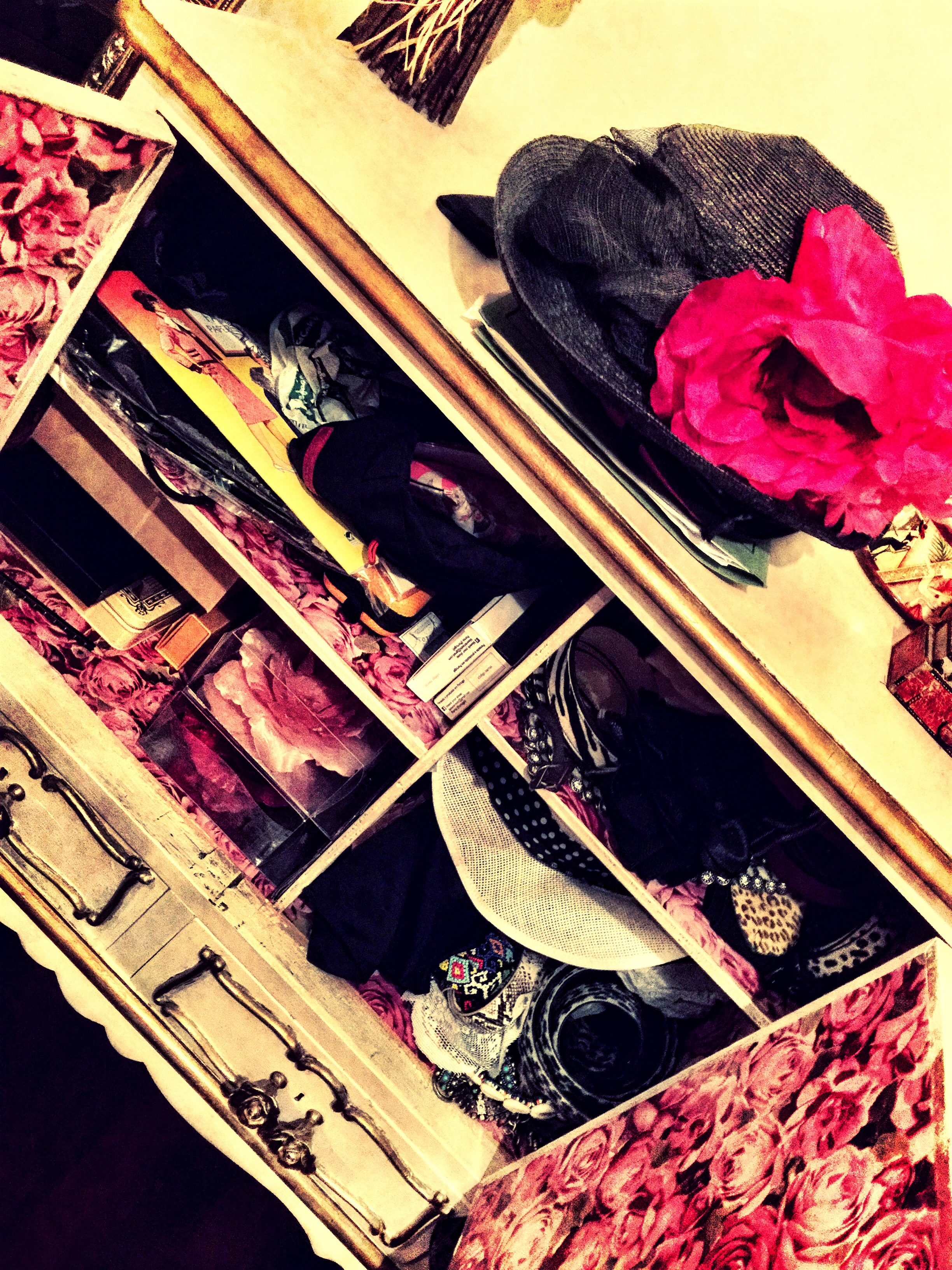








 Stories from A Closet of Errors