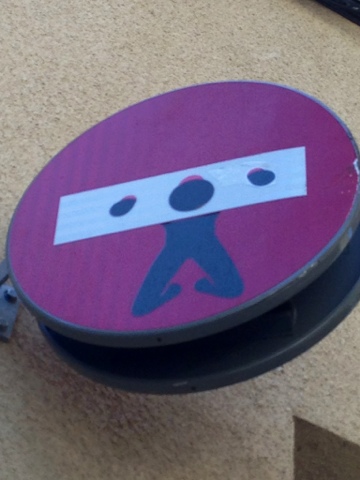
At the end of the sidewalk 

I like cities where you can walk almost everywhere. In my case this would be almost any city I have ever visited. I have walked an average of 10 km a day in Barcelona, New Orleans and Boston. I have walked along the river in Dubai under a blazing 49 degrees Celsius. I have walked the boarder to get to Tijuana and walked around the city trying to look relaxed. I used to walk home both in Porto and London so I didn’t need to cope with overcrowded buses or subways. I have walked in  Los Angeles and got lost around Chinatown trying to walk back to somewhere. I had to follow a couple of tourists with a map in Venice after getting irremediably lost walking along narrow alleys. I can’t read maps.

I have walked all the way from downtown Atlanta to Georgia Tech even though there were no real sidewalks. Where Atlanta did have sidewalks, me and some friends where told by a screaming police officer that we couldn’t just stand there waiting for a cab. We were loitering. It was a new word in my English vocabulary, describing some kind of illegal activity that I didn’t even know I was engaging in. All four of us that night, waiting for a taxi to show up after our farewell dinner, had grown up in countries with past military or other forms of dictatorships. We all remembered stories told by our grandparents or parents about how it was forbidden to stop on the sidewalk for a chat just in case it would turn out to be some kind of conspiracy. It stroke us as really odd that this was happening to us in Atlanta.

In Porto, sidewalks have become wider, probably because the city got used to being voted “best destination” of this and that over the past few years. Wider sidewalks accommodate more tourists and make people feel safer. They are, I suppose, also more efficient, there’s more space to move quicker. According to James Petty, “all urban architecture or urban design has a level of control built into it,” pedestrian crossings and sidewalks exist to  guide the behavior of the public. The sidewalks in Brasilia have no corners. This avoids impromptu meetings that could disrupt the efficiency of the city.


I had never really thought about this before Atlanta. I’m absolutely urban, I have tried to live in the countryside for a few months and even though I enjoyed the quietness, I also missed the noise and the people and the new discoveries you make when you experience a city, your own or somebody else’s, just by walking. Even if there’s no sidewalks. It’s just easier to be a dilettante walker when the sidewalks are there. You don’t really get to understand where you are just driving around getting from point A to B. Walking allows you to stop and look, it creates a common space and it helps to experience cities beyond their efficiency, just as places of history and stories. I like cities, I like their “inclusive” character but, as Petty also notes, “you’ve got a point where that kind [urban planning] of controlling becomes direct, explicit, and targeted against certain groups and not others.” Cities with sidewalks still seem to avoid this, at least they make you feel more welcome.

Photos: my own

Sidewalk

Coloring by words 

I cannot rest from travel: I will drink Life to the lees

This was beautifully handwritten inside a birthday card given to me by my summer course English teacher in Cheltenham the year I turned 18. These words (and the card) have stayed with me since then and I even had them embroidered on a dress. Who wouldn’t want to live like that? These words felt like the perfect “how to” to life at that time.

They were also responsible for the immense love I feel for a language which is not native to me but has always understood me better than my own.

Before these words, all the poetry in songs, from Morrison to Morrissey, the texts of disquiet, the Stranger’s paragraphs all seemed to work as companions to a growing existential hole, some sort of solace to an awkward confrontation with reality. And then these words, out of their natural context, as quotes are usually presented, showed a sunny alternative and I still tend to hold on to them as way of seeing a brighter tomorrow.

Other words, other poems, other texts have found their way to me because of their music when read aloud or because they are the words that I wished were mine and because, in a way, I still need words as a compass even when those same words make me feel overwhelmed and scared that in the midst of all the quotes living in my head I will not be able to find words that are mine. And again I borrow, from Beckett when I try and fail and vow to fail again better, from Jung while trying to take control of my own narrative, from Emerson while I try to go on being myself, from Camaron de la Isla when trying to come to terms with all the anger and honey that I too seem to carry with me.

And still none of those words have resonated as strongly as the realization that

tomorrow, and tomorrow, and tomorrow,
Creeps in this petty pace from day to day,
To the last syllable of recorded time;
And all our yesterdays have lighted fools
The way to dusty death. Out, out, brief candle!
Life’s but a walking shadow, a poor player,
That struts and frets his hour upon the stage,
And then is heard no more. It is a tale
Told by an idiot, full of sound and fury,
Signifying nothing.
I carry them on me. So I don’t forget.

Quote Me better late than never

A different way of letting go

“Women [seem to] have a dynamic relationship with their clothes that can be grouped around three co-existing views of self; ‘The woman I want to be’, ‘The woman I fear I could be’ and ‘The woman I am most of the time’.These three views illustrate women’s attempts to achieve satisfying images as they engage with clothes to create, reveal or conceal aspects of their identity.”( Guy and Banim).

They can also help explain why we keep the clothes that we no longer wear or even those that we have never worn. These clothes laid to rest are somewhat magic both because they connect us to our memories and they keep the promise of possibilities, of a different future.  Letting them go is also letting go of past and future, at least of the one we no longer see ourselves fulfilling.

Why open an online shop instead of just donating everything? This would not allow me the necessary reflection time to understand the process of revisiting myself and, above all, I could not tell the stories of how the Closet came to be.

Selfie

20140208-210627.jpg

Walking through Bagamoyo street in Maputo, two kids asked me to take a photo of them. I had a Polaroid camera back then and they ran away when they saw the photo come out. They came back some 10 minutes later and I asked them if they wanted it. No, they said, it doesn’t look like us at all.

The Outsiders

Image

Daily prompt: My own photo, not my own voice. Still, it explains how I feel.

“For a long while I have believed – this is perhaps my version of Sir Darius Xerxes Cama’s belief in a fourth function of outsideness – that in every generation there are a few souls, call them lucky or cursed, who are simply born not belonging, who come into the world semi-detached, if you like, without strong affiliation to family or location or nation or race; that there may even be millions, billions of such souls, as many non-belongers as belongers, perhaps; that, in sum, the phenomenon may be as “natural” a manifestation of human nature as its opposite, but one that has been mostly frustrated, throughout human history, by lack of opportunity.

And not only by that: for those who value stability, who fear transience, uncertainly, change, have erected a powerful system of stigmas and taboos against rootlessness, that disruptive, anti-social force, so that we mostly conform, we pretend to be motivated by loyalties and solidarities we do not really feel, we hide our secret identities beneath the false skins of those identities which bear the belongers’ seal of approval.

But the truth leaks out in our dreams; alone in our beds (because we are all alone at night, even if we do not sleep by ourselves), we soar, we fly, we flee. And in the waking dreams our societies permit, in our myths, our arts, our songs, we celebrate the non-belongers, the different ones, the outlaws, the freaks.

What we forbid ourselves we pay good money to watch, in a playhouse or a movie theater, or to read about between the secret covers of a book. Our libraries, our palaces of entertainment tell the truth. The tramp, the assassin, the rebel, the thief, the mutant, the outcast, the delinquent, the devil, the sinner, the traveler, the gangster, the runner, the mask: if we did not recognize in them our least-fulfilled needs, we would not invent them over and over again, in every place, in every language, in every time.”
― Salman Rushdie, The Ground Beneath Her Feet