The Mediation of Truth: Hegel, Bloom, and the Role of Poetry


Art has long been regarded as a vessel for truth, transcending mere aesthetics to probe the depths of human experience. For Hegel, art is a stage in the unfolding of the Absolute Spirit, rendering abstract truths sensuously intelligible. Harold Bloom, in Take Arms Against a Sea of Troubles, positions poetry as a shield against existential despair, a means of self-creation in the face of chaos. This essay explores how poetry, as an art form, bridges Hegel’s universal truth and Bloom’s individual salvation, arguing that poetry uniquely mediates between collective human consciousness and personal revelation.


Hegel’s philosophy situates art within the dialectical journey of the Absolute Spirit toward self-realization. In his Lectures on Aesthetics, he posits that art’s purpose is to “unfold the truth” by embodying spiritual ideals in material forms. Unlike philosophy, which abstracts truth into concepts, art makes truth palpable through imagery, sound, and narrative. Poetry, as the highest form of verbal art, synthesizes the concrete and the abstract, using language to evoke both emotion and intellect. For Hegel, great poetry—such as Greek tragedy or Shakespearean drama—captures the spirit of its age, reflecting societal values and conflicts. The truth here is historical and collective, a manifestation of humanity’s evolving self-awareness.


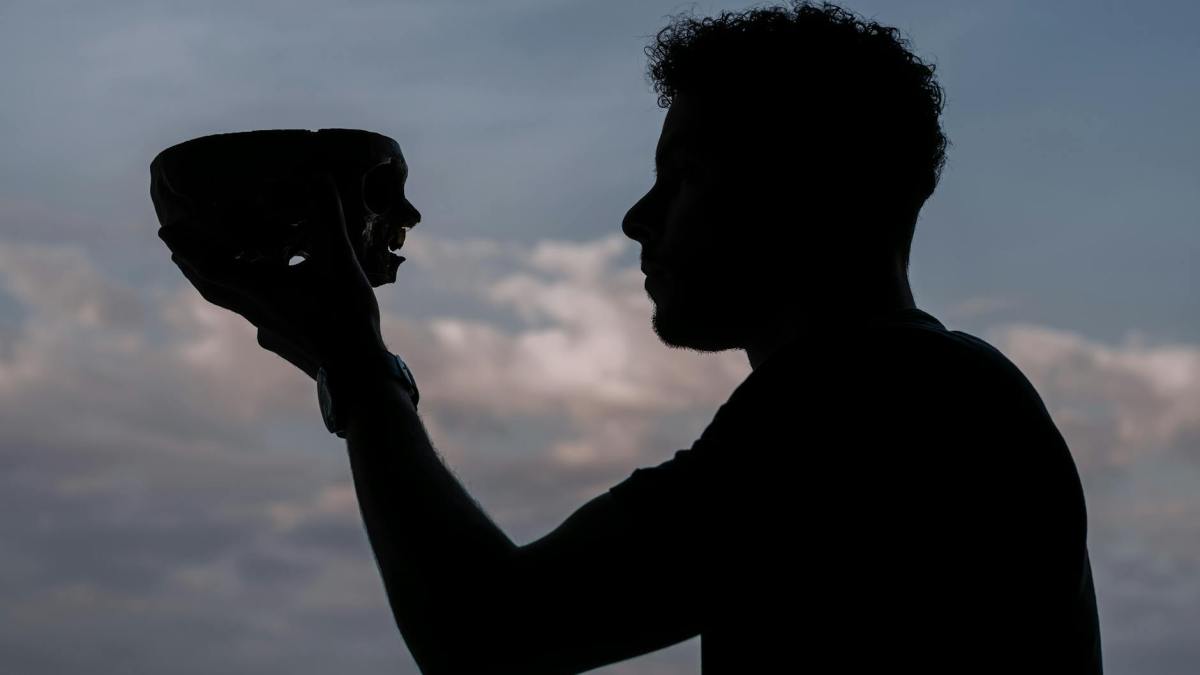
Bloom’s Take Arms Against a Sea of Troubles shifts the focus inward, framing poetry as a tool for individual survival. Drawing on Shakespeare’s Hamlet (“take arms against a sea of troubles”), Bloom argues that poetry equips readers to confront suffering and mortality. Through close engagement with canonical poets—from Milton to Whitman—readers forge their own identities, resisting the “anxiety of influence” by internalizing and reinterpreting poetic voices. For Bloom, truth is not universal but existential; it emerges in the interplay between reader and text, offering solace and self-knowledge. Poetry becomes a “mirror turned lamp,” illuminating the reader’s inner world while reflecting shared human struggles.


Hegel and Bloom converge in their belief that art reveals truths inaccessible to pure reason, but they diverge in scope. Hegel’s truth is teleological, part of humanity’s collective march toward freedom. Bloom’s is intimate, a dialogue between solitary reader and text. Yet poetry bridges these realms. Consider Wordsworth’s Tintern Abbey: Hegel might laud its embodiment of Romanticism’s spirit, while Bloom would emphasize its therapeutic role in reconciling memory and loss. Similarly, Emily Dickinson’s condensed verses distill metaphysical inquiries into personal lyricism, satisfying Hegel’s demand for sensuous form and Bloom’s call for existential courage.

Poetry’s power lies in its duality. It transforms abstract truths (Hegel’s “Absolute”) into visceral imagery, while inviting readers to project their lived experiences onto its language (Bloom’s “self-creation”). A Shakespearean sonnet about time’s passage speaks both to Renaissance cosmology and a modern reader’s fear of mortality. This duality ensures poetry’s endurance: it is both a cultural artifact and a personal companion.


Hegel and Bloom, though separated by centuries and aims, collectively affirm poetry’s role as a mediator of truth. For Hegel, it is a historical force; for Bloom, a lifeline. Together, they illustrate how poetry transcends its form to become a space where universal and personal truths coexist. In an age of fragmentation, poetry remains vital—not merely as a relic of the spirit’s journey, but as a living dialogue between the self and the sublime. As long as humans seek meaning in chaos, poetry will endure as both witness and weapon, unfolding truths that philosophy cannot touch and solace that history cannot provide.

Disclaimer: not really jotting down the first thing that comes to mind, practicing for a speech next week

References:

Harold Bloom,  Take Arms Against a Sea of Troubles: the Power of the Reader’s Mind Over a Universe of Death (2020)

Hegel’s Aesthetics at Stanford Encyclopedia of Philosophy

Impermanence

I stumbled upon this quote by Béla Tarr on A Bitter Sweet Life:

I don’t care about stories. I never did. Every story is the same. We have no new stories. We’re just repeating the same ones. I really don’t think, when you do a movie that you have to think about the story. The film isn’t the story. It’s mostly picture, sound, a lot of emotions.

And, I remembered that one of the first movies that made me feel the same was Peter Greenway’s The Pillow Book, beautiful to behold and impossible to forget. I can’t remember the story but I do remember feeling spellbound by its visual poetry and the idea of being a living book. Greenway employs multiple aspect ratios, picture-in-picture compositions, and superimposed calligraphy that transforms the screen into a living, breathing manuscript. Bodies become canvases, and ink becomes an extension of desire. The film’s approach to visual composition mimics the practice of calligraphy itself—disciplined yet sensual, structured yet flowing with emotion.

It took me another 10 years to get my first tattoo and it was not a written one. I had a leopard done in Johannesburg because I was born in South Africa and the leopard is one of the Big 5. When I finally decided to have something written, I was in San Diego in 2014. For a full 5 hours or so, someone patiently wrote Macbeth’s soliloquy in Act 5 Scene 5 on the right side of my rib cage. Surprisingly, there was no pain. The tattooer, who was very young, asked why I had chosen such a strange thing. I wanted to be constantly reminded of the fleeting nature of life and meaning, I said.

After I got divorced, Richard II was written on my right tight under the leopard. I wasted time and now doth time waste me.

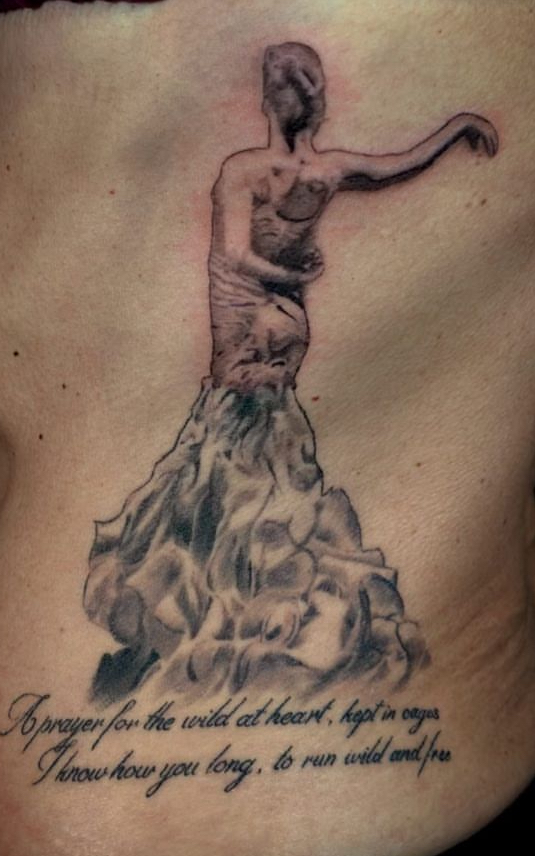
My last one was done in 2024, a very common tattoo written under a flamenco dancer on my left rib cage. Tennessee Williams’ first verses of A Prayer for The Wild at Heart. The tattoo artist thought that having the whole poem would be over the top.

I wanted to show, even though they are not visible, that for me there’s nothing more important than literature. Particularly the one exploring human struggles, mortality, and the desire for freedom.

The “Pillow Book” connection made perfect sense now – like the film, I was using my body as a canvas for meaningful text. Yes, I could use paper, but text on skin becomes something more intimate and embodied than words on a page. I also see them as a way of relating my reminder’s of life’s impermanence and the tension between duty and desire to the struggles of everyone else.

I am now thinking of getting a tattoo of goddess Athena. I have to find suitable words.

There. There you are. You have just dropped a marker pin on your body, to reclaim yourself, to remind you where you are: inside yourself. Somewhere. Somewhere in there
Caitlin Moran, How to Be a Woman

Out of step

We are the music-makers,
And we are the dreamers of dreams,
Wandering by lone sea-breakers
And sitting by desolate streams;
World losers and world forsakers,
On whom the pale moon gleams:
Yet we are the movers and shakers
Of the world for ever, it seems.
 
With wonderful deathless ditties
We build up the world’s great cities.
And out of a fabulous story
We fashion an empire’s glory:
One man with a dream, at pleasure,
Shall go forth and conquer a crown;
And three with a new song’s measure
Can trample an empire down.
 
We, in the ages lying
In the buried past of the earth,
Built Nineveh with our sighing,
And Babel itself with our mirth;
And o’erthrew them with prophesying
To the old of the new world’s worth;
For each age is a dream that is dying,
Or one that is coming to birth.
Ode by Arthur O’Shaughnessy (1874)
Photo taken at Black Mamba – Burgers & Records, a very cool vegan burger place in Porto

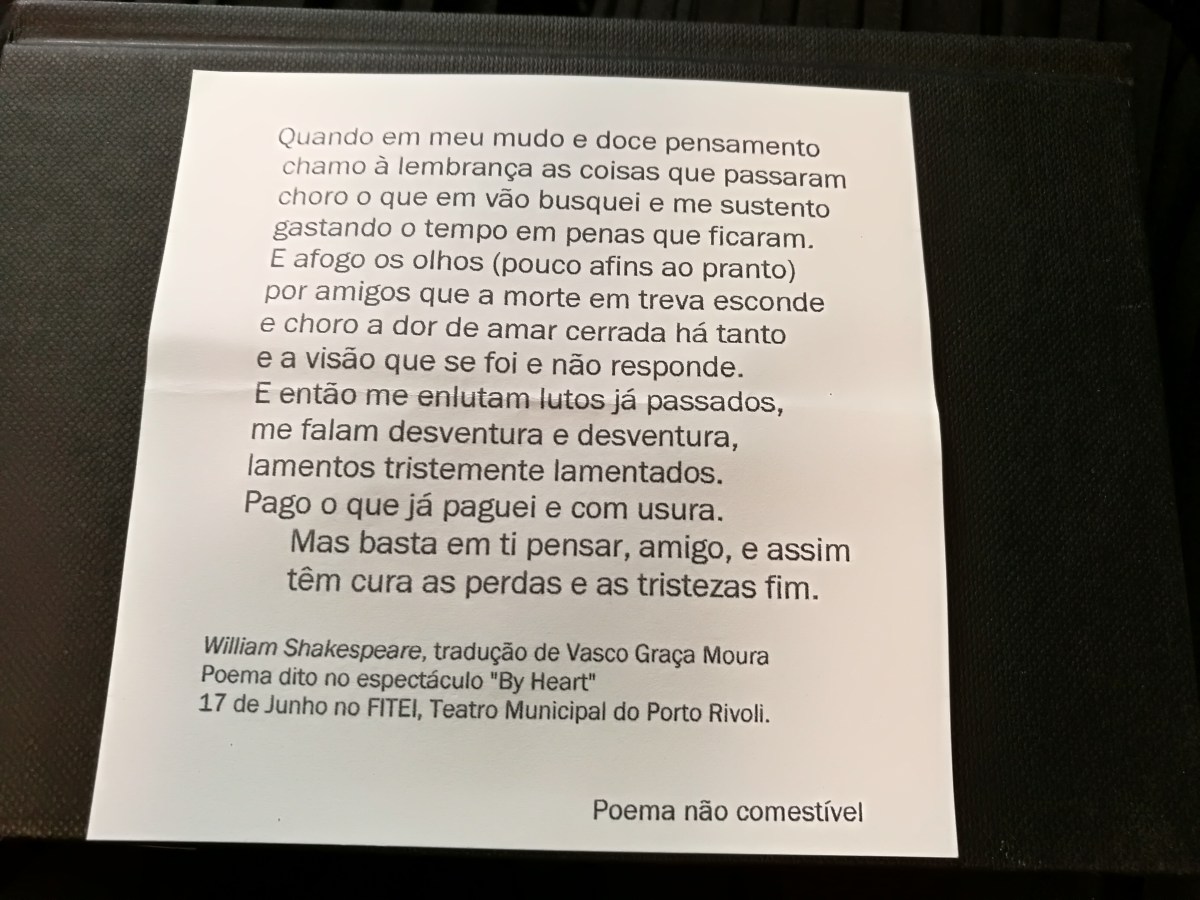
By heart

When to the sessions of sweet silent thought

I summon up remembrance of things past,

I sigh the lack of many a thing I sought,

And with old woes new wail my dear time’s waste:

Then can I drown an eye, unus’d to flow,

For precious friends hid in death’s dateless night,

And weep afresh love’s long since cancell’d woe,

And moan th‘ expense of many a vanish’d sight;

Then can I grieve at grievances foregone,

And heavily from woe to woe tell o’er

The sad account of fore-bemoaned moan,

Which I new pay as if not paid before.

But if the while I think on thee, dear friend,

All losses are restor’d, and sorrows end.

Sonnet 30, William Shakespeare


My weekend was perfect because of Tiago Rodrigues’s play “By Heart”

My world is, after all, a place of beauty.

Things I learned in the midst of frivolous amusements 

I am a frivolous person and I have often felt guilty about it mainly because I fear that most people would understand that as meaning that I am a shallow person. Most of my time seems to be occupied with aesthetic considerations or concerns of some kind. Most of the space I live in is organized accordingly. Every morning I go out hoping that what I have chosen to wear will contribute to make the day a little more beautiful, a little less real (I suppose that’s where the love of vintage clothes comes from). Every evening I want to come back home to the same kind of fantasy. I watch movies and plays looking for the kind of visual and emotional grandeur that can make one forget that there’s some kind of reality out there. I read books to be seduced by the music in words and I like music because it embodies all the beauty I find in movies and books.
Form always seems to overcome purpose and content.

Except when it comes to people. Their content is what sustains their form. And still, I also tend to understand human relationships as an aesthetic ideal in the sense that they should be a pursuit of pleasure and an avoidance of pain.  I like people. I like watching them, I like talking to them and getting to know their stories and I feel mesmerized by the things they know and the lives they lived.

I am terribly shy so I never start conversations with strangers but I do engage in them often and listen.

There was someone from Belgium sitting next to me on a flight to Lisbon and he told me how he hadn’t spoken to his family in over twenty years because he had taken his dad to court over child support money. There was an  elegant lady in the subway in New York who collected ancient tiles and a kid from Spain who talked for over seven hours during a flight between Johannesburg and Madrid and  street artists in London and drag queens in Porto and soccer fans in Zambia and the regal looking lady in Houston during intermission at the ballet. She was a widow and her son was working for an oil company in Nigeria. Maybe we could go to the ballet together the following week. I would not be in Houston anymore. And the Brazilian girl  that had been left at the altar and was trying to forget that she was hurt and afraid of flying while the plane was getting ready to land.

And, if they asked me, I could go on and almost write a book with all the moments some stranger decided to confide in me. Sometimes I talk and understand how liberating it is to be your vulnerable self with someone you know will not cross paths with you ever again. And you go on for hours sitting across a perfect stranger in some Lower East Side bar after checking some independent production of Hamlet and talk about all your unfulfilled dreams and what your fear and how finding Shakespeare has changed your life.

These are the moments of bliss that truly feel they could be enough for a whole lifetime and shield me when the world just seems to hurtful to endure. I am one of those. Deeply hurt by the trivial, the rudeness and mainly by the pain of others, of strangers, by the injustice, by whatever dehumanizing force seems to be operating on any given day.

“Yet, taught by time, my heart has learned to glow for other’s good, and melt at other’s woe.”

And my heart also got used to marvel at others, to shudder, tremble and thrill with the same pleasure and emotion it felt coming face to face with Hopper’s “New York Movie” or driving to Jarrett’s “Köln Concert”.

Works of art,  Martha Nussbaum says,  “give us insight into how other people live and feel, how they strive for happiness, and how conditions of many types affect them. [And] that is crucial for living any sort of decent life.”


References

Marcel Proust

Dinah Washington

Fyodor Dostoyevsky

Homer

Martha Nussbaum