
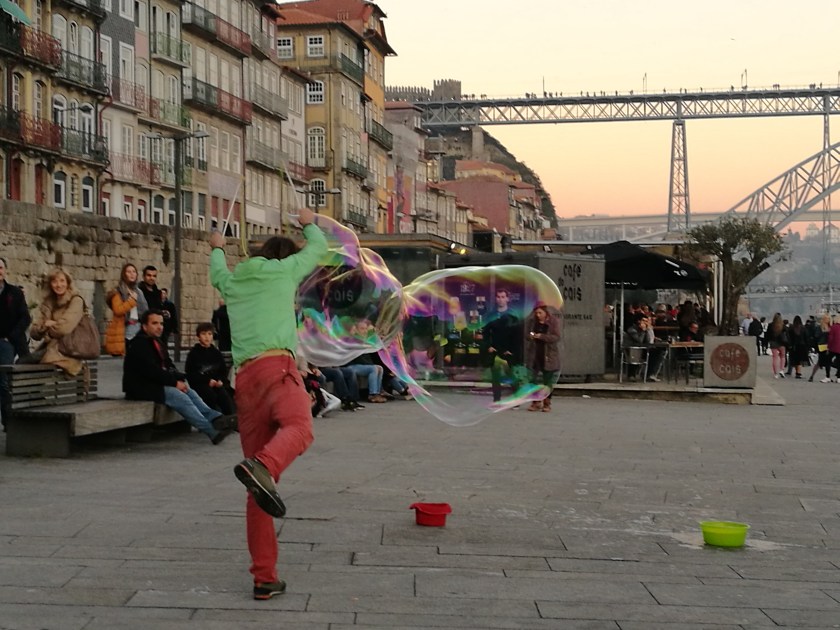
And to me also, who appreciate life, the butterflies, and soap-bubbles, and whatever is like them amongst us, seem most to enjoy happiness.
Friedrich Nietzsche, Thus Spoke Zarathustra
Porto through a different filter
And to me also, who appreciate life, the butterflies, and soap-bubbles, and whatever is like them amongst us, seem most to enjoy happiness.
Friedrich Nietzsche, Thus Spoke Zarathustra
Porto through a different filter

nothing can better cure the anthropocentrism that is the author of all our ills than to cast ourselves into the physics of the infinitely large (or the infinitely small). By reading any text of popular science we quickly regain the sense of the absurd, but this time it is a sentiment that can be held in our hands, born of tangible, demonstrable, almost consoling things. We no longer believe because it is absurd: it is absurd because we must believe.
Julio Cortázar, Around the Day in Eighty Worlds
Scale (ing) down Porto
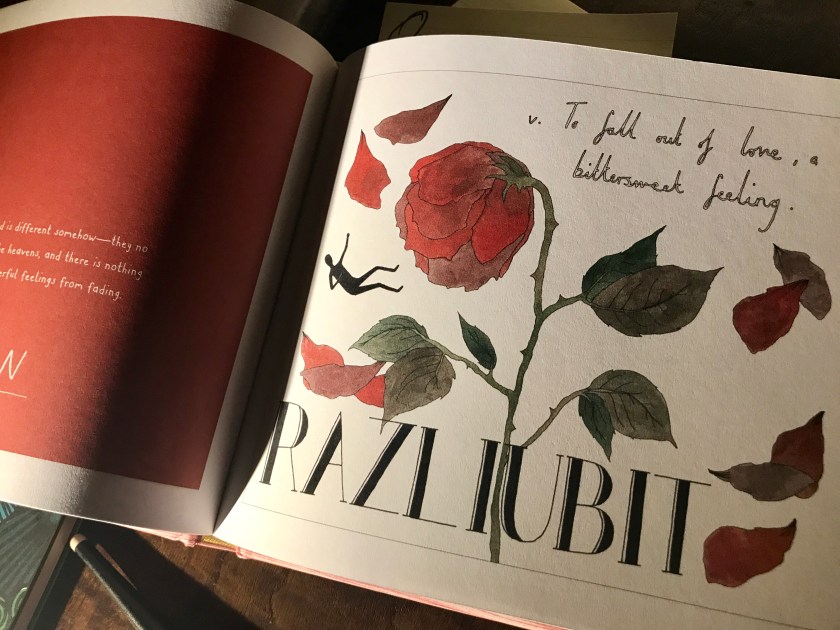
Photo from a page of the beautiful “Lost in Translation” by Ella Frances Sanders
References: C. Northcote Parkinson
I truly wish I could deny it
If we never have enough love, we have more than most.
We have lost dogs in our neighborhood and wild coyotes,
and sometimes we can’t tell them apart. Sometimes
we don’t want to. Once I brought home a coyote and told
my lover we had a new pet. Until it ate our chickens.
Until it ate our chickens, our ducks, and our cat. Sometimes
we make mistakes and call them coincidences. We hold open
the door then wonder how the stranger ended up in our home.
There is a woman on our block who thinks she is feeding bunnies,
but they are large rats without tails. Remember the farmer’s wife?
Remember the carving knife? We are all trying to change
what we fear into something beautiful. But even rats need to eat.
Even rats and coyotes and the bones on the trail could be the bones
on our plates. I ordered Cornish hen. I ordered duck. Sometimes
love hurts. Sometimes the lost dog doesn’t want to be found.
Hunger by Kelli Russel Agodon
Photo: Hard Club, Porto (2014)
when Whitman wrote, “I sing the body electric”
I know what he
meant
I know what he
wanted:
to be completely alive every moment
in spite of the inevitable.
we can’t cheat death but we can make it
work so hard
that when it does take
us
it will have known a victory just as
perfect as
ours.
A song with no end
Photo CPF (September 16, 2017). This was the last place, the exact last room where I saw O. for the last time. I don’t know if he liked Bukowski. I hope he did because I seem to be having a Bukowski moment and this poem made me think of him.
after many years
of hard work and a long voyage
you stand in the centre of your room,
house, half-acre, square mile, island, country,
knowing at last how you got there,
and say, I own this,
is the same moment when the trees unloose
their soft arms from around you,
the birds take back their language,
the cliffs fissure and collapse,
the air moves back from you like a wave
and you can’t breathe.
No, they whisper. You own nothing.
You were a visitor, time after time
climbing the hill, planting the flag, proclaiming.
We never belonged to you.
You never found us.
It was always the other way round.

sends a thrilling pulse through me.
References
Henry Wadsworth Longfellow
Photo: Piscina das Marés, July 2017

Coffee is a lot more than just a drink; it’s something happening. Not as in hip, but like an event, a place to be, but not like a location, but like somewhere within yourself. It gives you time, but not actual hours or minutes, but a chance to be, like be yourself, and have a second cup.
Gertrude Stein, Selected Writings

Mr. Alexandre used to work here, from 1962 until he died in 2016.
From the street, looking through the window, it doesn’t look like this place is abandoned. He might come back. Someone might come back for their bespoke suit.
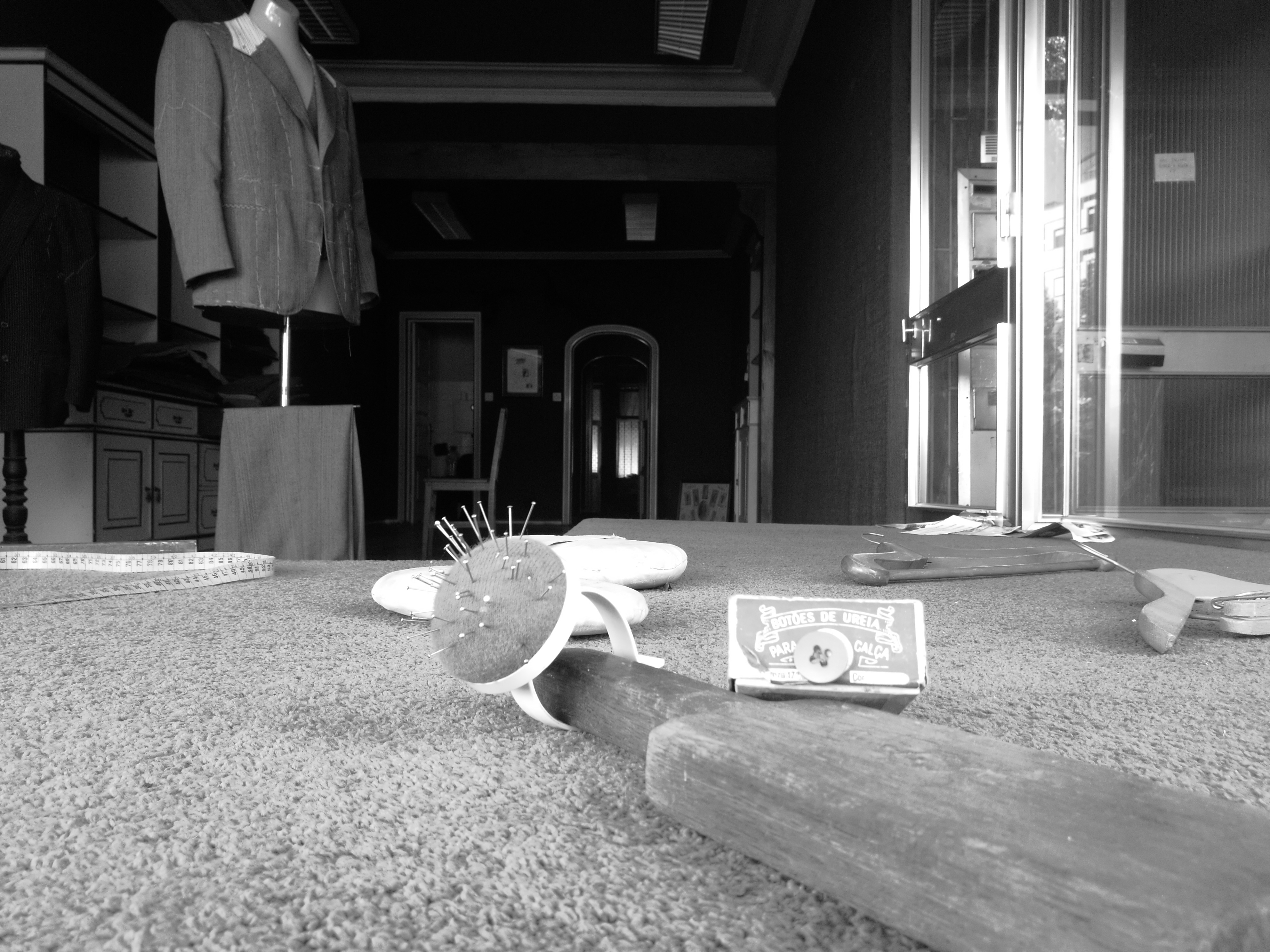
If you read Portuguese, please head to Blog dos Alfaiates, Mr. Alexandre’s story is there along with other stories about other masters of elegance.
Photo: Alexandre Alfaiate, Praça Coronel Pacheco, Porto
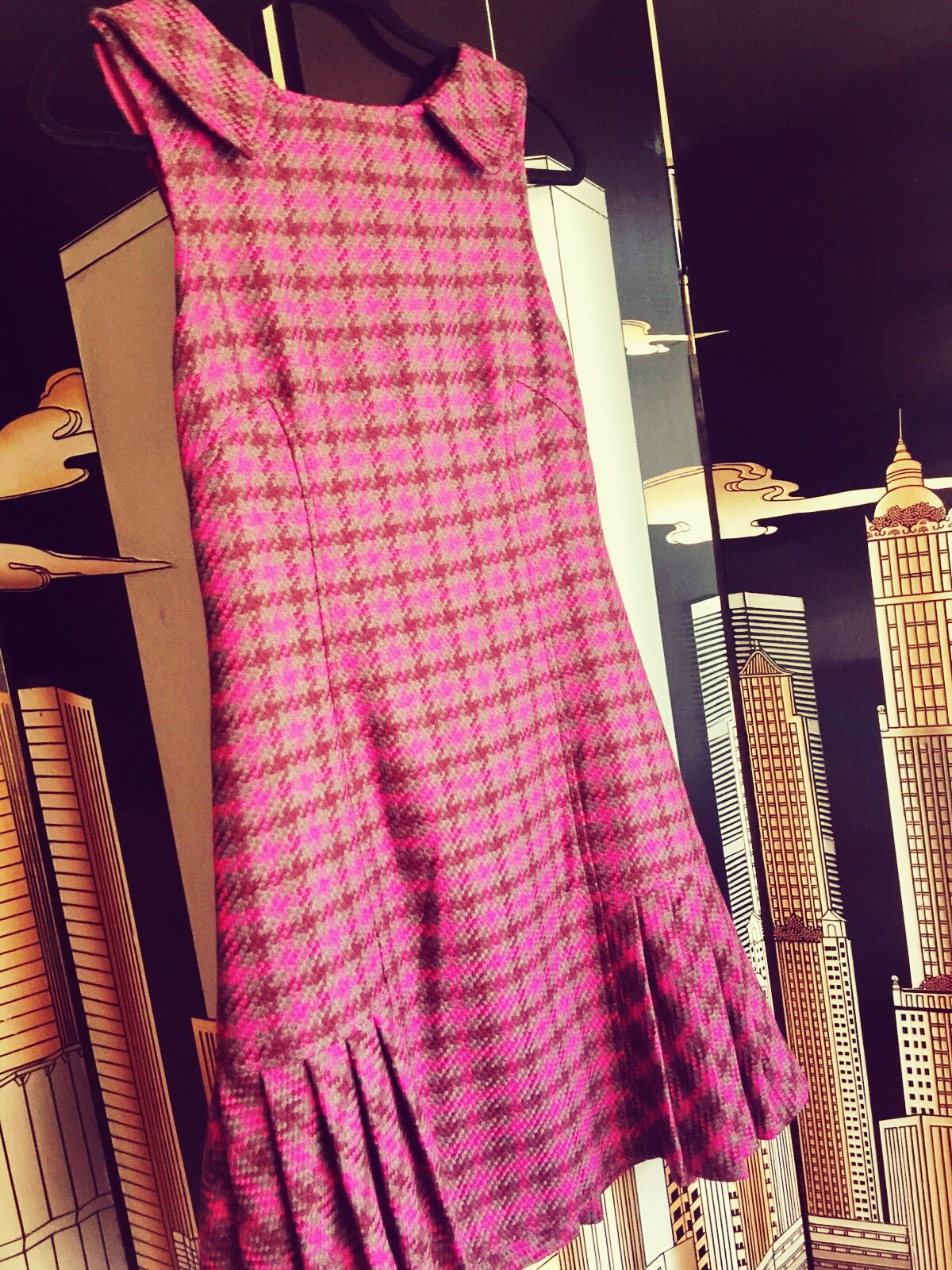
I wore this dress on Monday and the whole day I felt as if was in disguise. I thought I looked like a twenty first century flapper when I checked myself in the mirror before leaving the house, but the minute I got to work I looked as if I had borrowed the last available dress left in someone else’s closet. And that someone definitely didn’t have a lot in common with me. I didn’t buy this dress. It was a gift from my mum who probably never abandoned the hope that, in the right outfit, I would look like a pretty girl. This dress is too pink for me, it’s either too short for me or I’m too tall for it, I am also too old to pull something like this off. Not being a mother myself, I am left with a daughter’s perspective on this strange relationship that sometimes infantilizes me in order to, so it seems, avoid confronting the inevitability of time.
Mondays are never easy and I have a horrible cold and the medication is making me feel like I’m living underwater and the weight of every single thought is too much to even consider taking any kind of action.
TUESDAY
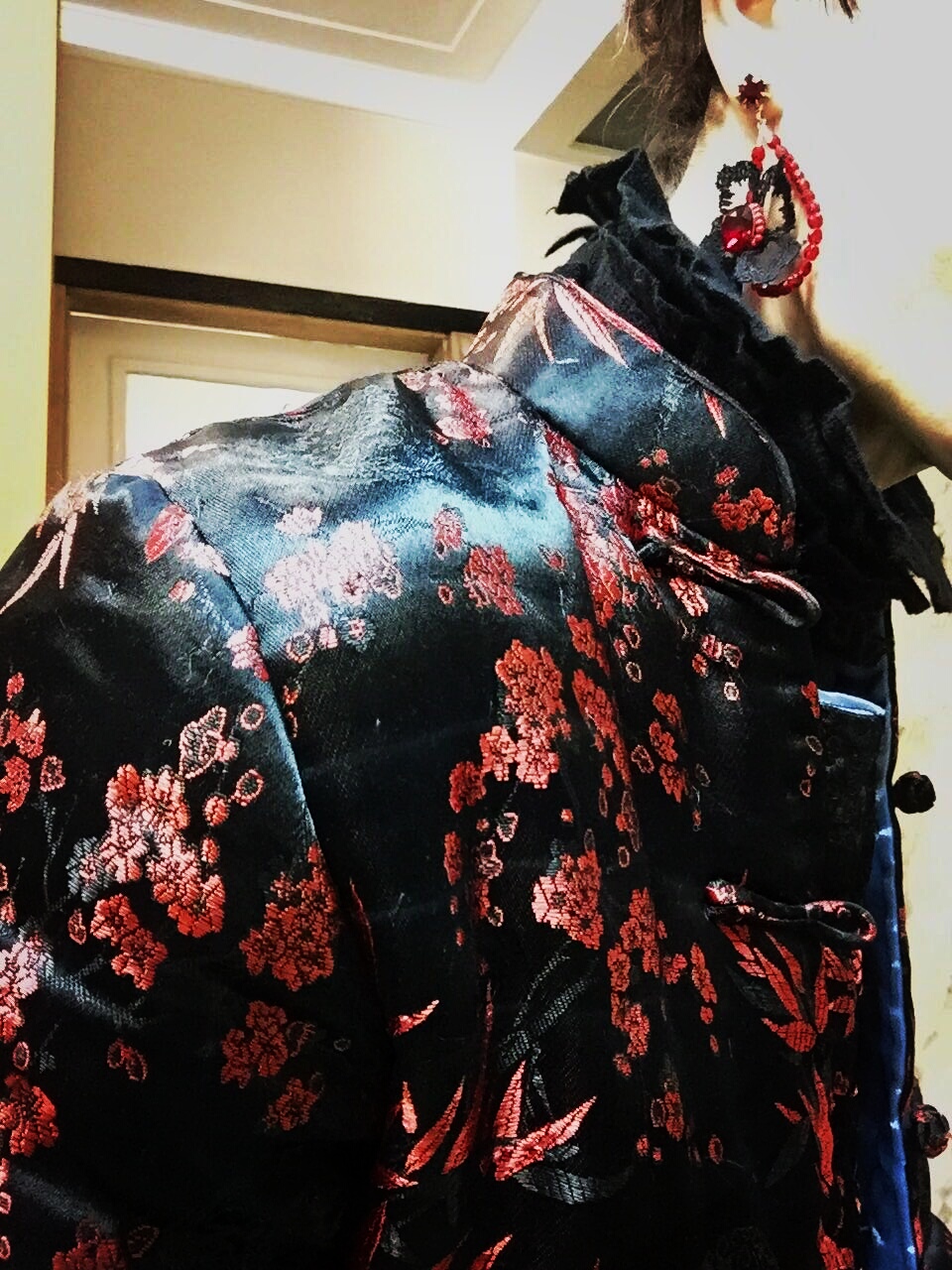
I bought this jacket in Vietnam in November 2014. A text message received while I was in Hanoi let me know that my great aunt had died. I was there for work and alone and while I can’t really say that I have always depended on the kindness of strangers, I have found that sometimes, strangers make the best friends and know exactly what to do and how to help.
Stray people brought together by chance
WEDNESDAY

I have a weak spot for chinoiserie and I absolutely adore these pants. I think I bought them some twenty years ago and they have never made it to the error category.
I felt a lot better today. After work we went to Java, the usual hang out before theater, for dinner. The TV was showing the aftermath of the Westminster attack. The coffee shop was crowded and we are all seating at an uncomfortable closeness. The gentleman next to me is wearing a brown jacket and turns his head often in my direction. Maybe he’s getting irritated at the proximity. No, he starts talking about the news. I try not to engage. I studied political science and I have no idea how to comment on the historical, sociological, or political contexts of what we are staring at. I find it difficult to rationalize barbarity. He’s British. He goes on about foreigners and political correctness. For twelve years he served in the Royal Navy, like his father before him. His eyesight started failing. He’s now a civilian. He was born in Cornwall and grew up in Scotland, now he lives in Manchester because he can’t afford to live in London. He’s been in Portugal for two weeks on vacation, this was his last night. He’s wearing a black t-shirt with some very graphic expression of discontent written in Afrikaans. I’ve never been a big fan of clothes that are too explicit in doing your talking for you. We have to go, the play starts at 9. He says goodbye kissing our hands and thanking us for the company and patience. Whatever was said, I realize I missed that accent and the blue eyed frankness I have lived with for four or so years of my life.
The play is a Portuguese – Belgian co-production spoken in French, Portuguese and Flemish with subtitles in English and Portuguese. I like the set and love the wardrobe when Anna Karenina is the woman inhabiting them and their actions. Still, it’s difficult to focus on anything either than the text. Forty years apart in Lisbon and Antwerp two couples fall out of love, question the normal life people manage to live and read Anna Karenina in French. One of the characters hasn’t read it. He actually thought about reading War and Peace but there were too many pages.
How she dies. It’s not supposed to be about this particular written death but about how literature changes or makes us change our lives. So the author says in a number of interviews.
But she did not take her eyes from the wheels of the second car. And exactly at the moment when the midpoint between the wheels drew level with her, she threw away the red bag, and drawing her head back into her shoulders, fell on her hands under the car, and with a light movement, as though she would rise immediately, dropped on her knees. And at the instant she was terror-stricken at what she was doing. ‘Where am I? What am I doing? What for?’ She tried to get up, to throw herself back; but something huge and merciless struck her on the head and dragged her down on her back
THURSDAY

Last week there was a promise of an early Summer that has vanished during this week as temperatures dropped some twenty degrees and the news reported closed schools because of the snow. Not in Porto. I miss my second ballet class of the week and go to a conference on culture and citizenship. Friends and experts come together to pay tribute to the Poet. To Poetry. There’s a painting exhibition in the room. There’s this painting, A homage to Gaugin, it’s called, and there’s this amazing figure of a woman that could also be a man painted in the warm colours that live in Tahiti. It keeps me from listening to most of what is being said.
FRIDAY

A lavender morning turned into a cold rainy afternoon. I took half the day off to seat at a open rehearsal of Macbeth at the national theater. They only started rehearsals on Monday so this is still the table-work phase of reading and exploring the text and the characters. There’s an English literature professor and expert in Shakespeare who has been invited to talk about the play, and the text, and the differences between the English original and the Portuguese translation. And there he was, academia at it’s very best, rethorical mighty with all its seductive power. And the words go on for five hours and I don’t feel tired or bored. There’s nothing more fascinating than being the witness to personal passions. Not to me, at least. The catastrophe of getting exactly what you want in life. Those who choose to loose everything and those who do. The fantasy of being whole and the prison it creates. And Sartre who could be very pedantic but also very intelligent.
We are left alone, without excuse. That is what I mean when I say that man is condemned to be free. Condemned, because he did not create himself, yet is nevertheless at liberty, and from the moment that he is thrown into this world he is responsible for everything he does.
In 2012 I did a course on Shakespeare at the University of Oxford. This was how I fell in love with Macbeth. My final essay was on the question of agency. My somewhat lazy conclusion stated that “Macbeth’s hamartia is not his ambition, as this is a character flaw, but his miscalculation of the personal consequences of assassinating Duncan and the inner torment that leads him on a murdering spree in the frantic desire for peace of mind. It is this tragic error that ultimately transforms his life in an empty mockery”. I’m often surprised and ashamed when reading what I have written.
SATURDAY

On Saturday I decided to revisit the rive gauche intellectual in me, ratty cashmere sweater and all.
Saturday is flamenco class day. I decided not to miss this one and take me and my cold for another session of trying to emulate Lola. It is not an easy, if at all possible, task to be a Lola. Either a fictional or a real one.
The rest of my Saturday is spent doing adult stuff, washing, and supermarket shopping, and other uninteresting errands. I sold a white Betty Barclay jacket. It’s going to Boise, Idaho. At the end of all this I go and see Ana present a book on American cuisine. I’m only there for moral support. Cookbooks are basically useless at my house.
It took five songs of the weird (I like to think about it as eclectic but I suspect it’s just weird) driving playlist on my iPod to drive home:

I suspect rive gauche intellectuals didn’t care much for glitter ballet flats. Shoes off. I’m not going out, I decide that watching This Property is Condemned on TV is a much better option.
SUNDAY

Daylight saving time began at 1 AM. Outside it still looks like Winter.
I go to the only cinema we have downtown, one of the two movie theaters that is not a multiplex. Popcorn free zone, what a bliss. The movie is Aquarius with Sonia Braga. Two and half hours lost, gone forever. Such a grand actress deserved a much better movie. Great soundtrack, though.
I get home to this
 My next door neighbour is a sweet Lady.
References
Tolstoy
Tennessee Williams
Aristotle


Coffee at the greenhouse around the corner

What men call the shadow of the body is not the shadow of the body, but is the body of the soul.
Oscar Wilde, A House of Pomegranates
A Infância de Caim (The Childhood of Cain)
António Teixeira Lopes, 1890
Museu Nacional Soares dos Reis

Friday dinner at Paju away from the “movida”and tourist circuits of downtown Porto.

Super Bock is the name of the local beer, what you would ask for before craft beer became “a thing”.



 Stories from A Closet of Errors