Movie Inspiration of the Week – Laura (1944)

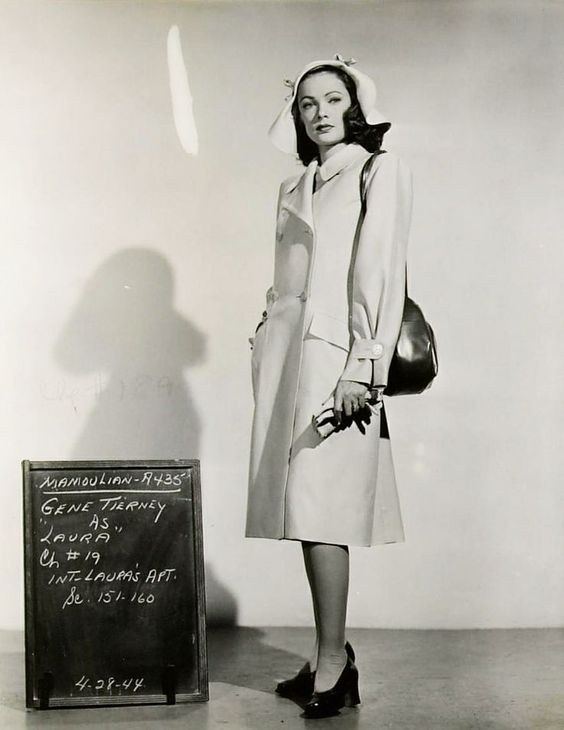
Costume Designer Bonnie Cashin

The movie basically consists of well-dressed rich people standing in luxury flats and talking to a cop. Roger Ebert

laura

I wasn’t designing for fashion, but for characteristics, which is the way I like to design clothes for daily wear. I like to design clothes for a woman who plays a particular role in life, not simply to design clothes that follow a certain trend, or that express some new silhouette.
laura1

Film noir is known for its convoluted plots and arbitrary twists, but even in a genre that gave us The Maltese Falcon, this takes some kind of prize … That Laura continues to weave a spell – and it does – is a tribute to style over sanity … All of [the] absurdities and improbabilities somehow do not diminish the film’s appeal. They may even add to it … [T]he whole film is of a piece: contrived, artificial, mannered, and yet achieving a kind of perfection in its balance between low motives and high style. What makes the movie great, perhaps, is the casting. The materials of a B-grade crime potboiler are redeemed by Waldo Lydecker, walking through every scene as if afraid to step in something

Roger Ebert

laura8According to Ula Lukszo, “clothes of the noir film – part of the noir Look – are essential to the nostalgia and fascination we associate with these films”. The same author suggests that “noir can be defined by fashion”, observing that noir films “contain common patterns of dress and related signifiers [that make] noir fashion a significant means of constructing noir into a contemporary genre and cultural fantasy”.

laura3I can afford a blemish on my character, but not on my clothes.

 laura5While it seems that styles portrayed in classic noir films are mere reflections of the popular styles at the time, giving the impression that clothing choices “reflect little more than everyday personal choices”, costumes in noir movies still retain their main function, characterization.

catwalk_yourself_laura-2jpgWherever we went, she stood out.”  It helps that the excellent costume design allows Laura to be all things to all people: Elegant, simple, romantic, feminine, and complimentary.

laura-10

Film noir relies on both the visual pleasure that resides in the costuming and the lighting of the film, and the emotional pleasure of seeing criminals punished and tough protagonists either dispensing “true justice (…) or succumbing to their transgressions. ( Lukszo)

laura2

 Laura had innate breeding, but she deferred to my judgment and taste. I selected a more attractive hairdress for her. I taught her what clothes were more becoming to her. Through me, she met everyone. The famous and the infamous. Her youth and beauty, her poise and charm of manner captivated them all. She had warmth, vitality. She had authentic magnetism. Wherever we went, she stood out: men admired her, women envied her. She became as well known as Waldo Lydecker’s walking stick and his white carnation. But Tuesday and Friday nights we stayed home, dining quietly, listening to my records. I read my articles to her. The way she listened was more eloquent than speech. These were the best nights. Then one Tuesday, she phoned and said she couldn’t come.

laura7No matter how undeniably inspiring the femme fatale in noir always is, I never really can bring myself to “walk the walk, talk the talk and dress the part”. Laura is a more approachable heroine in a sense that, throughout the narrative,  she seems to be a “self-made” woman in spite of what the men around her might think and beyond the femme fatale / “nurturing woman” dichotomy. There’s more to her than the “fantasy of the to-be-looked-at-ness“.

Photos and References

Laura

Tough Talk: 14 Unforgettable Film Noir Lines

Journeys in Classic Film

Noir women: “Laura” (1944)

Ula Lukszo,  Noir Fashion and Noir as Fashion in Munich, Adrienne (editor) Fashion in Film

One too many

Eyes blinded by the fog of things

cannot see truth.

Ears deafened by the din of things

cannot hear truth.

Brains bewildered by the whirl of things

cannot think truth.

Hearts deadened by the weight of things

cannot feel truth.

Throats choked by the dust of things

cannot speak truth.

Harold Bell Wright, The Uncrowned King

And yet, there is no amount of self help books, “keep it simple” formulas or declutter instructions that will tame the maximalist in me.  

A euphemism for self-indulgence most probably. 

The childhood of Cain

What men call the shadow of the body is not the shadow of the body, but is the body of the soul.

Oscar Wilde, A House of Pomegranates

 A Infância de Caim (The Childhood of Cain)

António Teixeira Lopes, 1890

Museu Nacional Soares dos Reis


Shadow

Gratitude

Blossoming Flamenca Lori from Fleur de Flamenco has gracefully and generously nominated my Closet stories for The Blogger Recognition Award! I must say I am very grateful and incredibly surprised and also very happy to be nominated by someone that I consider part of my “Flamenco family” and whose journey on “becoming the dance” I truly identify with. Gracias Guapa!

Here are the rules:

  • Thank the blogger who nominated you and provide a link to their blog.
  • Write a post to show your award.
  • Give a brief story of how your blog started.
  • Give two pieces of advice to new bloggers.
  • Select 15 other bloggers you want to give this award to.
  • Comment on each blog and let them know you have nominated them and provide the link to the post you created.

Story of how I started:

I started in 2013 not really knowing what I wanted to do. Almost four years later I am not sure that I have a clearer picture of what I am writing. While I try to keep a focus on the “emotional life of my closet”, I do tend to let my attention wander and get excited about a whole lot of different things. As with everything, I just don’t seem to be able to settle for just one thing.

Advice to new bloggers:

I don’t really feel qualified to give advice. I am not even able to follow the sensible voice in my head. Have fun, I suppose, get inspired by others. Stay passioned.

My  Wonderful nominations:

Wide Eyed in Wonder

Jules Verne Times Two

Roxy Moto

Too Mutch for Words

Do You See What I see?

VANERPADDEL

Inside the Life of Moi

Georg Papp

The View From My Window

A Walk in the Garden

Haiku out of Africa

The Naga

Sascha Darlington’s Microcosm Explored

A Cooking Pot and Twisted Tales

Renegade Expressions

blogger

Listening

10.06 am Train 122 to Lisbon

The woman wearing a green polyester dress and a fake fur jacket is a lawyer. She needs a plumber because the faucet in her bathroom is leaking. She hang up that call and is now talking to her friend Ritinha about her marriage and how taking confession at the Vatican with a Spanish priest has helped to cope and forgive even though she is still hurt. Maybe he cheated on her. She has decided to start her master’s degree. Maybe she will get to be a judge. She needs to work on her resume and then move to do a Doctorate, something on tax and fiscal law. Her friend has a better resume, it seems. Anyway, she wants to base her studies in practical cases so she doesn’t feel the pressure of the doctrine. Her son, Francisquinho stayed with her mother-in-law. Her husband António stayed in Porto. She doesn’t like to be alone. She is going to Coimbra to fix her diploma, the silver seal and the ribbons are missing. She had the diploma framed the minute she got it. She couldn’t resist. She hangs up. Her friend is probably busy.

12.30 pm 

We have arrived at Santa Apolónia Station. The smart looking old gentleman seating across the corridor has a beautiful engraved cane. I offer to take his bag down. He tells me that the only good thing about growing old is the young people who are willing to help. He reassures me that he was young once. 

1 pm blue line subway train

The lady wearing a tropical print maxi skirt is on the phone explaining she is late and that she has forgotten her check book. She will have to pay the deposit in cash.

1.20 pm Calouste Gulbenkian Museum

I register for the conference and buy the ticket to see the Almada Negreiros exhibition. I stop listening. Chance encounters and unexpected company bring out the chatterbox in me. 

4 pm international congress on Fernando Pessoa

The session is on “Fernando Pessoa the classicist”.  I seem to not really be listening to most of it. Athena magazine and the supreme art form. Inferior art is meant to please, average art should elevate you and the superior art sets you free. It makes your soul rise above everything that is narrow in life, by freeing you it goes beyond elevation which can only occur outside oneself. The supreme art frees you from within. Ricardo Reis and the classic form, syntactic analyses of five odes to a boy who is dead. Homoerotic poetry or simply a lyrical lament for the person that was and is no longer. Questions from the audience in academic conferences always tend to be transformed into frustrated presentations.

The beautiful blonde lady with flawless skin seating next to me comes to the conclusion that the more she searches for knowledge, the more she realizes that there’s just too much to be learnt.

5.30 pm coffee break

I run back to the exhibition room.I forgot to write down the references for some of the paintings. In a dark room Eros and Psyche shine from a rectangular stained glass panel. On the way out there’s a painting called “Family”. I have a replica bought at a jail art fair. It’s not very good, I just find it moving that it was painted by someone serving time in prison.

6 pm back at the conference hall

This is the session that made me travel today. Intellectual giants are still my superheroes.

Professor Eduardo Lourenço is 93. He is here, he says, as a ghost of himself. There is a new generation of experts who have the most admirable of qualities, they are alive and he had, for quite some time now, abdicated of giving presentations at events such as this one. But he came as “one of the victims of the fulgurating passage of that star, that absolute vampire who was Fernando Pessoa (…) because once the Pessoan Galaxy hits you, you are forever transfigured, blood and soul sucked out of you by the celestial vampire who bragged that he could be everything in every way”. And that makes him extraordinary and baffling. How can, Professor Gil, asks, one live with a shattered self? How is it that this person never sought to unify but could clearly understand himself and the world as parts without a whole, infinitely multiple. And the risk of madness, the divine folly of wanting to continuously devour everything, of becoming the interlocutor of everything by transforming even the most insignificant experience into an universal reaching reading of ourselves.

To feel everything in every way.
To feel everything excessively

7.50 pm the train will leave in 10 minutes

The man in scruffy blue overalls is telling the girl wearing a jersey in earthy tones that people now are very much attached to their pets because they know other people are going to be a disappointment. That is what’s wrong with the world. We are becoming irrational because of our egos and because of greed. We are losing our values, he says, we are losing our love for each other. And what happens when there’s no love? We live in terror, we loose ourselves. He has to go but before he does, he apologizes for his impassioned speech, “I can be a bit of a pain sometimes”.

10 pm we just left Coimbra. There’s never much talking in night trains, specially on a Friday.


Photo: Untitled, Almada Negreiros (1921) Watercolour on paper

Heard

This is not solitude, ’tis but to hold

solo

To sit on rocks, to muse o’er flood and fell,
To slowly trace the forest’s shady scene,
Where things that own not man’s dominion dwell,
And mortal foot hath ne’er or rarely been;
To climb the trackless mountain all unseen,
With the wild flock that never needs a fold;
Alone o’er steeps and foaming falls to lean;
This is not solitude, ‘tis but to hold
Converse with Nature’s charms, and view her stores unrolled.

But midst the crowd, the hurry, the shock of men,
To hear, to see, to feel and to possess,
And roam alone, the world’s tired denizen,
With none who bless us, none whom we can bless;
Minions of splendour shrinking from distress!
None that, with kindred consciousness endued,
If we were not, would seem to smile the less
Of all the flattered, followed, sought and sued;
This is to be alone; this, this is solitude!

George Gordon Byron

Photo: Flying to Poznan, June 2016

Solitude

Movie Inspiration of the Week – One from the Heart (1982)

Costume designer Ruth Morley

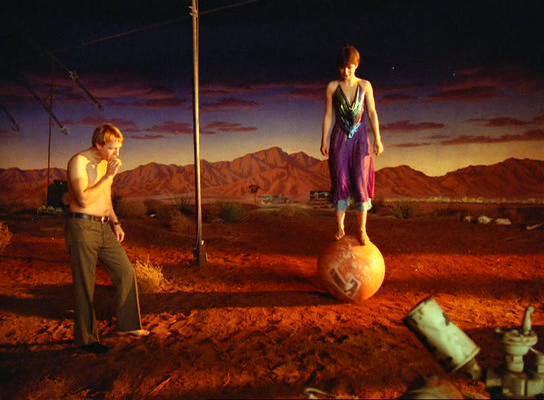
Considered by many Coppola’s worst movie and one of the biggest flops in film history, eventually leading to the director’s, and his company Zoetrope’s, bankruptcy, One from the Heart is a flamboyant and artificial musical following Frannie ( Teri Garr) and Hank (Frederic Forrest) 5th anniversary celebrations in their hometown Las Vegas during a 4th of July weekend.

one-heart_14 I can clearly see nothing is clear
I keep falling apart every year
Lets take a hammer to it
There’s no glamour in it
Is there any way out of this dream

one-from-the-heart-4Frannie works at Paradise Travel Agency and dreams of flying off to Bora Bora while lending her vivid imagination to the thematic window displays she sets up while Hank is the owner of a junkyard called Reality.

outsideI’m as blue as I can possibly be
Is there someone else out there for me
Summer is dragging its feet
I feel so incomplete
Is there any way out of this dream

Having met 5 years before over the 4th of July, reality has settled in and Frannie and Hank now struggle with the increasing boredom and disillusionment over each other. After an argument, Frannie decides to leave, taking refuge with her best friend Maggie (Lainie Kazan) while Hank finds solace near his best friend Moe (Harry Dean Stanton) and both decide to reinvent themselves through perms and haircuts, tailored funky suits and enticing red dresses and present new and alluring self-images to new prospective partners.

wp-1486323267133.jpegBecause I know I’ve been swindled
I never bargained for this
What’s more you never cared about me
Why don’t you get your own place
So you can live like you do
And I’m sick and tired of picking up after you

wp-1486321838868.jpegTake all your relatives and all of your shoes
Believe me I’ll really swing when you’re gone
I’ll be living on chicken and wine after we’re through
With someone I pick up after you

wp-1486321952651.jpegI got upset
I lost my head
I didn’t mean the things I said
You are the landscape of my dreams
Darling I beg your pardon

wp-1486321720320.pngWhile Frannie finds the excitement and adventure she’d been craving for with Ray (Raúl Juliá) the dark and handsome lounge pianist/waiter, Hank finds his new idealized partner in the otherworldly beautiful Leila (Nastassja Kinski) who decides to abandon her circus troupe.

wp-1486321792965.jpegSo little boy blue
Come blow your top
And cut it
Right down to the quick
Don’t sit home and cry
On the fourth of July
Around now you’re
Hitting the bricks

wp-1486322237699.jpegYou can’t unring a bell Junior
It’ll cost you to get out of this one Junior
She’s got big plans that don’t include you
Take it like a man

img_2228Everything is over the top and cartoonish and obviously fake. And it’s even maybe a little soppy and oversentimental and corny but it’s a tale of ordinary lives taking place in an extraordinary setting and narrated by a wonderful Tom Waits soundtrack.

wp-1486322737718.jpegI can’t tell
Is that a siren or a saxophone
But the roads get so slippery when it rains
I love you more than all these words can ever say
Oh baby
This one’s from the heart

img_2234While it might not be Coppola’s best, for me, in all its artificiality and melodramatic extravaganza, One from the Heart, is the musical that we, sometimes, can’t resist playing in our heads. We might not be able to sing but once in a while, we just can’t resist the daydreaming fantasy of having our little ordinary life soundtracked and choreographed.

wp-1486322927535.jpegI’m so sorry
That I broke your heart
Please don’t leave my side
Take me home
You silly boy
Cause I’m still in love with you

wp-1486321736590.jpegIn the end, Frannie does not board the flight taking her first to Los Angeles and then to Bora Bora with Ray. She goes back to Hank. True love always wins, or that’s probably the way a musical should end or, again, we like to believe the artifices we see on screen are real.

Photos via thredlist.com

Lyrics https://genius.com/albums/Tom-waits/One-from-the-heart-soundtrack

First ballet shoes

The pink of the leather turned out to be a lighter shade than I’d hoped, it looked like the underside of a kitten, and the sole was a dirty grey cat’s tongue, and there were no long pink satin ribbons to criss-cross over the ankles, no only a sad elastic strap (…)

Zadie Smith, Swing Time

I remember my first ballet shoes. After being accepted to the dance school, my mum took me to Porfirios in Rua Santa Catarina to buy the light blue leotard and skirt and that same kind of faded ballet pink leather shoes. I don’t actually remember the details but I remember the smell of those very first ballet slippers.

Scent is, in a way,  charged with history (…) the sense of smell is, as McLuhan stresses,” iconic”. In the same perspective, we could also say that it is the narrative epic sense. It brings together, weaves and condenses historic happenings into an image, into a narrative composition. 

Byung-Chul Han, The Scent of Time

Scent gives us back who we are by conferring some kind of stability to our own narrative, allowing us to make sense of ourselves by composing some sort of self-portrait. My childhood smells like new ballet shoes. This is a scent I have tried in vain to reencounter. New ballet shoes don’t have that exact smell anymore. In October last year, I bought new shoes. I prefer canvas to leather now and split soles and pre-sewn elastics. I haven’t been to ballet class yet. Life or some other excuse has been in the way.

It was also the aroma of possibilities, once they’re gone, they’re gone.

The Wharton School –  a critical house tour


Pictures representing life and action often grow tiresome when looked at over and over again, day after day.

There are but two ways of dealing with a room which is fundamentally ugly: one is to accept it, and the other is courageously to correct its ugliness.


Where much pattern is used, it must be as monotonous as possible or it will become unbearable.

Plain shelves filled with good editions in good bindings are more truly decorative than ornate bookcases lined with tawdry books.

Not only do mediocre ornaments become tiresome when seen day after day, but the mere crowding of furniture and gimcracks into a small room intended for work and repose will soon be found fatiguing.


The money spent on a china “ornament” in the shape of a yellow leghorn hat with a kitten climbing out of it would probably purchase a good reproduction of one of the Tanagra statuettes or a plaster cast of some French or Italian bust.

That cheap originality which finds expression in putting things to uses for which they were not intended is often confounded with individuality; whereas the latter consists not in an attempt to be different from other people at the cost of comfort, but in the desire to be comfortable in one’s own way, even though it be the way of a monotonously large majority.

It is one of the misfortunes of the present time that the most preposterouly bad things often possess the powerful allurement of being expensive.

Wharton rallied against the “black art” and “dubious eclecticism” that was the house decoration of her day. Thick curtains, dinner tables covered in velvet, bric-a-brac of the era, and “a great deal of gilding” were, in the mind of Wharton, totally out.

I still haven’t found the perfect velvet curtains for the living room.

References

Edith Wharton by Design

Lapham’s Quarterly

Exposure

Reinterpreting – Marchesa Luisa Casati

Casati was born Luisa Adele Rosa Maria Amman on January 23, 1881

Determined to become a “living work of art”, she lived her life as a reaction to her horror of the mundane, crafting herself into an otherworldly creature whose image was her voice.

Christian Dior Spring 1998 Couture

An outsized personality, hers was a life lived in performance.

Christian Dior Spring 1998 Couture

She was in herself and in her creations an unforgettable spectacle, and although by the time of her demise she had ceased to live a gilded existence, her legacy was not about to fade away

Christian Dior Spring 1998 Couture

But life as performance seems to bear the ingredients of tragedy. As described by Jean Cocteau,

As soon as she came out of her dressing room, the Marquise Casati received the applause usually given to a famous tragedian at her entry to the stage. It remained to act the play. There was none. This was her tragedy.


Is it the common choice of those who don’t feel that they belong or are seen (or feel themselves to be) as inadequate to choose being the performance of self over being oneself?

Tilda Swinton by Paolo Roversi

Age cannot wither her, nor custom stale her infinite variety
William Shakespeare 

Anthony and Cleopatra

References

An Ode to the Singular Marchesa Luisa Casati

Anarchists of Style: Marchesa Luisa Casati

Marchesa Casati Goth, Glamorous and Wild 

http://www.vogue.com/fashion-shows/spring-1998-couture/christian-dior

Mozambique 97

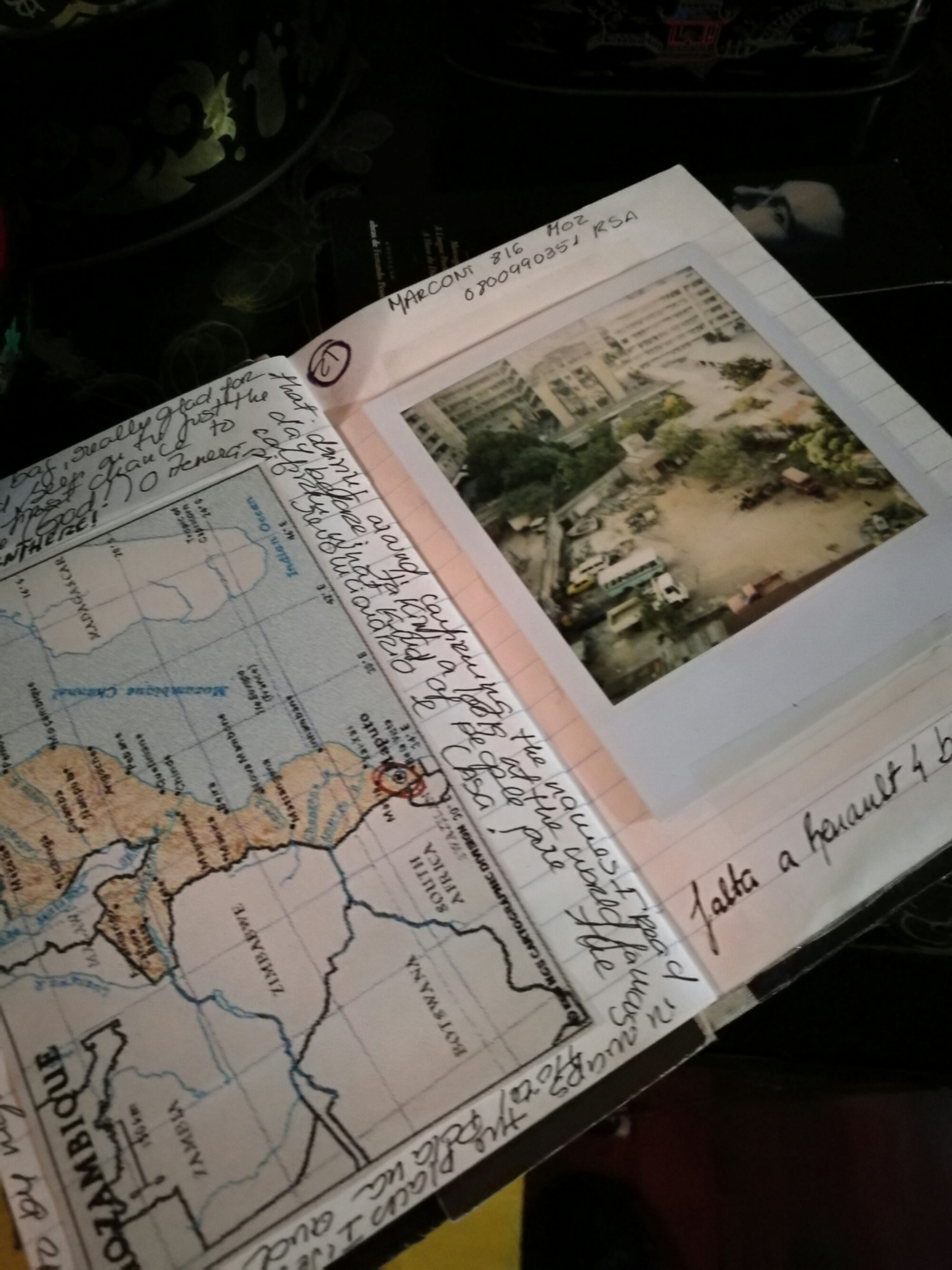
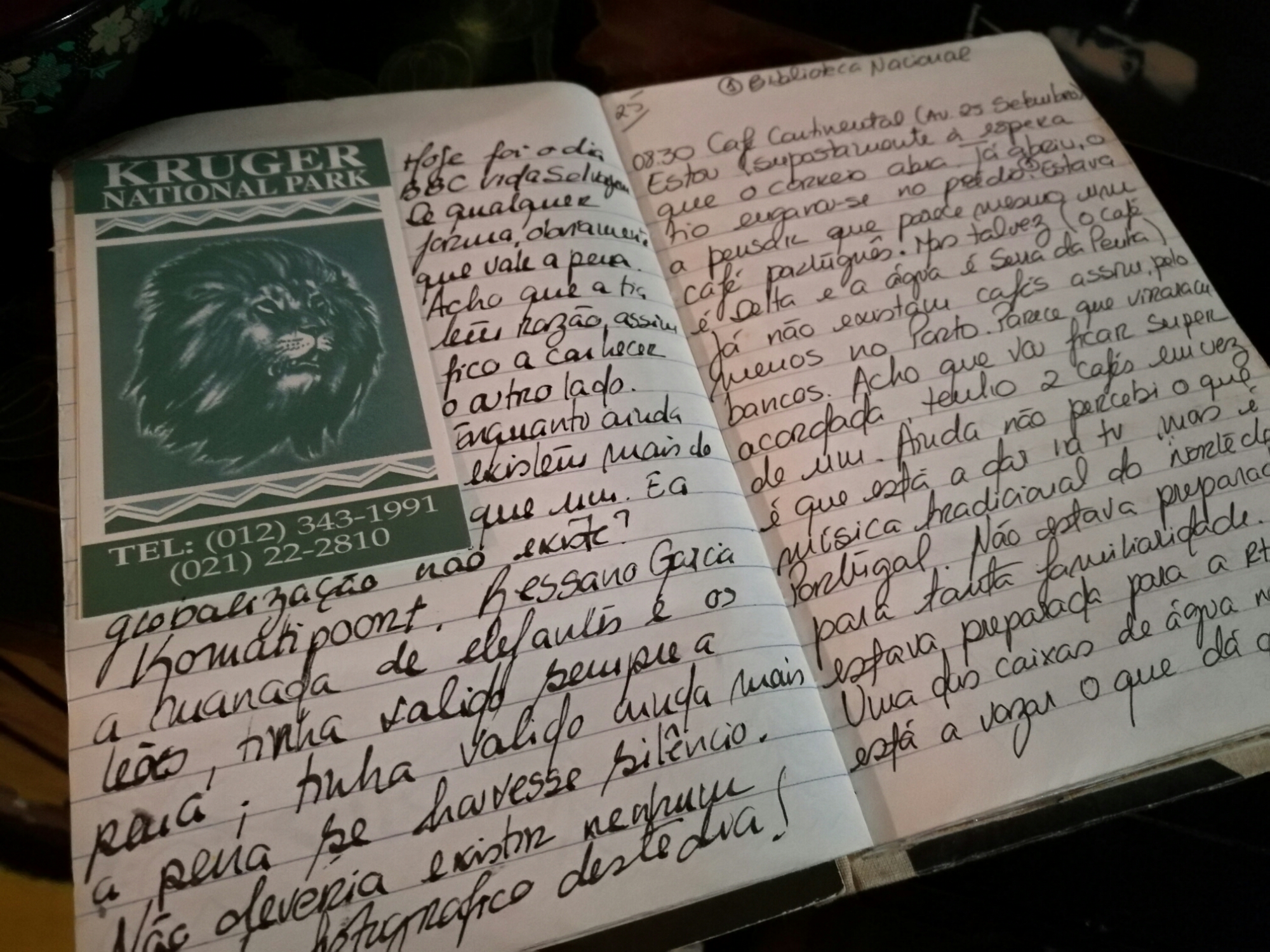
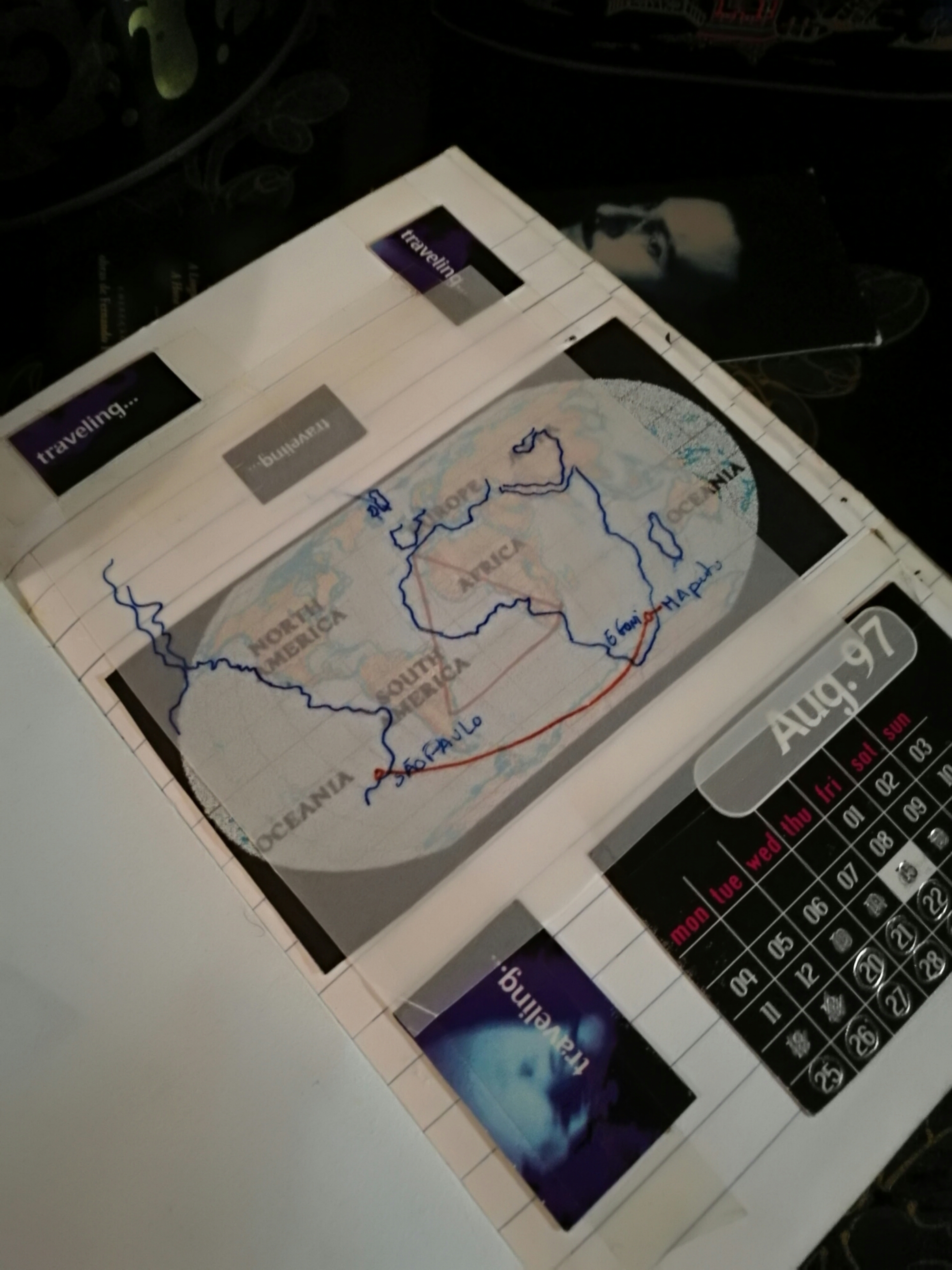
In August 1997 I travelled from Brazil, where I was on vacation with my parents, to Maputo where I stayed for a while with an uncle who was working there at the time. These are pages from my travel diary.

After six days in Porto Alegre, a city I was quite familiar with during my teens and early twenties, I flew to São Paulo to get on the flight to Beijing which had its first stop in Johannesburg.

At Guarulhos I waited,  trying to read Raygun magazine’s special issue on Cinema and Music.

I think my mistake was that I thought you could live the things that you acted. But I realized that that wasn’t the case. Then I realized that I would be better suited to try to do that but without an audience. To pretend I was in the movies all the time, basically. And to try to create a narrative flow out of actions, and sequences and events.

Will Oldham in that Raygun Magazine

My mum made me promise I wouldn’t get out of the airport in Johannesburg during the six-hour-long layover. I did. I took a taxi and Philly drove me downtown to Museum Africa and drove past Ponte Tower and took me to Ellis Park and the flea market in Gateway and told me I should walk around Carlton Center and I remembered that my mum used to talk about this place. There were people playing chess on a gigantic board. I was born in Johannesburg. How could I not go out?

I arrived in Maputo at night. My uncle, my aunt and my cousin picked me up and drove me home, a big apartment in Avenida Albert Lutuli, overlooking the Aga Khan foundation from the living room and the car park on the Polaroid from my bedroom.

I went to Mozambique to do research on forced labour migration. Most of my first weeks were spent at the library of the Provincial Culture Centre in Rua do Bagamoyo, former Rua do Araújo in the also former “red light district” of the former Lourenço Marques.

The long balcony of the former brothel was where I spent my smoking breaks. Across the street there was a Pensão (I suppose a hostel by now) and the life of the Dutch couple staying there became also some sort of voyeuristic break. Under the balcony, every day, the same lady selling matchboxes danced to her own rhythmic section when she got bored.

This how research turned mostly into contemplation of life by the Indian Ocean.

Every morning I would pretend to be a morning person and go downtown at 6.30, have coffee at the Scala or the Continental and wait for the library to open while marvelling at the long line of men and women getting their shoes polished. We are proud of our shoes, Professor C. tells me. Most of us only have one pair, most probably handed down, we have to keep them looking new.

Before my aunt and my cousin go back to Portugal we go to Nelspruit to do some supermarket shopping. It felt like the old ritual of crossing the border to go to Tui or Vigo in Galicia for the same purpose before there were “free markets” and you could buy the same sort of things on the Portuguese side at the border. We get to Ressano Garcia and there are long lines of people and cars to cross to Komatipoort. I walk around amazed at the chaos of this mythical place that I knew only from books. It’s dirty and crowded. On the other side, I don’t have to wait, my passport is South African and everyone thinks I am American because of my accent. Nelspruit looks like a giant supermarket where people buy giant tins of butter. I had never seen a tin of butter before. We spend the night at a lodge near the Kruger Park and go visit the next day. There’s no diary entry for this. There are hundreds of photos and boxes of photographic slides (!) I still can’t find the words to tell anyone what it felt like.

My aunt and cousin return to Portugal in time for the start of the school year. I stay on with my uncle and Olga who worked as a cleaner and cook at the flat and was now a single mother of two after her husband left. We had fun together. There was a fabric warehouse just around the corner from our flat and we often went to buy capulanas and play dress up. With my uncle, there were a lot of arguments about how to “behave in Africa” and how to deal with “things you know nothing about”.

Outside, there was still a whole world to be explored and a lot of bureaucracy to deal with when trying to get authorization to see archives. The upstairs neighbour who owned the liquor store in Avenida Josina Machel tells on me because she saw me walking home. It’s not appropriate. Apparently.

I spend two days reading labour legislation at the Ministry. The intern there just got a scholarship to go to Holland to study for a Masters degree. He’s happy is not heading to Portugal to do that. I then move to the National Film Institute. I had an amazing two weeks in this place just watching movies and making friends.

Everywhere, I am surrounded by words and images and words and images that always have some sort of political meaning. And writers, and artists and liberation activists and foreign journalists that have stayed on after the colonial war was over. And Italians that have become African and don’t even speak Italian anymore. And generous souls that have shared pieces of their lives and changed mine.

Re-living these pages I am, sometimes, amazed at what I have written. From quotes of Ruth First and Margot Dias to somewhat futile accounts of every little detail of every walk around the city, every coffee, every encounter.

I didn’t want to risk missing a thing. I didn’t want to risk losing the memory of the place and of the people.

Re-living these pages, I am really sorry that I haven’t kept the habit of writing travel diaries. Re-reading some of these pages, I realise they are actually a script for the adventure movie of that African winter.


Movie Inspiration of the week

Marguerite (2015)

Costume Designer: Pierre-Jean Larroque. César Best Costume Design (Meilleurs costumes)

I did not see this movie when it came out, I’ve watched it on TV on Christmas Eve. As with Florence Foster Jenkins (2016) , Marguerite is also inspired by the life of the “world’s worst opera singer“. While Stephen Frears‘ film (that I did not see)  is set in 1940s New York, director Xavier Gianolli, tells Marguerite’s story in Paris during the Golden Twenties. Since the 20s are my “in the wrong place at the wrong time” period in history, this little detail makes all the difference. Not only because Pierre-Jean Larroque’s period costumes are exquisite but also because the story benefits from the social, cultural and artistic  context of European avant-gardism.
marguerite-backdrop

This is a story of passion without talent. Not of a simple love of music but of a vital need to express that love. The  Baroness Marguerite Dumont loves opera and wants to be loved by her cheating husband through her talent as a venerated soprano, creating a dream world enabled by the butler / photographer  Madelbos and her own wealth, pleasant disposition and childlike enthusiasm that prevent everyone around her from telling her how excruciatingly bad she is. 

Marguerite creates a dream world helped by Madelbos, the butler, who protects her from the harsh reviews and mockeries of the outside world but also turns her and the elaborate photo shoots of delusional Diva roles into his own personal artistic project. For that he is willing to let her die and this was, for me, the darkest side of the movie. While this is a thoroughly beautiful and  inspirational look at the nature of art and the value of a dream it is also a bitter reflection on the use of others as the object / subject of that art.

marguerite_movie

While Florence Foster Jenkins might have never known just how terrible she was, Marguerite does get to know and that ends up not making Life possible anymore.