Sophie’s Misadventures

There are books that entertain us, books that educate us, and then there are books that find us exactly when we need them most. For me, that book was “Les Malheurs de Sophie” by Comtesse de Ségur—a slim volume about a mischievous little French girl whose disasters somehow made perfect sense to a kid who never quite fit the mold.

Sophie was gloriously, unapologetically flawed. She cut her own hair with disastrous results. She melted her favorite wax doll into puddles. She fed her goldfish bread until they died, convinced she was being kind. She broke things, lost things, and approached the world with a curiosity that invariably led to chaos.

Reading about Sophie’s misadventures felt like looking into a mirror—not because I was destructive, but because I recognized that particular brand of being misunderstood. Sophie’s logic made sense to her, just as my own odd thoughts and interests made sense to me. The adults in her world sighed and shook their heads, much like the grown-ups in mine did when I asked too many questions or got excited about things other kids found boring.

What struck me most wasn’t Sophie’s misbehavior, but her earnestness. She wasn’t trying to be difficult—she was genuinely trying to figure out how the world worked, often with spectacularly wrong conclusions. Her attempts at helpfulness backfired. Her creative solutions created bigger problems. Sound familiar to anyone who’s ever felt like they’re speaking a different language than everyone else?

Comtesse de Ségur didn’t write Sophie as a cautionary tale or a perfect little angel. She wrote her as a real child—impulsive, curious, sometimes selfish, often confused, but fundamentally good-hearted. For a kid who felt like their own thoughts and reactions were somehow “wrong,” Sophie was revolutionary. Here was a character who made mistakes not out of malice but out of a different way of seeing the world.

Yes, “Les Malheurs de Sophie” was written as a moral tale for children, complete with consequences for poor choices. But what I absorbed wasn’t the moralizing—it was the acceptance. Sophie was loved despite her flaws. Her stepmother, Madame de Réan, was patient and kind. Even when Sophie’s plans went awry, she wasn’t rejected or labeled as “difficult.” She was guided, corrected, and most importantly, understood.

This was radical for a child who often felt like an inconvenience, whose questions were too complex, whose interests were too intense, whose emotional reactions seemed too big for the situations that prompted them. Sophie’s world had room for misfits. It suggested that being different wasn’t a character flaw to be fixed, but simply another way of being human.

Sophie stumbled through her childhood making mistake after mistake, but she was never written off. Her curiosity, even when it led to disaster, was treated as a fundamental part of who she was.

For kids who feel like they’re always getting it wrong—who are too loud or too quiet, too interested in the wrong things, too sensitive or not sensitive enough—Sophie’s story offers a different narrative. It says that the children who don’t fit neatly into expected boxes aren’t broken; they’re just Sophie-shaped instead of conventional-shaped, and that’s perfectly fine.

Sometimes the books that save us aren’t the ones with grand adventures or profound wisdom. Sometimes they’re the quiet stories about girls who cut their own hair badly and love too hard and make beautiful messes of simple tasks. Sometimes they’re about finding yourself in a character who proves that being odd isn’t a failing—it’s just another way of being wonderfully, complexly human.

Years later, I discovered that Sophie’s story had found another voice entirely. Clarice Lispector’s “Os Desastres de Sofia” deliberately borrows its title from the Comtesse de Ségur’s work, creating a literary dialogue across centuries and cultures. But where Ségur’s Sophie was a child navigating social expectations through innocent mischief, Lispector’s Sofia embodies something far more complex—the devastating intensity of a nine-year-old girl who terrorizes her teacher not out of malice, but out of a desperate, unconscious attempt to wake him up to life itself.

Lispector’s Sofia sits in the back row, speaks loudly, stares defiantly, and disrupts her teacher’s lessons with the same earnest confusion that characterized her French predecessor. But this Sofia operates on a deeper psychological level—she acts “moved by a binary impulse of rage and love, in the confused hope of awakening him to life”. She sees through to her teacher’s cowardice, his retreat from living, and her child’s wisdom compels her to try to save him, even though she doesn’t understand what she’s doing or why.

The parallel between these two Sofias reveals something profound about the archetype of the misfit child. Both represent children whose inner logic operates differently from social expectations, but where Ségur’s Sophie learns to conform, Lispector’s Sofia remains uncompromisingly true to her authentic self, even when it leads to psychological devastation. The Brazilian Sofia’s story ends not with moral lessons learned, but with the recognition that some kinds of wisdom—the kind that sees too clearly—come at a terrible price.

Reading Lispector’s take on Sofia later in life illuminated something I hadn’t fully grasped as a child: that the discomfort other people feel around “difficult” children isn’t always about the child’s behavior—it’s often about the truths the child unconsciously exposes. Both Sofias, in their different ways, hold up mirrors that adults find uncomfortable to look into.

This literary conversation between the two Sofias suggests that the experience of being an outsider child isn’t just about personal struggle—it’s about carrying a different kind of perception that the world both needs and resists. The French Sophie learns to channel her uniqueness into acceptable forms; the Brazilian Sofia shows us what happens when that channeling fails, when the child’s vision remains too pure, too uncompromising.

For those of us who grew up feeling like we saw the world through a different lens, both Sofias offer validation: the first showing us we can belong while remaining ourselves, the second honoring the parts of us that perhaps never quite learned to fit, that remained forever a little too intense, a little too perceptive, a little too willing to speak uncomfortable truths.

Tokio ya no nos quiere

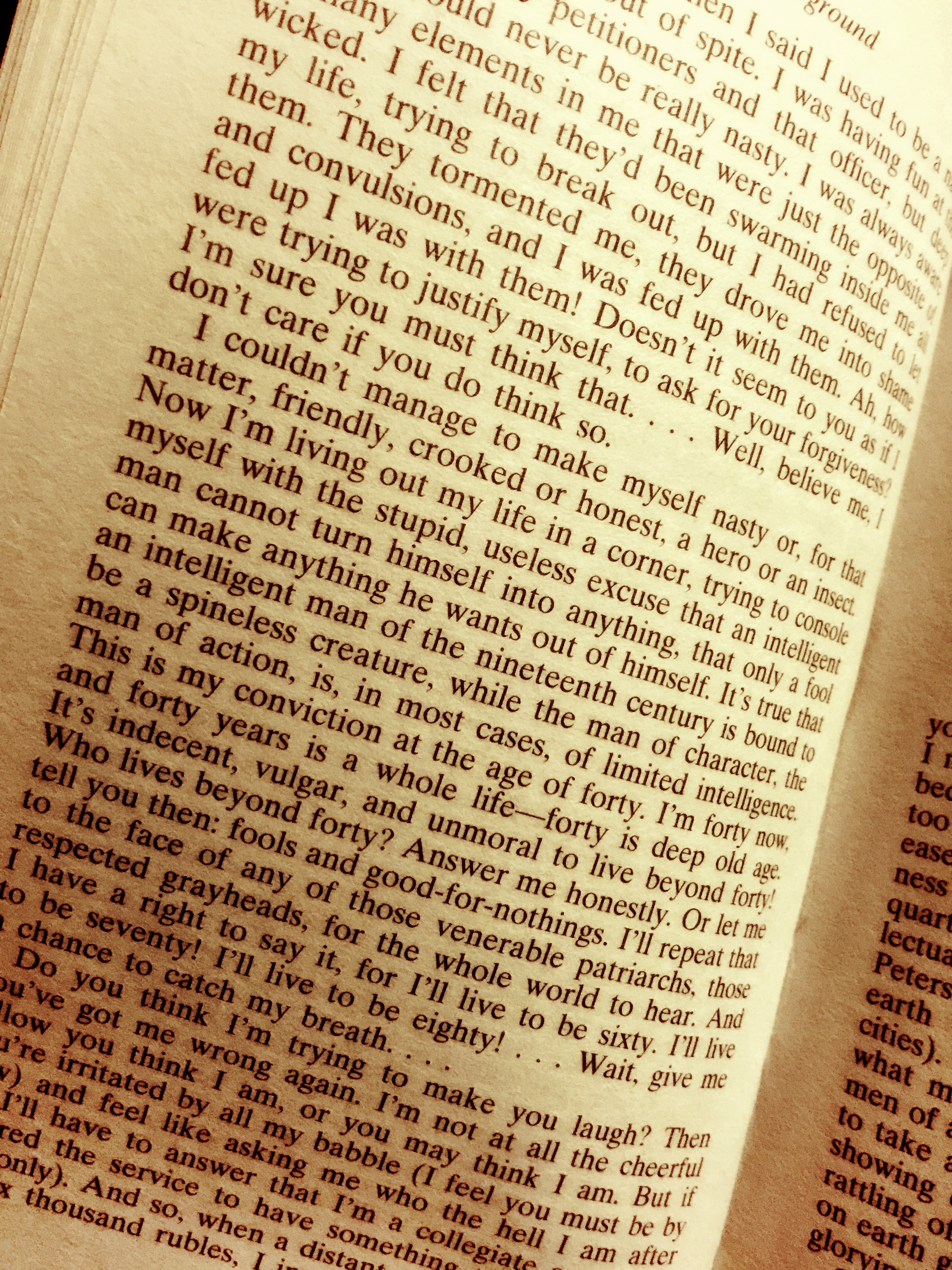
Other than The Stranger by Albert Camus that I have first read when I was 12 and had to re-read years later, for obvious reasons, I do not tend to return to books I’ve already read unless I’m reading for work.

If I had to choose one to go back to, I would probably settle on Tokyo Doesn’t Love Us Anymore by Ray Loriga.

Published in 1999, this prescient work examines themes that have only grown more relevant: the fragility of memory, the construction of identity, and our desperate attempts to escape emotional pain.

The unnamed protagonist works as a traveling salesman for a corporation that manufactures and distributes memory-erasing drugs. He traverses a near-future landscape of international cities—Tokyo, Barcelona, Los Angeles—selling his wares to those desperate to forget traumas, heartbreaks, and regrets. As he helps others erase their pasts, he increasingly samples his own product, gradually eroding his own identity in the process.
What makes Loriga’s narrative particularly compelling is how it positions memory erasure not as science fiction but as a logical extension of our pharmaceutical culture. The protagonist doesn’t view himself as peddling something extraordinary, but rather as providing a service comparable to antidepressants or sleep aids—just another chemical solution to human suffering.

The novel poses a profound question: If we are, essentially, the sum of our memories, what happens when we selectively delete parts of our past? The protagonist’s steady deterioration as he abuses memory-erasing drugs illustrates the devastating consequences. Without the anchoring force of his personal history, he drifts through existence as a hollow shell, unable to form meaningful connections or understand his own desires and fears.  Loriga’s spare prose mirrors the protagonist’s fractured psyche, leaving readers to question: If we erase our pain, what remains of our humanity?

At its core, Tokyo Doesn’t Love Us Anymore is a meditation on memory’s role in shaping identity. Loriga asks: Are we more than the sum of our experiences? The novel’s dystopia isn’t ruled by tyrants but by a collective yearning to numb the soul. Memorama, the drug, becomes a metaphor for modern escapes—social media, substances, consumerism—that promise freedom but deliver alienation.

Tokyo is both setting and symbol. Loriga paints it as a glittering ghost town, where skyscrapers pulse with artificial light but human connection flickers out. The protagonist wanders through love hotels, karaoke bars, and rain-soaked alleyways, each locale steeped in loneliness. Unlike the chaotic vitality of real-world Tokyo, this city feels like a screensaver—vivid yet void. It’s a backdrop that recalls Blade Runner’s dystopia but feels eerily adjacent to our tech-saturated present.

Our salesman is no hero. He’s a hollow man, a mirror for the reader’s complicity in systems of escape. His internal monologue—terse, fragmented—reveals a soul gasping for meaning. When he muses, “I sell what I need most,” we glimpse Loriga’s critique of capitalism’s cycle of creation and consumption. The character’s anonymity amplifies his universality: he could be anyone, anywhere, trading fragments of self for fleeting peace.

In 2025, as AI filters our realities and “digital detox” enters the lexicon, Tokyo Doesn’t Love Us Anymore reads like a prophecy. It challenges us to ask: What do we lose when we prioritize comfort over growth? The novel doesn’t offer answers but lingers like a phantom limb, reminding us that pain and joy are inseparable threads in the fabric of self.

Ray Loriga’s book is not a love letter to Tokyo but a requiem for the modern soul. It’s a slim, sharp novel that cuts deeper with each read, leaving readers to wonder: Would I take the pill? As you close the book, Tokyo’s neon fades, but the question remains, glowing in the dark.

FREEDOM & MEMORY: THE RAY LORIGA INTERVIEW

Impermanence

I stumbled upon this quote by Béla Tarr on A Bitter Sweet Life:

I don’t care about stories. I never did. Every story is the same. We have no new stories. We’re just repeating the same ones. I really don’t think, when you do a movie that you have to think about the story. The film isn’t the story. It’s mostly picture, sound, a lot of emotions.

And, I remembered that one of the first movies that made me feel the same was Peter Greenway’s The Pillow Book, beautiful to behold and impossible to forget. I can’t remember the story but I do remember feeling spellbound by its visual poetry and the idea of being a living book. Greenway employs multiple aspect ratios, picture-in-picture compositions, and superimposed calligraphy that transforms the screen into a living, breathing manuscript. Bodies become canvases, and ink becomes an extension of desire. The film’s approach to visual composition mimics the practice of calligraphy itself—disciplined yet sensual, structured yet flowing with emotion.

It took me another 10 years to get my first tattoo and it was not a written one. I had a leopard done in Johannesburg because I was born in South Africa and the leopard is one of the Big 5. When I finally decided to have something written, I was in San Diego in 2014. For a full 5 hours or so, someone patiently wrote Macbeth’s soliloquy in Act 5 Scene 5 on the right side of my rib cage. Surprisingly, there was no pain. The tattooer, who was very young, asked why I had chosen such a strange thing. I wanted to be constantly reminded of the fleeting nature of life and meaning, I said.

After I got divorced, Richard II was written on my right tight under the leopard. I wasted time and now doth time waste me.

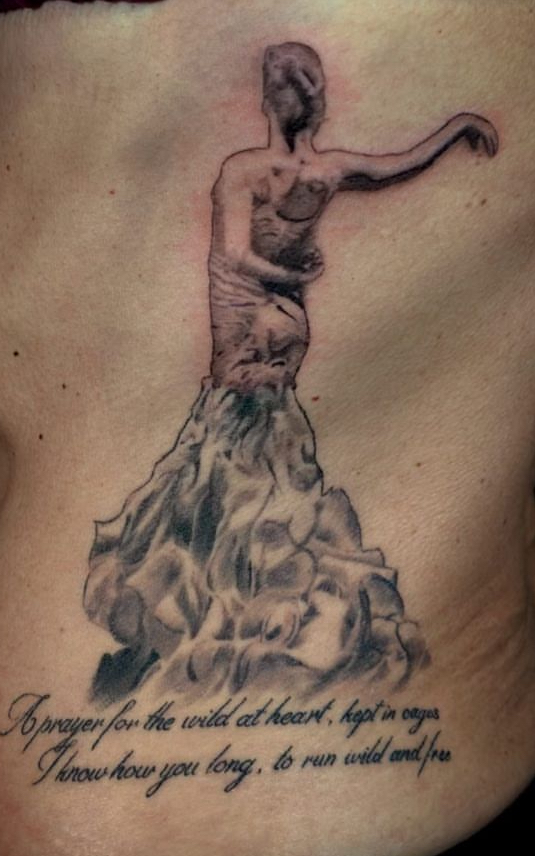
My last one was done in 2024, a very common tattoo written under a flamenco dancer on my left rib cage. Tennessee Williams’ first verses of A Prayer for The Wild at Heart. The tattoo artist thought that having the whole poem would be over the top.

I wanted to show, even though they are not visible, that for me there’s nothing more important than literature. Particularly the one exploring human struggles, mortality, and the desire for freedom.

The “Pillow Book” connection made perfect sense now – like the film, I was using my body as a canvas for meaningful text. Yes, I could use paper, but text on skin becomes something more intimate and embodied than words on a page. I also see them as a way of relating my reminder’s of life’s impermanence and the tension between duty and desire to the struggles of everyone else.

I am now thinking of getting a tattoo of goddess Athena. I have to find suitable words.

There. There you are. You have just dropped a marker pin on your body, to reclaim yourself, to remind you where you are: inside yourself. Somewhere. Somewhere in there
Caitlin Moran, How to Be a Woman

The unlived life of N S

The unexamined life is surely worth living, but is the unlived life worth examining?

I think Stanley Kubrick actually captured something similar when he said “The truth of a thing is in the feel of it, not the think of it.”

While Socrates emphasized reflection as crucial to a meaningful life, there needs to be something substantive to reflect upon. Pure contemplation without lived experience could become a kind of hollow philosophical exercise.

There’s a point where self-reflection can spiral into a kind of paralytic introspection or self-commiseration.

When examination turns into rumination, we find ourselves in an echo chamber of our own thoughts. This detaches us from the vitality of direct experience. Excessive self-examination can also drain experiences of their natural meaning and immediacy.

Yet, I wonder if the issue isn’t with examination itself, but with its nature and purpose. There’s a difference between examination that enriches our engagement with life – helping us understand our patterns, make better choices, appreciate moments more fully – and examination that becomes a form of self-absorbed withdrawal from life.


A little more sun – I’d have been embers,
A little more blue – I’d have been beyond.
To reach it, I lacked the stroke of wings…
If only I had stayed beneath…

Wonder or peace? In vain… All faded
In a vast, deceitful sea of foam;
And the grand dream awakened in mist,
The grand dream – oh pain! – almost lived…

Almost love, almost triumph and flame,
Almost the beginning and end – almost expansion…
But in my soul, everything spills out…
And yet nothing was mere illusion!

Everything had a start… and all went astray…
– Oh, the pain of being – almost, endless pain…
I failed others, failed myself,
A wing that entwined but didn’t fly…

Moments of soul that I squandered…
Temples where I never raised an altar…
Rivers I lost without leading to the sea…
Yearnings that passed but I never held…

If I wander, I find only traces…
Gothic arches toward the sun – I see them closed;
And hands of heroes, without faith, cowardly,
Set bars over the precipices…

In a diffuse impulse of despair,
I began everything and possessed nothing…
Today, of me, only disillusion remains,
Of the things I kissed but never lived…

A little more sun – and I’d have been embers,
A little more blue – and I’d have been beyond.
To reach it, I lacked the stroke of wings…
If only I had stayed beneath…


(AI translation)

Here's the original poem, Quase by Mário de Sá Carneiro:


Um pouco mais de sol – eu era brasa,
Um pouco mais de azul – eu era além.
Para atingir, faltou-me um golpe de asa…
Se ao menos eu permanecesse aquém…

Assombro ou paz? Em vão… Tudo esvaído
Num grande mar enganador de espuma;
E o grande sonho despertado em bruma,
O grande sonho – ó dor! – quase vivido…

Quase o amor, quase o triunfo e a chama,
Quase o princípio e o fim – quase a expansão…
Mas na minh’alma tudo se derrama…
Entanto nada foi só ilusão!

De tudo houve um começo … e tudo errou…
– Ai a dor de ser – quase, dor sem fim…
Eu falhei-me entre os mais, falhei em mim,
Asa que se enlaçou mas não voou…

Momentos de alma que, desbaratei…
Templos aonde nunca pus um altar…
Rios que perdi sem os levar ao mar…
Ânsias que foram mas que não fixei…

Se me vagueio, encontro só indícios…
Ogivas para o sol – vejo-as cerradas;
E mãos de herói, sem fé, acobardadas,
Puseram grades sobre os precipícios…

Num ímpeto difuso de quebranto,
Tudo encetei e nada possuí…
Hoje, de mim, só resta o desencanto
Das coisas que beijei mas não vivi…

Um pouco mais de sol – e fora brasa,
Um pouco mais de azul – e fora além.
Para atingir faltou-me um golpe de asa…
Se ao menos eu permanecesse aquém…


Yes, that “agony of the almost” is the heart of what makes this poem so powerful and painful. Sá-Carneiro captures something uniquely torturous about consciousness – not just the pain of failure, but the specific suffering that comes from knowing you came close and fell short. All the intention was there – just not the final decisive action. It’s the difference between never having talent and having talent you squandered.

There’s also something especially modern about this kind of suffering. In earlier times, one’s path might have been more predetermined by circumstances. But now, we face a growing burden of choice and possibility. This makes the failure to realize potential feel like a personal shortcoming instead of an external limitation.

And, again, the same question, is the unlived life worth examining? Awareness itself can be a curse. As Sá-Carneiro, we don’t just lament missed opportunities, but also knowing about them – and wish we “had stayed beneath.” Self-reflection does have a potential to become self-commiseration – when awareness of what could have been overwhelms and paralyzes rather than motivates. And we stay trapped between worlds – neither fully engaged in life nor able to transcend it (“To reach it, I lacked the stroke of wings…”)

If, as Joan Didion wrote “We are well advised to keep on nodding terms with the people we used to be, whether we find them attractive company or not”, we might as well learn how to come to terms with the people we did not become.

References
Adam Phillips, Missing Out: In Praise of the Unlived Life

What’s in a name

Sonnet 30: When to the sessions of sweet silent thought
BY WILLIAM SHAKESPEARE


When to the sessions of sweet silent thought
I summon up remembrance of things past,
I sigh the lack of many a thing I sought,
And with old woes new wail my dear time’s waste:
Then can I drown an eye, unus’d to flow,
For precious friends hid in death’s dateless night,
And weep afresh love’s long since cancell’d woe,
And moan th’ expense of many a vanish’d sight;
Then can I grieve at grievances foregone,
And heavily from woe to woe tell o’er
The sad account of fore-bemoaned moan,
Which I new pay as if not paid before.
But if the while I think on thee, dear friend,
All losses are restor’d, and sorrows end.

In 1937, the Soviet Writers’ Union instructed its members to sign a manifesto supporting the death penalty for General Yona Yakir and Marshal Mikhail Tukhachevsky, who were accused of conspiracy. During the Union’s congress, when Pasternak refused to sign this manifesto, everyone thought he would be arrested. When he stood up to speak at the congress, he only said “30” and 2,000 people stood up and recited Sonnet 30. This story is told by George Steiner here, because knowing a poem by heart is a form of resistance (like in Fahrenheit 451). During the years when Mandelstam was imprisoned (he died during this time), his wife, Nadezhda, memorized and taught others everything he had written so that after Stalin’s death, she could finally publish it.

Nadezhda (Надежда) is the Slavic and original form of my name. It means “hope.”

This is a powerful story about literary resistance in the Soviet era. The name Nadezhda is particularly meaningful in this context – the concept of hope was especially significant during the dark periods of Soviet repression. Nadezhda Mandelstam’s act of preserving her husband’s poetry through memorization became one of the most famous examples of maintaining cultural memory under totalitarianism. Her memoir “Hope Against Hope” is considered one of the most important accounts of life during the Stalinist period.

Nadezhda (Надежда) holds deep cultural and spiritual significance in Slavic culture, particularly in Russian tradition. Let me elaborate:

In religious context, Nadezhda is one of the three theological virtues celebrated in Orthodox Christianity, alongside Vera (Faith) and Lyubov (Love). This trinity is so important that there’s a feast day (September 30) celebrating Saint Sofia and her three daughters named after these virtues. The story of their martyrdom has made these names particularly meaningful in Orthodox Slavic culture.

The concept of hope (nadezhda) appears frequently in Russian literature and poetry. For example, in Pushkin’s works, hope is often portrayed as a light in darkness, reflecting the Russian cultural understanding of hope as a sustaining force during difficult times. This resonates deeply with how the name was embodied by Nadezhda Mandelstam.

In everyday Russian culture, the name is often shortened to Nadya (Надя), which maintains its warm, positive associations while being more informal. The name was particularly popular during the Soviet era, perhaps as a reflection of people’s need for hope during challenging times.

Interestingly, in Slavic naming traditions, names were often chosen for their protective or aspirational qualities. Giving a child the name Nadezhda was seen as bestowing them with the quality of hope itself, making them both a bearer and symbol of hope for their family and community.

There’s also a fascinating linguistic aspect: the word nadezhda is related to the Old Church Slavonic word “надѣяти” (nadeyati), meaning “to lay upon, to rely on.” This etymology suggests that hope in Slavic culture isn’t just about optimism for the future, but about having something solid to rely on – a more grounded, resilient kind of hope.

Or, quoting Nick Cave in Faith, Hope and Carnage, ‘Hope is optimism with a broken heart’. 

Is this then a book

Os Livros

É então isto um livro,

este, como dizer?, murmúrio,

este rosto virado para dentro de

alguma coisa escura que ainda não existe

que, se uma mão subitamente

inocente a toca,

se abre desamparadamente

como uma boca

falando com a nossa voz?

É isto um livro,

esta espécie de coração (o nosso coração)

dizendo “eu” entre nós e nós?

Manuel António Pina

Books

Is this then a book,

this, how shall I say? murmur,

this face turned to the inside

of something dark that doesn’t yet exist,

that if touched

by a suddenly innocent hand

opens helplessly

like a mouth

speaking in our own voice?

Is this a book,

this kind of heart (our heart)

saying ‘I’ between we and us?

Translated by Ana Hudson

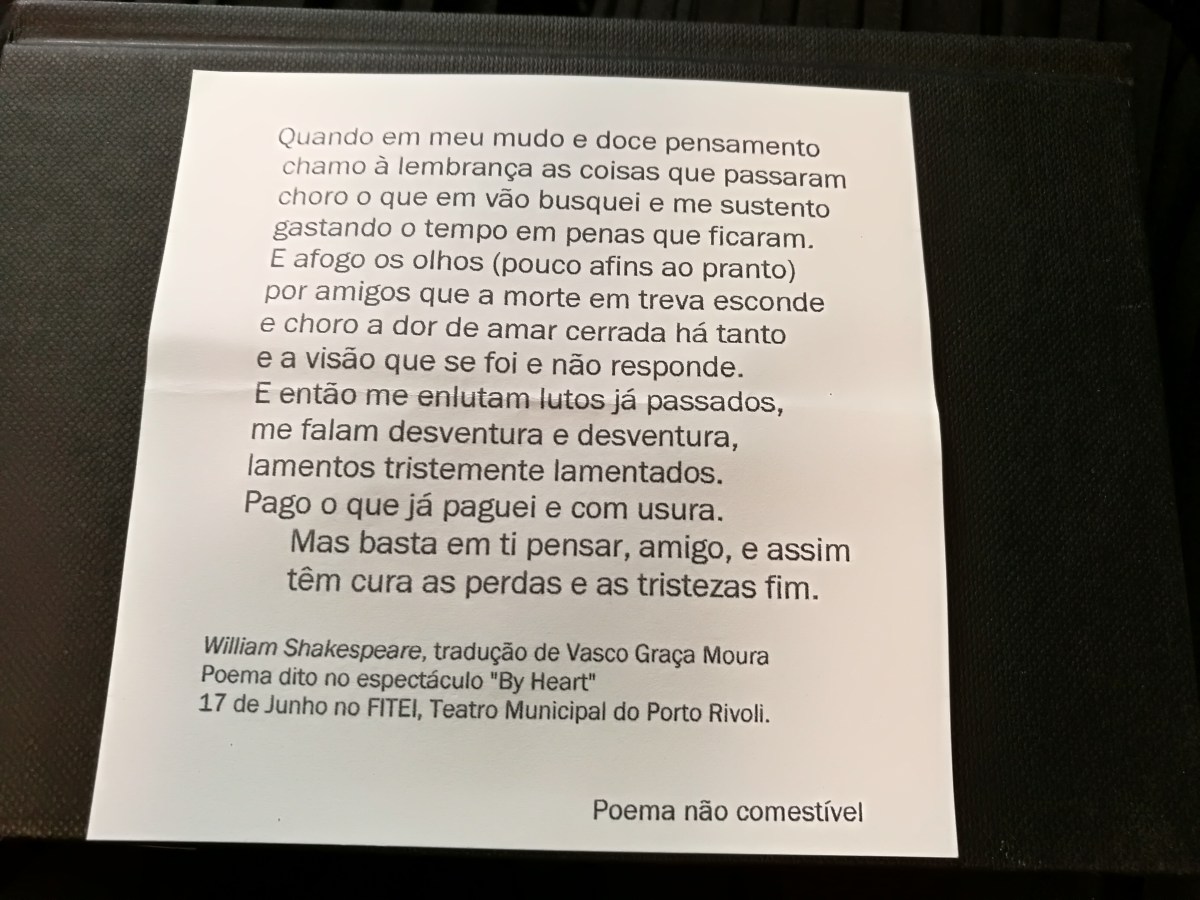
By heart

When to the sessions of sweet silent thought

I summon up remembrance of things past,

I sigh the lack of many a thing I sought,

And with old woes new wail my dear time’s waste:

Then can I drown an eye, unus’d to flow,

For precious friends hid in death’s dateless night,

And weep afresh love’s long since cancell’d woe,

And moan th‘ expense of many a vanish’d sight;

Then can I grieve at grievances foregone,

And heavily from woe to woe tell o’er

The sad account of fore-bemoaned moan,

Which I new pay as if not paid before.

But if the while I think on thee, dear friend,

All losses are restor’d, and sorrows end.

Sonnet 30, William Shakespeare


My weekend was perfect because of Tiago Rodrigues’s play “By Heart”

My world is, after all, a place of beauty.

An ill fitting week

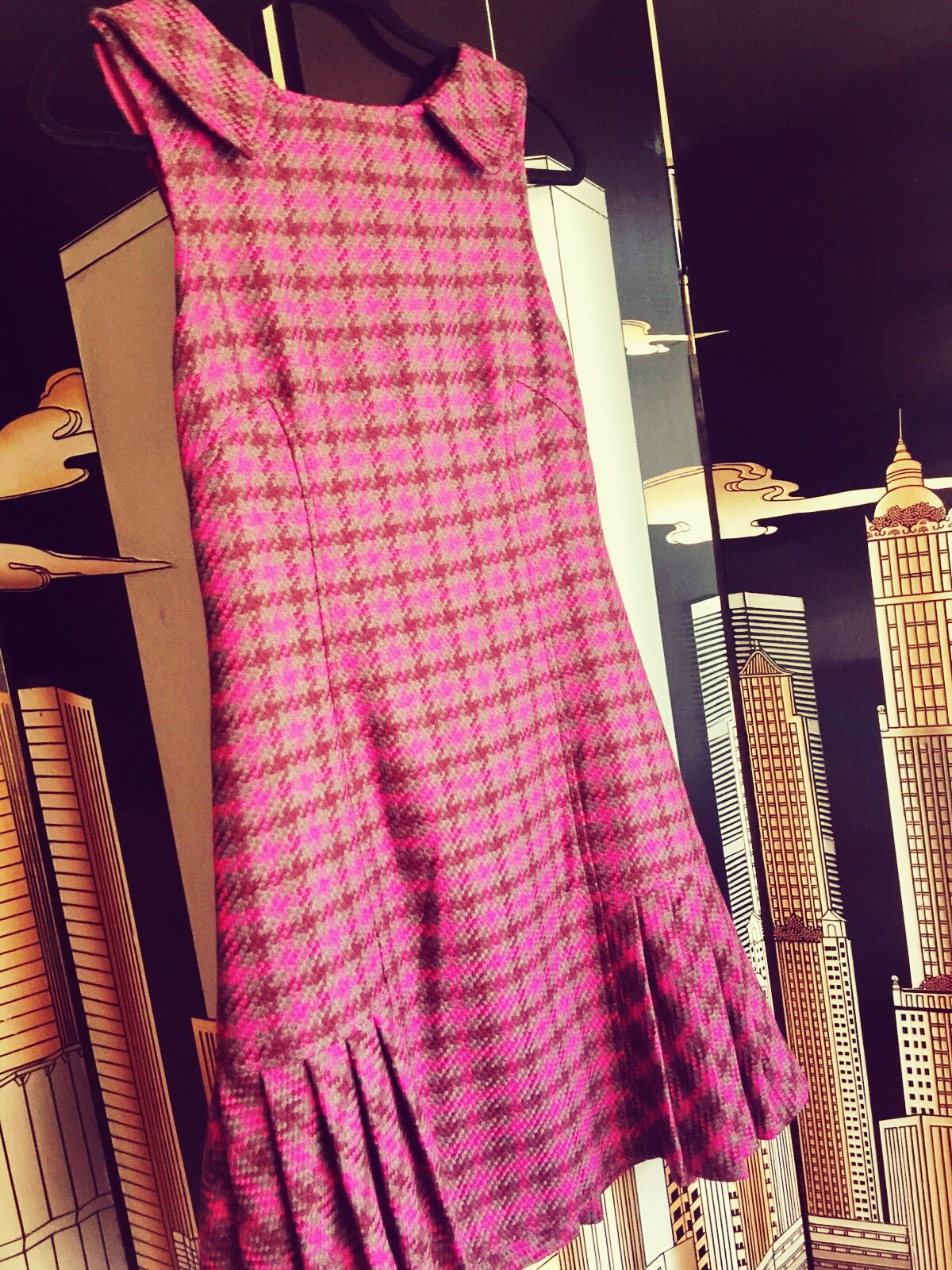
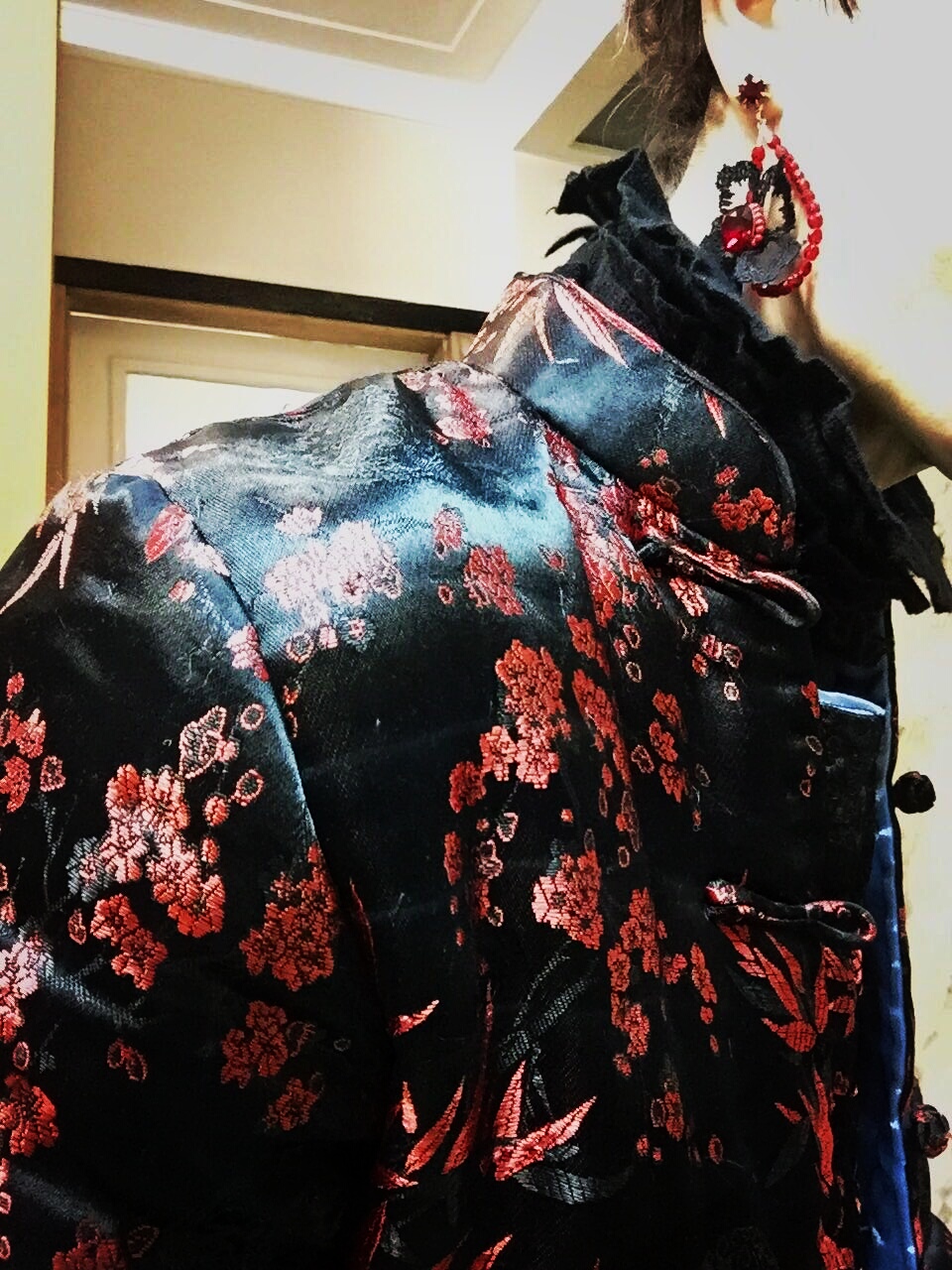
I wore this dress on Monday and the whole day I felt as if was in disguise. I thought I looked like a twenty first century flapper when I checked myself in the mirror before leaving the house, but the minute I got to work I looked as if I had borrowed the last available dress left in someone else’s closet. And that someone definitely didn’t  have a lot in common with me. I didn’t buy this dress. It was a gift from my mum who probably never abandoned the hope that, in the right outfit, I would look like a pretty girl. This dress is too pink for me, it’s either too short for me or I’m too tall for it, I am also too old to pull something like this off. Not being a mother myself, I am left with a daughter’s perspective on this strange relationship that sometimes infantilizes me in order to, so it seems, avoid confronting the inevitability of time.

Mondays are never easy and I have a horrible cold and the medication is making me feel like I’m living underwater and the weight of every single thought is too much to even consider taking any kind of action.

TUESDAY

I bought this jacket in Vietnam in November 2014. A text message received while I was in Hanoi let me know that my great aunt had died. I was there for work and alone and while I can’t really say that I have always depended on the kindness of strangers, I have found that sometimes, strangers make the best friends and know exactly what to do and how to help.

Stray people brought together by chance

WEDNESDAY

I have a weak spot for chinoiserie and I absolutely adore these pants. I think I bought them some twenty years ago and they have never made it to the error category.

I felt a lot better today. After work we went to Java, the usual hang out before theater, for dinner. The TV was showing the aftermath of the Westminster attack. The coffee shop was crowded and we are all seating at an uncomfortable closeness. The gentleman next to me is wearing a brown jacket and turns his head often in my direction. Maybe he’s getting irritated at the proximity. No, he starts talking about the news. I try not to engage. I studied political science and I have no idea how to comment on the historical, sociological, or political contexts of what we are staring at. I find it difficult to rationalize barbarity. He’s British. He goes on about foreigners and political correctness. For twelve years he served in the Royal Navy, like his father before him. His eyesight started failing. He’s now a civilian. He was born in Cornwall and grew up in Scotland, now he lives in Manchester because he can’t afford to live in London. He’s been in Portugal for two weeks on vacation, this was his last night. He’s wearing a black t-shirt with some very graphic expression of discontent written in Afrikaans. I’ve never been a big fan of clothes that are too explicit in doing your talking for you. We have to go, the play starts at 9. He says goodbye kissing our hands and thanking us for the company and patience. Whatever was said, I realize I missed that accent and the blue eyed frankness I have lived with for four or so years of my life.

The play is a Portuguese – Belgian co-production spoken in French, Portuguese and Flemish with subtitles in English and Portuguese. I like the set and love the wardrobe when Anna Karenina is the woman inhabiting them and their actions. Still, it’s difficult to focus on anything either than the text. Forty years apart in Lisbon and Antwerp two couples fall out of love, question the normal life people manage to live and read Anna Karenina in French. One of the characters hasn’t read it. He actually thought about reading War and Peace but there were too many pages.

How she dies. It’s not supposed to be about this particular written death but about how literature changes or makes us change our lives. So the author says in a number of interviews.

But she did not take her eyes from the wheels of the second car. And exactly at the moment when the midpoint between the wheels drew level with her, she threw away the red bag, and drawing her head back into her shoulders, fell on her hands under the car, and with a light movement, as though she would rise immediately, dropped on her knees. And at the instant she was terror-stricken at what she was doing. ‘Where am I? What am I doing? What for?’ She tried to get up, to throw herself back; but something huge and merciless struck her on the head and dragged her down on her back


THURSDAY

Last week there was a promise of an early Summer that has vanished during this week as temperatures dropped some twenty degrees and the news reported closed schools because of the snow. Not in Porto. I miss my second ballet class of the week and go to a conference on culture and citizenship. Friends and experts come together to pay tribute to the Poet. To Poetry. There’s a painting exhibition in the room. There’s this painting, A homage to Gaugin, it’s called, and there’s this amazing figure of a woman that could also be a man painted in the warm colours that live in Tahiti. It keeps me  from listening to most of what is being said.

FRIDAY

A lavender morning turned into a cold rainy afternoon. I took half the day off to seat at a open rehearsal of Macbeth at the national theater. They only started rehearsals on Monday so this is still the table-work phase of reading and exploring the text and the characters. There’s an English literature professor and expert in Shakespeare who has been invited to talk about the play, and the text, and the differences between the English original and the Portuguese translation. And there he was, academia at it’s very best, rethorical mighty with all its seductive power. And the words go on for five hours and I don’t feel tired or bored. There’s nothing more fascinating than being the witness to personal passions. Not to me, at least. The catastrophe of getting exactly what you want in life. Those who choose to loose everything and those who do. The fantasy of being whole and the prison it creates. And Sartre who could be very pedantic but also very intelligent.

We are left alone, without excuse. That is what I mean when I say that man is condemned to be free. Condemned, because he did not create himself, yet is nevertheless at liberty, and from the moment that he is thrown into this world he is responsible for everything he does.

In 2012 I did a course on Shakespeare at the University of Oxford. This was how I fell in love with Macbeth. My final essay was on the question of agency. My somewhat lazy conclusion stated that “Macbeth’s hamartia is not his ambition, as this is a character flaw, but his miscalculation of the personal consequences of assassinating Duncan and the inner torment that leads him on a murdering spree in the frantic desire for peace of mind. It is this tragic error that ultimately transforms his life in an empty mockery”. I’m often surprised and ashamed when reading what I have written.

SATURDAY

On Saturday I decided to revisit the rive gauche intellectual in me, ratty cashmere sweater and all.

Saturday is flamenco class day. I decided not to miss this one and take me and my cold for another session of trying to emulate Lola. It is not an easy, if at all possible, task to be a Lola. Either a fictional or a real one.

The rest of my Saturday is spent doing adult stuff, washing, and supermarket shopping, and other uninteresting errands. I sold a white Betty Barclay jacket. It’s going to Boise, Idaho.  At the end of all this I go and see Ana present a book on American cuisine. I’m only there for moral support. Cookbooks are basically useless at my house.

It took five songs of the weird (I like to think about it as eclectic but I suspect it’s just weird) driving playlist on my iPod to drive home:

Everybody knows

The famous blue raincoat

For once in my life

Girl, you’ll be a woman soon

Guilty

wp-1490479384225.jpg

I suspect rive gauche intellectuals didn’t care much for glitter ballet flats. Shoes off. I’m not going out, I decide that watching This Property is Condemned on TV is a much better option.

SUNDAY

Daylight saving time began at 1 AM. Outside it still looks like Winter.
I go to the only cinema we have downtown, one of the two movie theaters that is not a multiplex. Popcorn free zone, what a bliss. The movie is Aquarius with Sonia Braga. Two and half hours lost, gone forever. Such a grand actress deserved a much better movie. Great soundtrack, though.

I get home to this

 My next door neighbour is a sweet Lady.

References

Tolstoy

Tennessee Williams

Aristotle

Inside history

Two weeks ago I ordered a few used books from AwesomeBooks and inside A History of Fashion by J. Anderson Black & Madge Garland I found four letters from 1992. This was not one of those amazing discoveries that sometimes happens in the wonderful world of second-hand books. They are letters written to Gemma by friends that seem to have met her during a summer course in France while sharing a dorm and, most probably, a few giggling nights in a chatêau. I remember this kind of experience when I was a teenager sharing a room with Monica from Cugat del Valles at Cathy and Howard’s house in Cheltenham. In our minds, our friendship was forever. We also wrote letters to each other planning visits and other adventures. They never happened and we never met each other again. I wonder if Gemma and her friends kept in touch.

The first letter to Gemma was written on December 26. Her friend, whose birthday was December 2, got clothes, chocolate, a “very nice new desk” and soft toys, for her collection, as Christmas gifts. Maybe Gemma got A History of Fashion as a seasonal token of affection. In another letter, another friend writes about her mother who is a teacher and even though she looks like one, she is actually not that boring. But she swears quite a lot at home. In public, she assumes a “pompous” persona. Her dad is a vicar described in short and rather unpleasant words. She really hopes Gemma won’t be “put off” by her family. The other two letters are about boys. There’s Tristan, the knight in shining armour, with whom the girl is so smitten that she even talked to her mother about him. She didn’t tell her mum everything… There’s also Bob, fancied by another one of Gemma’s friends. Bob doesn’t seem very interested in going out with her. Maybe they could have one of those “open relationships, as they say”.

After the first excitement of finding these letters ( I do love all kinds of surprises and most especially if they are of the written kind), it took me a week to decide whether I should read them or not. I suppose the answer to this would always have to be no. These are, after all, personal stories traveling between Lincolnshire and Essex and I still read them. And even decided to share what I’ve read.

I remember C. telling me that he wished he would have the time to get rid of all his notes and letters before he died so no one would get to invade what was only his. We had this conversation again a few weeks ago. He has now given up on that sort of absolute control. Maybe it doesn’t make much sense to fight for privacy anymore. It does, however still bother me that I did not resist the temptation to invade someone’s else’s life.

There’s a full name and address (I didn’t Google them) on the envelopes; maybe you could just return them, J. suggests. What’s the chance that Gemma is still living in the same place? What’s the chance that twenty-five years later she is actually interested in getting some loose pieces of her life back? Would you want your adolescence to come back to you?

That magic moment

[That] Magic  moment so different and so new

img_1312

Was like any other until I met you 

img_1316

And then it happened 

img_0158

You took me by surprise 

img_1315

Sweeter than wine

img_1311

Softer than a summer’s night 

img_1314

References and inspiration 

Pomus, Shuman, Reed, Auster, Coetzee, Vonnegut, Dostoyevsky, Kerouac, Rushdie, Gordimer, Camus, Pessoa, Hughes, Sá-Carneiro, Smith, Atwood, Plath, Faulkner, Shakespeare, Lampedusa, Maugham, Breyner, McCullers, Selby Jr., Williams, Morrison, Blake, Loriga,…………Dad

img_1317

Everything I want, I have

 end_1324

On the shoulders of giants

In December 2001 Salman Rushdie visited Porto for one of the final lectures in a series of conferences about the “Future of the Future”.  In 2001 Porto was, with Rotterdam, European Culture Capital  and the discussion of a post future at the end of a year that forever changed the collective perception of our present seemed appropriate. “The Middle Ages trying to destroy the Third Millennium”, he said.

Three months after 9/11 and 12 years after the fatwa on him, Mr. Rushdie walked alone in Porto. No bodyguards. Carefree.

On the last week before Christmas shops in downtown Porto stay open at night for people like me who can’t plan their shopping in advance. As part of our mini-tradition, me and my best friend went out for some late night shopping that December of 2001. We stopped at a deserted Café Majestic for tea. In 2001 there were no lists of “the most beautiful coffee shops in the world”, there were no lines of tourists at the door, there was no Maître d’ trying to bring some kind of order to the process of sitting down. In 2001  you could actually go in and sit and be almost alone. It was late and the gentleman sitting at the far end table by the piano paid his check and got up to leave. As he made his way to the door, Mr. Rushdie walked past our table and looked at the incredulity on my face and winked and left. I was brought up in a house of books, my father is a Literature professor and  meeting or just seeing one of these “giants”in person, still makes me feel as over the moon as a teenage girl coming face to face with her favourite rock star would.

ground

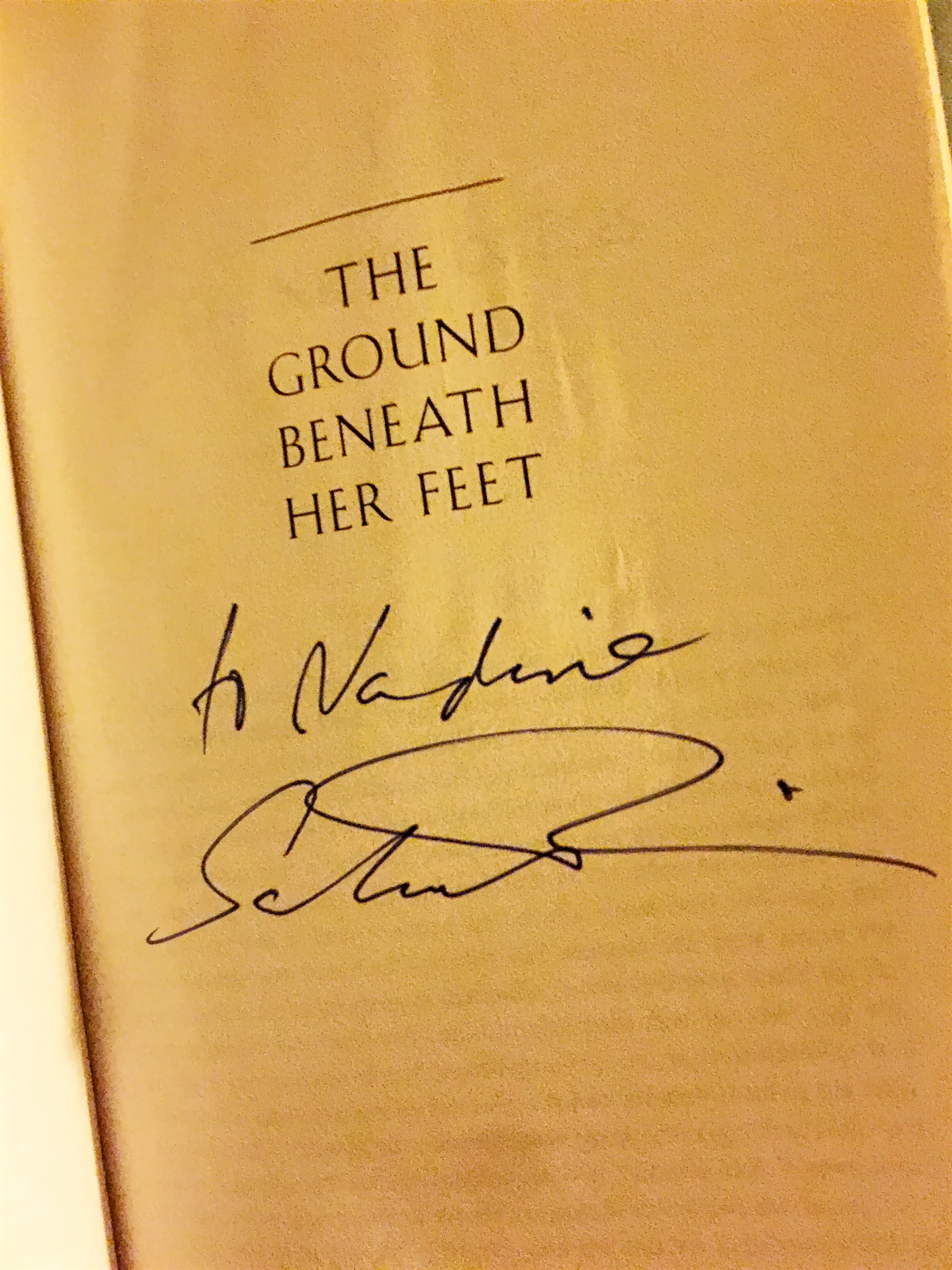
In June 2010 Sir Salman Rushdie was the keynote speaker at a conference I was attending in Kansas City and spoke about freedom and the media and the power of Literature and novelists  “who are able to probe the truth without being beholden to facts.” After his plenary address, I and few hundred others waited in line to have our books signed. Holding my copy of The Ground Beneath Her Feet, I approached his table and didn’t ask him if he remembered that night in December 2001. That was the fantasy conversation going on in my mind.

These line focus on Salman Rushdie because of a cold night in December 2001. They could easily be about Borges, Coetzee, Murakami, Pessoa, Auster, Cortazar, Sontag or many others. These are my superheroes. The ones with no x-ray vision but that are able to pierce into your soul and help you discover yourself. The ones that can’t fly but still make your imagination soar and plant the seed of invincibility in your heart. The fearless ones that keep fighting for their truth in a world that so many times keeps telling us that intellectualism is frivolous as if, paraphrasing Orwell, the only goal was to keep ourselves alive when the ultimate objective should be to retain our humanity. Or as Flexner, ten years before 1984 was published, questioned whether “there would be sufficient opportunity for a full life if the world were emptied of some of the useless things that give it spiritual significance; in other words, whether our conception of what is useful may not have become too narrow to be adequate to the roaming and capricious possibilities of the human spirit.”

img_0660

And because I am not superhero myself, I will keep borrowing the words

The old idea of the intellectual as the one who speaks truth to power is still worth holding on to. Tyrants fear the truth of books because it’s a truth that’s in hock to nobody. It’s a single artist’s unfettered vision of the world. They fear it even more because it’s incomplete, because the act of reading completes it, so that the book’s truth is slightly different in each reader’s inner world. These are the true revolutions of literature, these invisible, intimate communions of strangers, these tiny revolutions inside each reader’s imagination. And the enemies of the imagination, all the different goon squads of gods and power, want to shut these revolutions down and can’t. Not even the author of a book can know exactly what effect his book will have. But good books do have effects and some of these effects are powerful and all of them, thank goodness, are impossible to predict in advance. Literature is a loose cannon. This is a very good thing.

Salman Rushdie, The Power of the Pen

Such is the power of Literature and the super power of writers. They may not be the kind of hero that braves  against the violence of the natural world but they are of the same kind of the ones that “do the useless, brave, noble, the divinely foolish and the very wisest things that are done by man. And what they prove to themselves and to others is that man is no mere creature of his habits, no mere automaton in his routine, no mere cog in the collective machine, but that in the dust of which he is made there is also fire, lighted now and then by great winds from the sky!

References

George Orwell, 1984

Abraham Flexner, The Usefulness of Useless Knowledge

Salman Rushdie, The Power of the Pen

Walter Lippmann, Amelia Earhart – Herald Tribune – 7/8/37


Superhero

Conflict and Costume

Revisiting one of my favourite books this Africa Day

jim-naughten-namibia-book

Jim Naughten’s wonderful book Conflict and Costume: The Herero Tribe of Namibia, tells the tale of the surviving descendants of the Herero whose 1904-1908 genocide at the hands of German colonialist is considered the first of the 20th century.

Conflict-and-Costume-book

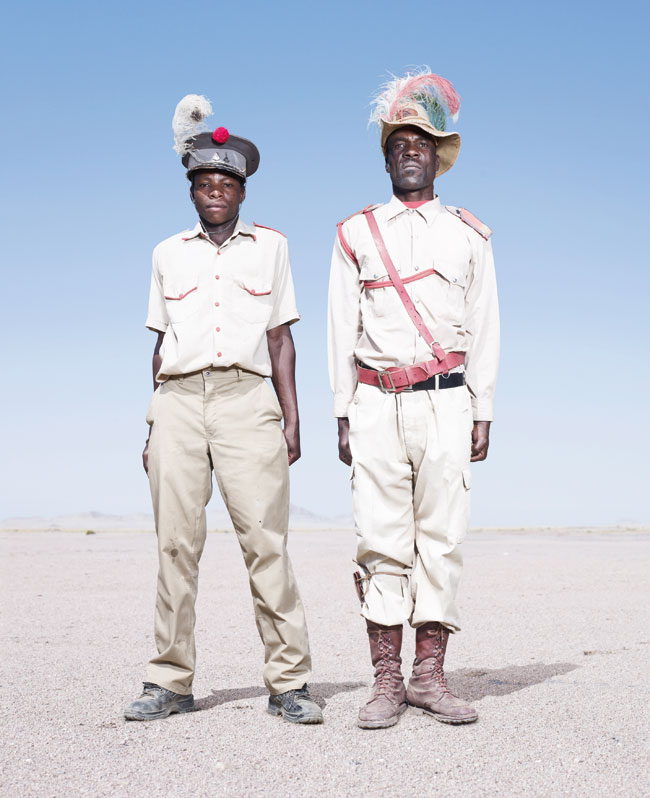
Each image, a portrait of Herero tribe members of Namibia,  reveals a material culture that harkens the region’s tumultuous  past: residents wear Victorian era dresses and paramilitary costume as a direct result and documentation of its early 20th  century German colonization. Namibia’s borders encompass the world’s oldest desert. Bleak lunar landscapes, diamond mines,  German ghost towns, rolling sea fogs, nomadic tribes and a  hostile coastline littered with shipwrecks and whale skeletons comprise the region’s striking and haunting natural features.  Namibia’s geography has witnessed a turbulent and little documented history of human settlement, upheaval and war within a particularly brutal period of European colonization.

Lutz Marten

jim-naughten-namibia-book-17

The history of Herero clothing is extraordinary. Rhenish missionaries first introduced Victorian dress, which the tribe gradually accessorized by adding, for example, cow horn headdresses. Later, during the 1904 war with Namibia’s German colonisers, Herero tribe members claimed the military uniform of dead German soldiers.

herero-cavalrymen


Dressed in the costumes that have been appropriated from their colonial past, the men, women and children are taking part in a modern re-enactment of their peoples’ bloody history. The tribe’s now traditional costumes are seen by anthropologists as a fascinating subversion of their former rulers’ fashion, showing how the tribe survived a concerted effort by German colonialists to wipe them from the face of the earth.

hererocostume_2


All photos: Jim Naughten

Conflict and Costume: The Herero Tribe of Namibia
By Jim Naughten

Introduction by Lutz Marten

Published by  Merrell Publishers (February 19, 2013)

The Outsiders

Image

Daily prompt: My own photo, not my own voice. Still, it explains how I feel.

“For a long while I have believed – this is perhaps my version of Sir Darius Xerxes Cama’s belief in a fourth function of outsideness – that in every generation there are a few souls, call them lucky or cursed, who are simply born not belonging, who come into the world semi-detached, if you like, without strong affiliation to family or location or nation or race; that there may even be millions, billions of such souls, as many non-belongers as belongers, perhaps; that, in sum, the phenomenon may be as “natural” a manifestation of human nature as its opposite, but one that has been mostly frustrated, throughout human history, by lack of opportunity.

And not only by that: for those who value stability, who fear transience, uncertainly, change, have erected a powerful system of stigmas and taboos against rootlessness, that disruptive, anti-social force, so that we mostly conform, we pretend to be motivated by loyalties and solidarities we do not really feel, we hide our secret identities beneath the false skins of those identities which bear the belongers’ seal of approval.

But the truth leaks out in our dreams; alone in our beds (because we are all alone at night, even if we do not sleep by ourselves), we soar, we fly, we flee. And in the waking dreams our societies permit, in our myths, our arts, our songs, we celebrate the non-belongers, the different ones, the outlaws, the freaks.

What we forbid ourselves we pay good money to watch, in a playhouse or a movie theater, or to read about between the secret covers of a book. Our libraries, our palaces of entertainment tell the truth. The tramp, the assassin, the rebel, the thief, the mutant, the outcast, the delinquent, the devil, the sinner, the traveler, the gangster, the runner, the mask: if we did not recognize in them our least-fulfilled needs, we would not invent them over and over again, in every place, in every language, in every time.”
― Salman Rushdie, The Ground Beneath Her Feet