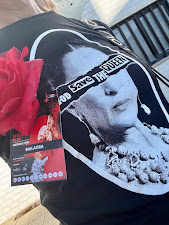
If you were forced to wear one outfit over and over again, what would it be?

Probably jeans and t-shirt but i would be very worried because this would mean the world had turned into a very dark place.

The relationship between fashion and totalitarianism reveals itself in how authoritarian regimes consistently target personal expression through dress. Consider how the Nazis required Jewish people to wear identifying badges, or how Mao’s China pushed everyone toward identical blue and gray uniforms. These weren’t just practical policies – they were deliberate erasures of individuality that made dissent and difference immediately visible.

Totalitarian systems understand that clothing is one of our most intimate forms of daily self-expression. When you control what people wear, you’re not just regulating fabric and color – you’re regulating identity itself. The uniform becomes a constant reminder of the state’s power over the most basic aspects of personal choice. It eliminates the small daily acts of creativity and self-determination that keep individual spirit alive.

Fashion, even in its most mundane forms, represents a kind of micro-democracy. When you choose your morning outfit, you’re making decisions about how you want to present yourself to the world, what mood you’re in, what activities you’re planning, even what weather you’re expecting. These tiny choices accumulate into a larger sense of agency and personal autonomy.

Authoritarian regimes also weaponize dress codes to create and enforce social hierarchies. The Khmer Rouge’s black pajama uniforms weren’t just about conformity – they were about breaking down previous social distinctions and creating a new order where only party loyalty mattered. Similarly, school uniform policies in their most extreme forms can prefigure more serious restrictions on personal freedom.

Perhaps most insidiously, fashion control works because it feels so trivial that resistance seems petty. Who wants to die on the hill of wearing colorful socks? Yet history shows us repeatedly that these “small” freedoms often serve as canaries in the coal mine. When societies begin restricting personal expression in dress, it’s frequently a precursor to much more serious erosions of liberty.

The psychological impact runs deep too. Getting dressed each morning is an act of self-creation, a daily ritual where we compose ourselves for the world. Remove that choice, and you’ve damaged something fundamental about human dignity and self-worth. The enforced sameness creates a kind of learned helplessness that extends far beyond clothing.

The relationship between fashion and totalitarianism becomes even more chilling when we examine its manifestations across history, literature, and film. These examples reveal how clothing control operates as both symbol and instrument of oppression.

Historical Examples

The interwar period saw a proliferation of “shirt movements” across Europe Shirt Movements in Interwar Europe: a Totalitarian Fashion – fascist groups that expressed their ideology through colored uniforms. Hitler’s Brown Shirts, Mussolini’s Black Shirts, and Franco’s Blue Shirts weren’t just practical clothing but visual manifestos of authoritarian identity. These uniforms served multiple purposes: they created instant group identification, intimidated opponents, and transformed political rallies into military-style displays of power.

Nazi Germany provides perhaps the most systematic example of fashion as totalitarian control. The regime didn’t just require Jews to wear yellow stars – it regulated clothing across society. The Hitler Youth had specific uniforms that emphasized conformity and militaristic values. Women were encouraged to abandon cosmetics and “foreign” fashions in favor of traditional German dress that supported Nazi ideals of motherhood and racial purity.

In Mao’s China, the blue and gray “Mao suits” became virtually mandatory, erasing centuries of Chinese sartorial tradition. During the Cultural Revolution, wearing anything remotely Western or colorful could mark you as a counter-revolutionary. The uniformity wasn’t accidental – it was designed to eliminate visual markers of class, regional identity, and individual taste.

Literary Explorations

George Orwell’s “1984” remains the most powerful literary examination of totalitarian clothing control. In Big Brother’s regime, Winston Smith lives “a sordid dehumanized life devoid of all the traditional sources of happiness” Slavery in Modern Clothing in Orwell’s 1984 – Crisis Magazine, and clothing plays a crucial role in this dehumanization. The Party members wear identical blue overalls, while the telescreen constantly monitors even the most private moments of dressing. Julia’s small act of rebellion – wearing makeup and fixing her hair – becomes a revolutionary gesture precisely because it asserts individual identity against the state’s demand for uniformity.

Margaret Atwood’s “The Handmaid’s Tale” uses clothing as a central metaphor for totalitarian control. The red robes and white bonnets of the handmaids aren’t just uniforms but symbols of reduced humanity – they transform women into walking wombs while stripping away personal identity. The color coding extends throughout Gilead society: blue for wives, green for marthas, creating a visual hierarchy that makes resistance immediately visible.

Ray Bradbury’s “Fahrenheit 451” explores how even subtle conformity in dress reflects deeper intellectual conformity. The firefighters’ uniforms with their salamander symbols and the identical leisure wear of the general population mirror the mental uniformity the state seeks to impose.

Cinematic Representations

Film has powerfully visualized fashion’s role in totalitarian control. Fritz Lang’s “Metropolis” (1927) presciently showed how clothing could divide society into rigid castes – the identical work clothes of the underground laborers versus the elegant fashions of the surface elite.

More recent films like “The Hunger Games” series use fashion as a central element of totalitarian critique. The Capitol’s obsession with extreme, ever-changing fashion contrasts sharply with the drab, practical clothing of the districts, illustrating how fashion can become both a tool of oppression and a symbol of decadent excess.

“V for Vendetta” demonstrates how uniform iconography can be reclaimed as resistance – the Guy Fawkes masks transforming anonymous conformity into anonymous rebellion.

Subtler Controls

The most insidious examples often involve seemingly voluntary conformity. Corporate dress codes, school uniforms, and social pressure to dress “appropriately” can prefigure more serious restrictions. Even democratic societies wrestle with how much clothing choice to allow – from debates over religious dress to workplace appearance standards.

The psychological impact appears consistently across these examples. When totalitarian systems control clothing, they’re not just regulating fabric – they’re conditioning minds to accept that the most intimate daily choices aren’t really choices at all. The person who accepts that the state can dictate their morning wardrobe has already surrendered a crucial piece of mental autonomy.

What makes these historical, literary, and cinematic examples so disturbing is how they reveal the progression from small restrictions to total control. It starts with “reasonable” regulations – safety, unity, tradition – and gradually expands until the very concept of personal choice in appearance becomes foreign. The uniform becomes not just what you wear, but who you are.

The how

How you move through the world

A stride, a gesture, the tilt of your head;

Some people enter a room like a storm; others radiate calm. Their “frequency” alters the space around them.

Do you rush? Linger? Dance while cooking? Your cadence reveals inner worlds.

The words you choose

Favorite phrases, slang, or even silences—words betray your history, humor, and heart.

How you frame experiences—a scientist might describe love as chemistry; a poet, as a wildfire. The specific vocabulary, phrases, and metaphors someone gravitates toward creates a verbal fingerprint. I’ve noticed how certain people have signature expressions or ways of framing ideas that immediately identify them, even in writing

How you treat others

The small kindnesses or thoughtlessness, who we make time for, how we respond to vulnerability or need – these interactions form patterns that define us. Some people consistently elevate others, while some drain energy from every room.

Your memory

 It’s not just what we remember, but how we remember, what we forget, and how those memories reshape us over time. As Oliver Sacks said  “Memory is dialogic and arises not only from direct experience but from the intercourse of many minds. […] It is a form of storytelling that goes on in the mind and never stops. […] Our memories are, in the end, a shifting, vanishing, mutating thing, a mirage of unreliable glimpses.” We don’t just have memories; we curate them, unconsciously editing our past to make sense of our present.

Your contradictions

Some people manage to be elegant yet unsettling, cool yet chaotic, polished but always a little off.

Each of us is an entire society, a whole neighborhood of Mystery; it is fitting that we at least make the life of this neighborhood elegant and distinguished, that in the celebrations of our sensations there be refinement and decorum, and that, because it is sober, there be courtesy in the banquets of our thoughts.

The Book of Disquiet

The Only Me
By Pat Mora

Spinning through space for eons,

our earth—oceans, rivers, mountains,

glaciers, tigers, parrots, redwoods—

        evolving wonders.


And our vast array, generations

of humans—all shapes, colors, languages.


        Can I be the only me?


Our earth: so much beauty, hate,

        goodness, greed.


“Study. Cool the climate,” advises my teacher.

                      “Grow peace.”


        Can I be the only me,

                      become all my unique complexity?

Who understands Me but Me

They turn the water off, so I live without water,
they build walls higher, so I live without treetops,
they paint the windows black, so I live without sunshine,
they lock my cage, so I live without going anywhere,
they take each last tear I have, I live without tears,
they take my heart and rip it open, I live without heart,
they take my life and crush it, so I live without a future,
they say I am beastly and fiendish, so I have no friends,
they stop up each hope, so I have no passage out of hell,
they give me pain, so I live with pain,
they give me hate, so I live with my hate,
they have changed me, and I am not the same man,
they give me no shower, so I live with my smell,
they separate me from my brothers, so I live without brothers,
who understands me when I say this is beautiful?
who understands me when I say I have found other freedoms?

I cannot fly or make something appear in my hand,
I cannot make the heavens open or the earth tremble,
I can live with myself, and I am amazed at myself, my love,
my beauty,
I am taken by my failures, astounded by my fears,
I am stubborn and childish,
in the midst of this wreckage of life they incurred,
I practice being myself,
and I have found parts of myself never dreamed of by me,
they were goaded out from under rocks in my heart
when the walls were built higher,
when the water was turned off and the windows painted black.
I followed these signs
like an old tracker and followed the tracks deep into myself,
followed the blood-spotted path,
deeper into dangerous regions, and found so many parts of myself,
who taught me water is not everything,
and gave me new eyes to see through walls,
and when they spoke, sunlight came out of their mouths,
and I was laughing at me with them,
we laughed like children and made pacts to always be loyal,
who understands me when I say this is beautiful?

Who Understands Me but Me by Jimmy Santiago Baca

Most people, and I am, obviously, most people as well, don’t fully understand how much their perception of reality is shaped by their own emotions, biases, and past experiences. The line between “knowing” and “feeling” is far blurrier than we often acknowledge. Much of what we consider “knowledge” is deeply entangled with emotion, intuition, and social conditioning. This is why debates over facts can feel so personal. They can even seem existential.

Accepting that much of what we “know” is provisional, socially shaped, or emotionally charged is the first step toward clearer thinking. But, at times, taking this first step just feels too much of an effort.

 The first principle is that you must not fool yourself—and you are the easiest person to fool.

References

Cargo Cult Science

by RICHARD P. FEYNMAN

Some remarks on science, pseudoscience, and learning how to not fool yourself. Caltech’s 1974 commencement address.

I have no skills for flight or wings

Every comparison would be aspirational. I guess we wished we could be compared to beautiful, bright and graceful, sensuous and brave animals but we seem to lack the effortlessness that comes with nature.

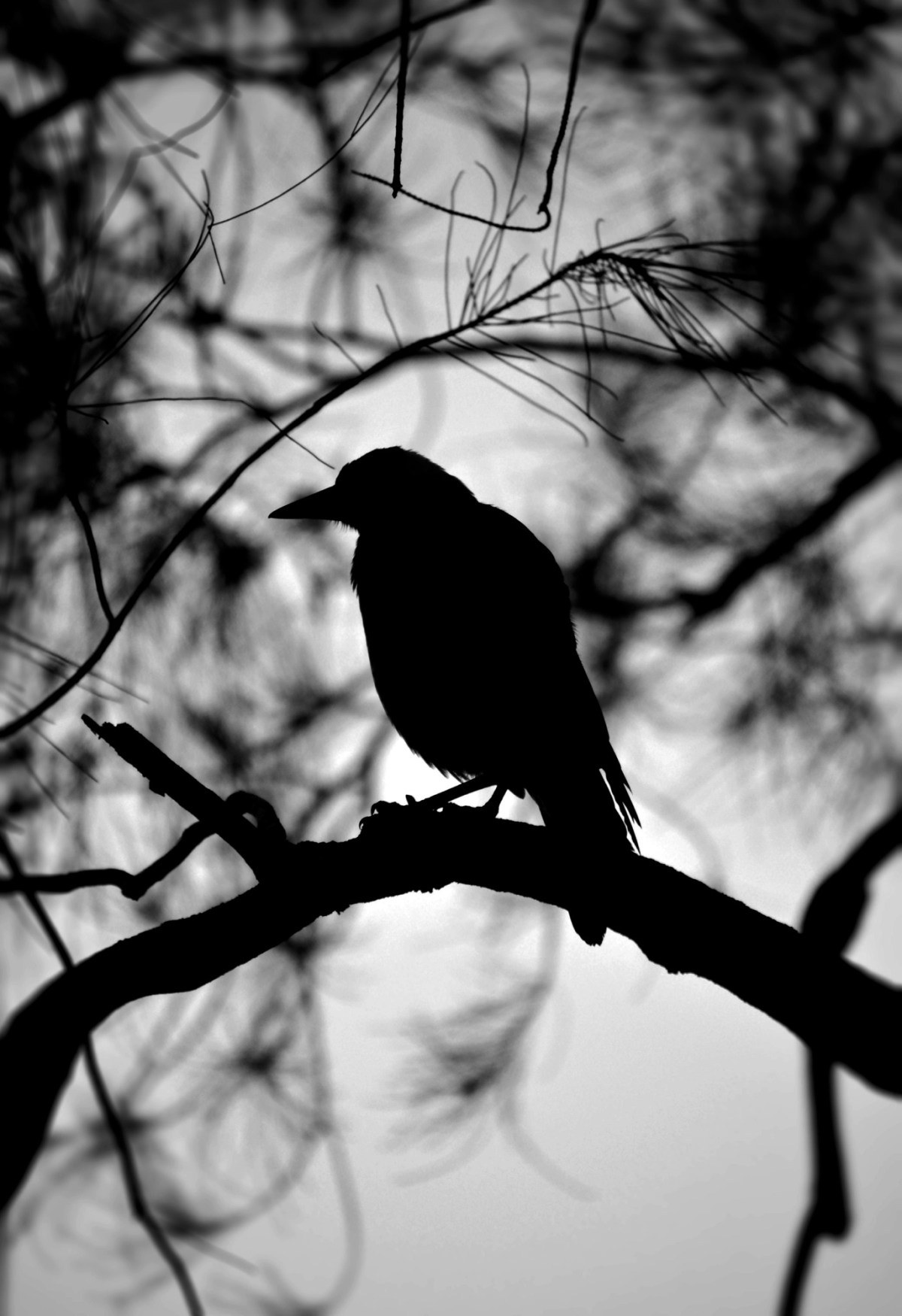
I wish I could be compared with a crow.

Crows are remarkably intelligent problem-solvers who can use tools, recognize human faces, and even understand cause and effect relationships. They’re known for their curiosity and enthusiasm about novel objects and experiences.

Despite their individual intelligence, crows maintain strong community bonds. They live in family groups that work together and even hold “funerals” for fallen members, showing a sense of the collective good that does resonate with my stubbornly public-minded values.

Their reputation for fairness appears in how they maintain relationships through reciprocity and remember those who have helped or harmed them – a form of integrity in their social world.

Though not conventionally beautiful like peacocks or graceful like deer, crows possess a different kind of elegance: the beauty of adaptability, resilience, and intellectual engagement with their world.

Crows remind us that there’s a special kind of grace in curiosity, in paying attention to details, and in maintaining ethical relationships with others.

Also, I find it increasingly difficult to get out of black clothes.

References


The Magnificent Frigatebird

BY ADA LIMÓN

Photo Diana Thoresen

Self love, my liege, is not so vile a sin as self-neglecting

Dear Nadine,

I haven’t written letters in so long that I’m not quite sure how to do this.

If you have made it as far into the future, I suppose you have managed to survive the anxiety and anger you were feeling when everything around you defied a logical explanation. Maybe you have learned that things are not as extreme as you perceive them. Although, being a Leo, I’m intrigued how you have managed to curb your tendency to overreact.

If you have made it as far into the future, I hope you have outgrown therapy or, at least, have found a therapist that does not seem to need help more than you do and, managed to open up and allowed yourself to be helped.

If you have made it as far into the future, I hope you danced as much and often as you could and that you have managed to read all the books you wanted to read and kept your to read pile always high.

If you made it as far into the future, I hope you have understood how to deal with the pain of losing loved ones and that you have kept your friends close by. I hope that living alone has not been too much of a burden and that you have enjoyed your freedom.

If you made it this far into the future, I guess you have mastered your horrible tendency to procrastinate. Maybe you followed through with all your plans and are now living in some Greek island surrounded by blue.

I hope you have always carried with you all the songs that have helped life make sense and that your inner soundtrack keeps growing.

I hope you have not gotten lost inside yourself. I hope you still remember.

I hope you have kept the passion and that you have not become indifferent to people, to beauty. I hope you still believe that elegance is a form of resistance.

I hope you have never stayed quiet in the face of injustice, that you have helped others and, that your world is much better than the one right now. I hope you haven’t given in.

I hope you have owned your choices and that you have always insisted on being the Sun and never a black hole.

Even if you do not look like the AI projected version of yourself, I hope your eyes keep showing that your name is Hope instead of impossible.

I hope you still like poetry even if you have never managed to write a single line of verse.

Dear future self
By JP Howard

If  I should ever forget you,
this is my love note to you

You were loved
You were somebody’s lover
You were loving
You held parts of all the women you loved,
somewhere deep in your generous heart

You were heartbroken
You were a heartbreaker too, girl
Sometimes you were heartache
Your heart never grew heavy though,
I remember that about you

You were silly
You were giggles
You were somebody’s Mama
You always wanted to be a Mama
Mama was the greatest title you ever had

You were jealous as fuck
You were selfish
You were sad
You held other folks’ sadness,
especially Mama’s sadness
You buried that deep in our heart

You were swag girl
Leo charm and confidence
Couldn’t nobody crack you up
as much as yourself

You were cute and you were vain
You wore lipstick under your mask
during a pandemic
because you were cute and you were vain

You loved your family
Your lover loved you for decades
Sometimes you would ask yourself,
How I get so lucky, girl?

You loved people
You were at home on a stage in front of a mic,
sitting with community in a circle,
or talking one on one with a friend
for hours on end in a coffee shop

You were a poet
You are a poet
This is your love poem to yourself, Juliet

References
Henry the V, Act 2, scene 4

Whatever you say

Say nothing


For nations vague as weed,
For nomads among stones,
Small-statured cross-faced tribes
And cobble-close families
In mill-towns on dark mornings
Life is slow dying.

So are their separate ways
Of building, benediction,
Measuring love and money
Ways of slowly dying.
The day spent hunting pig 
Or holding a garden-party,

Hours giving evidence
Or birth, advance
On death equally slowly.
And saying so to some
Means nothing; others it leaves
Nothing to be said.

Philip Larkin, Nothing to be Said

Forever alive, forever forward

In a collection that’s grown to nearly 200 pairs (I couldn’t write on budgeting even if I was paid to do it), choosing a favorite seems almost unfair although not difficult.

When I look across what I wished was a carefully curated kingdom of footwear but it’s probably just a sign of some kind of derangement , my eyes always land on the same pair: my custom Converse All Stars emblazoned with Walt Whitman’s timeless words, “resist much, obey little.”

The customization process was simple enough—Converse’s website, a font choice, a color scheme that wouldn’t overshadow the message. But the impact was anything but simple. 

Whitman’s phrase—tucked into his poem “Caution”—spoke to something essential in me. A reminder that blind conformity is the enemy of growth. That questioning authority isn’t rebellion for rebellion’s sake, but a necessary component of being and feeling alive.

“Resist much, obey little,
Once unquestioning obedience, once fully enslaved,
Once fully enslaved, no nation, state, city of this earth, ever afterward resumes its liberty.”

I received them in April 2024. In May I took them to New Orleans—my soul city. There’s something poetic about first breaking in shoes dedicated to resistance in a place that has itself resisted time, tragedy, and homogenization. Walking as if dancing, feeling the rhythm of this marvellous city, breathing music from morning to night, watching the white canvas collect the character of a city that refuses to surrender its identity—it felt like a perfect baptism for both the shoes and for me. I always feel more alive in New Orleans. I always feel I get to be myself anew.

They carried me through heartbreak in Greece, they were with me in Wembley to celebrate life with a friend that took me to see Bruce Springsteen and 60 thousand people whit hungry hearts, they got to see Ian Astbury who no longer is my teenage crush but can still stir something when singing about paradises in shattered dreams. They take me to work when I’m feeling disappointed and a bit defiant.

They remind me that authentic self-expression isn’t always comfortable, but it’s always worthwhile. That small acts of personal courage accumulate into a life of integrity. That sometimes the loudest statements are made in the quietest ways. That  resistance sometimes it’s as simple as a daily choice to live by your own compass.

References

Song of the Open Road

Walt Whitman’s Caution

A good day

We are nothing more
than the time we have left,
walking toward the oblivion
we will become.

It's harsh, but that's the way it is.

The rest is just literature.

The best thing
is not to think about it too much:
keep walking,
drink coffee, fall in love,
watch the rain...

Karmelo C. Iribarren (my own attempted translation)

Monday poetry is late, again, so am I for most things

Resources

Recursos

El sobresalto fuera del poema y dentro del poema, apenas aire contenido.

Leer y releer una frase, una palabra, un rostro. Los rostros, sobre todo.
Repasar, pesar bien lo que callan.

Como no estás a salvo de nada, intenta ser tú mismo la salvación de algo.

Caminar despacio, a ver si, tentado el tiempo, hace lo mismo.

Ida Vitale in “Jardin de sílice”

—————————————————–

The startle outside the poem and inside the poem, barely contained air.

Read and reread a phrase, a word, a face. The faces, above all.
Review, carefully weigh what they silence.

Since you are safe from nothing, try to be the salvation of something.

Walk slowly, to see if, tempted by time, it does the same.

Living

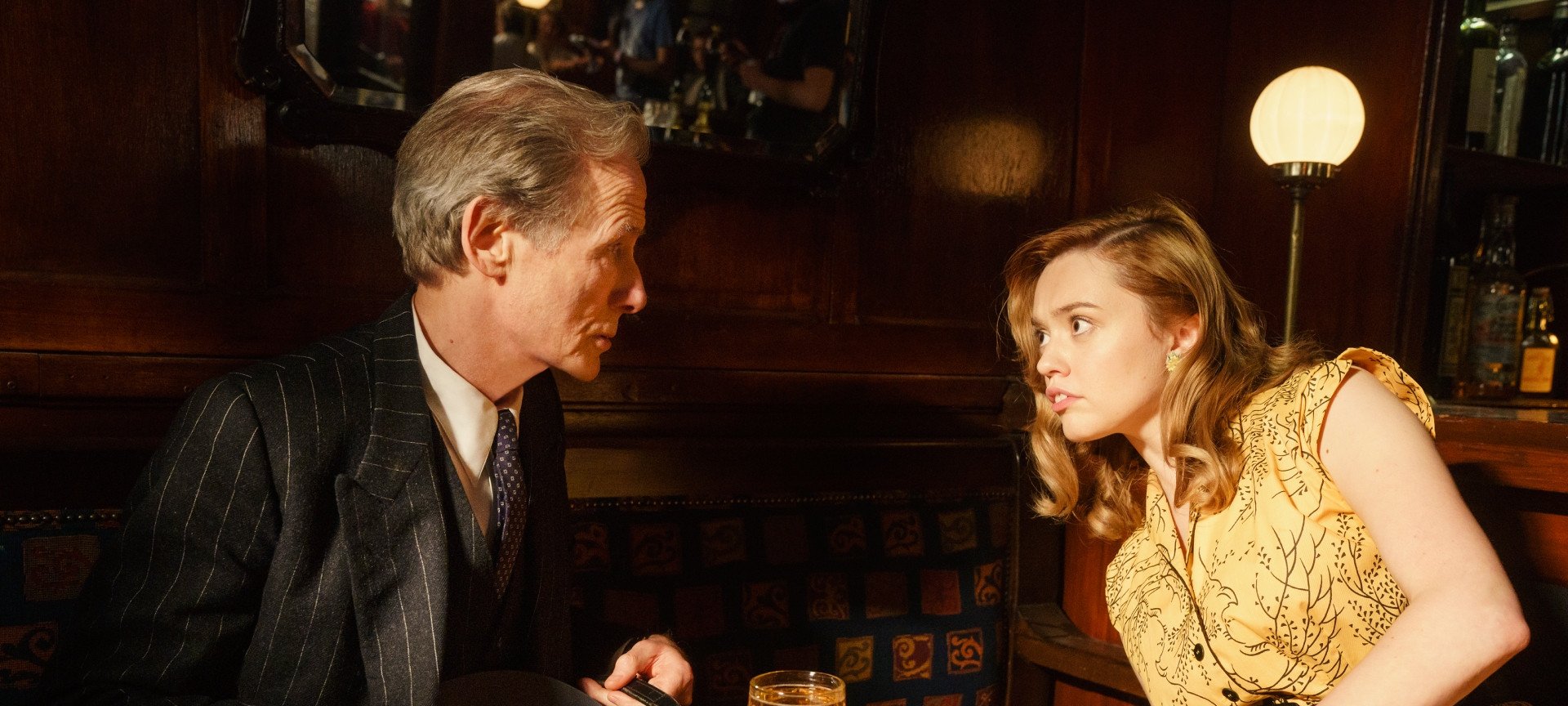
In Oliver Hermanus’s “Living” (2022), we witness a remarkable cultural translation that spans continents and decades. The film, starring Bill Nighy in a masterfully restrained performance, reimagines Akira Kurosawa’s 1952 masterpiece “Ikiru,” itself inspired by Leo Tolstoy’s “The Death of Ivan Ilyich.” This layered adaptation creates a fascinating meditation on bureaucracy, mortality, and the search for meaning in one’s life.

I watched this movie last Monday, January 6, and since I couldn’t come up with any New Year’s resolutions, I figured I’d use this movie as a bit of a wake-up call during that time of year when SAD usually kicks in, leaving me feeling as bare as a dormant tree. It will serve as a reminder that there is more to life than killing time and adjusting your reactions to whatever is thrown at you.

The film transposes Kurosawa’s narrative from post-war Tokyo to 1950s London with remarkable precision. The setting shift illuminates fascinating parallels between Japanese and British societies – both deeply hierarchical, bound by tradition, and struggling with the weight of their own formalities. Where Kurosawa’s film depicted Japanese bureaucracy through the lens of post-war reconstruction, Hermanus explores British civil service during the dawn of the welfare state.

The film’s portrayal of working life in 1950s London is meticulously crafted. The film’s opening credits sequence serves as a masterful visual overture to its themes of conformity and class structure. Shot from above, we witness a mesmerizing choreography of dark-suited men crossing London Bridge, their bowler hats creating a hypnotic pattern of black circles moving in mechanical precision. This aerial view transforms individual civil servants into an abstract pattern – a visual metaphor for the system’s absorption of individual identity.

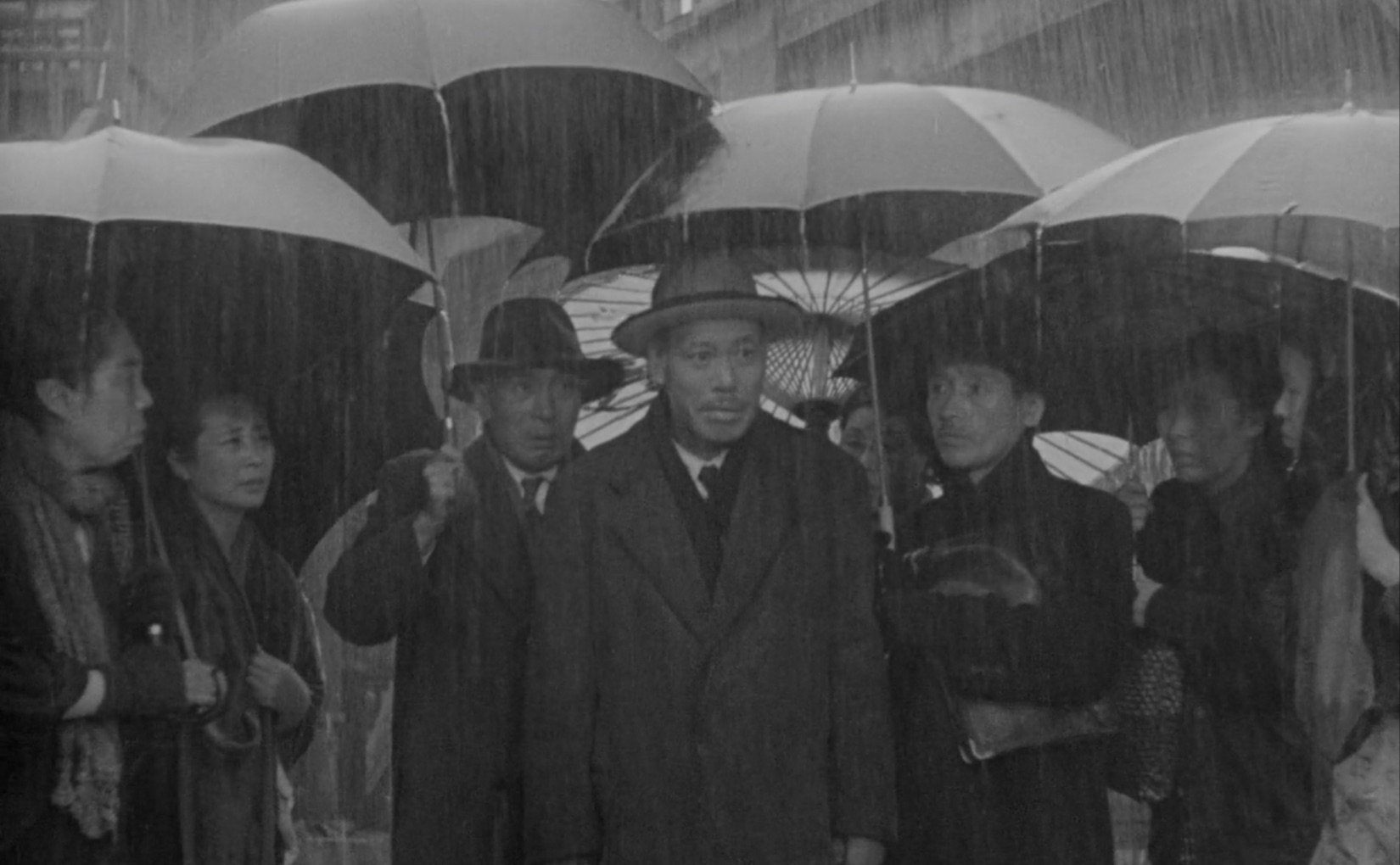
The sequence pays homage to the famous “Umbrella Scene” in Kurosawa’s “Ikiru,” but recontextualizes it for 1950s London. Where Kurosawa used umbrellas to suggest the anonymity of bureaucratic life, Hermanus employs the bowler hat – a quintessentially British symbol of middle-class respectability. The camera’s careful composition turns these hats into a kind of musical notation, with the men’s movements creating a visual rhythm that echoes the mechanical nature of their working lives.

The credits themselves, appearing in a clean, period-appropriate typeface, float above this sea of conformity. Their precise placement and timing work in concert with the movement below, creating a multi-layered opening that establishes both the film’s aesthetic restraint and its concern with systems and structures.

As the sequence progresses, we begin to distinguish Mr. Williams among the crowd – a feat that becomes significant only in retrospect, as we watch him gradually break free from this uniformity throughout the film. The way he emerges from this abstract pattern of hats and suits foreshadows his journey from anonymity to individuality.

The Public Works department where Mr. Williams (Nighy) serves as a senior civil servant becomes a microcosm of British society. The carefully arranged desks, the ritualistic shuffling of papers, and the precise adherence to tea times all speak to a system where order masks stagnation.

Costume designer Sandy Powell crafts a visual hierarchy that speaks volumes about social status and personal transformation. The film opens with a sea of identical bowler hats and dark suits flooding London Bridge – a powerful image of conformity within the civil service. Mr. Williams’s bowler hat serves as a symbol of his position and the rigid system he inhabits. When illness forces him to leave it behind, its absence marks the beginning of his transformation.

The subsequent adoption of a Borsalino hat represents more than a mere change in headwear. The Italian-made fedora, with its softer lines and continental associations, symbolizes Mr. Williams’s gradual liberation from the constraints of his former life. This subtle costume change speaks to a broader rebellion against the suffocating propriety of British bureaucracy.

The precision in costume extends beyond headwear. The gradual loosening of Mr. Williams’s tie, the eventual unbuttoning of his collar, and even the slight dishevelment of his usually impeccable suit all chart his journey from rigid conformity to a more authentic existence. These changes are particularly striking against the unchanged appearance of his colleagues, who remain locked in their sartorial prison.

Wearing Existence: Costume as Existential Metaphor

The costume design in both “Ikiru” and “Living” serves as a powerful visual metaphor for the existential journey that Tolstoy first explored in “The Death of Ivan Ilyich.” Each film uses clothing to express both the weight of social conformity and the gradual awakening to authentic existence, though they do so through distinctly different cultural vocabularies.

The Uniform of Non-Existence

In both films, the protagonists’ initial costumes represent what Tolstoy called a life lived “most ordinarily” – a form of spiritual death disguised as propriety:

– Watanabe’s dark suits and hat in “Ikiru” reflect the standardization of post-war Japanese bureaucracy, where Western business attire represented both modernization and loss of traditional identity

– Mr. Williams’s bowler hat and precisely tailored suit in “Living” embody the British civil service’s rigid hierarchy and emotional suppression

These initial costumes serve as armor against life itself, much as Ivan Ilyich’s dedication to propriety served as a shield against authentic experience.

The Gradual Undressing of the Soul

Both films use subtle changes in costume to chart their protagonists’ awakening:

In “Ikiru”:

– Watanabe’s gradual dishevelment mirrors his breaking free from social constraints

– His hat, initially perfectly positioned, begins to sit askew

– The loosening of his tie reflects his loosening grip on social conventions

– His final appearance in the swing scene, where his clothing moves freely in the snow, suggests a return to childlike authenticity

In “Living”:

– The loss of the bowler hat marks the first crack in Mr. Williams’s facade

– The Borsalino hat represents not just rebellion but a conscious choice of a new identity

– The subtle relaxing of his suit’s precision mirrors his internal liberation

– His final outfit maintains dignity while suggesting comfort in his own skin

The way each film handles this sartorial journey reflects deep cultural differences:

– Watanabe’s transformation involves a more complete dishevelment, reflecting Japanese culture’s understanding of liberation as a form of surrender

– Mr. Williams’s changes are more subtle, suggesting the British capacity for rebellion within conformity

– Both contrast with Tolstoy’s Ivan Ilyich, whose physical deterioration serves as the primary metaphor for his spiritual transformation

Class, Clothing, and Authenticity

Each film uses costume to explore how class structures inhibit authentic existence:

In “Ikiru”:

– The contrast between bureaucrats’ Western suits and the working-class traditional clothing

– The young office girl’s modern dress representing post-war freedom

– Watanabe’s final dishevelment as a rejection of class-based propriety

In “Living”:

– The precise gradations of suit quality marking civil service ranks

– The young woman’s colorful clothing suggesting life outside the system

– Mr. Williams’s Borsalino as a subtle sign of continental sophistication challenging British class rigidity

The Final Garment

Both films end with powerful costume statements:

– Watanabe dies in his loosened, snow-covered clothing, suggesting a final liberation from social constraints

– Mr. Williams’s final appearance shows him in his modified uniform – the Borsalino replacing the bowler – indicating that true liberation can occur within, rather than in rejection of, one’s social role

These costume choices echo Tolstoy’s message that awareness of death can lead to authentic life, but they do so through carefully chosen cultural idioms. The Japanese dishevelment and the British modified propriety represent different paths to the same truth: that genuine existence requires shedding, or at least transforming, the uniforms society demands we wear.

Beyond the Physical

In all three works, clothing serves as a metaphor for what Tolstoy called the “fictional life” – the life lived according to external expectations rather than internal truth. Both films use costume design to visualize what Tolstoy could only describe: the gradual awakening from this fiction to authenticity.

The genius of both adaptations lies in recognizing that this universal journey must be expressed through particular cultural languages of dress and deportment. In doing so, they make Tolstoy’s abstract existential concerns tangible and immediate, showing how the great questions of existence play out in the minute details of how we present ourselves to the world.

The Existential Thread: From Tolstoy to Kurosawa to Hermanus

At the heart of “The Death of Ivan Ilyich,” Tolstoy poses a devastating question: “What if my whole life has been wrong?” This existential inquiry echoes through both “Ikiru” and “Living,” each adaptation finding its own cultural language to explore this universal concern. The visual grammar of both films serves this central question, though they approach it through distinctly different cultural prisms.

Tolstoy’s novella examined this question through the lens of 19th-century Russian society, where Orthodox Christianity and aristocratic values shaped the understanding of a “proper life.” Kurosawa translated this inquiry into post-war Japanese society, where questions of purpose became particularly acute amid reconstruction and changing values. Hermanus relocates it to 1950s Britain, where class structures and emotional restraint created their own form of spiritual imprisonment.

In each iteration, the protagonist’s awakening to life’s true meaning is preceded by a recognition of social performance. Ivan Ilyich realizes his life has been lived “most simply and most ordinarily and therefore most terribly.” Kurosawa’s Watanabe finds that his decades of stamping papers have produced nothing of value. Mr. Williams discovers that his perfect embodiment of civil service propriety has been a form of living death.

Visual Languages of Awakening

Where Tolstoy used precise prose to dissect his protagonist’s spiritual crisis, both films employ careful visual strategies to externalize this internal journey:

– Kurosawa uses stark contrast and dramatic weather to reflect Watanabe’s emotional states, with snow and rain serving as powerful metaphors for cleansing and renewal.

– Hermanus employs the gradual softening of visual rigidity – from the geometric patterns of bowler hats to the free-flowing movement of children in the playground – to show Mr. Williams’s liberation from social constraints.

Both films share a crucial understanding: that the answer to Tolstoy’s terrible question lies not in grand gestures but in small, meaningful actions. Watanabe’s playground and Mr. Williams’s park represent more than public works projects – they are physical manifestations of their creators’ breakthrough to authentic living.

The Weight of Time

All three works deal poignantly with time’s passage:

– Tolstoy’s Ivan Ilyich realizes too late that his life has been misspent

– Kurosawa’s Watanabe races against time to complete his playground

– Mr. Williams’s measured transformation suggests that even a brief period of authentic living can redeem a lifetime of conformity

Cultural Translations of Truth

What makes both film adaptations remarkable is how they maintain Tolstoy’s essential truth while speaking through their own cultural idioms:

– Kurosawa expresses it through the lens of giri (duty) transformed into meaningful action

– Hermanus finds it in the British capacity for quiet revolution within seemingly rigid structures

Legacy and Memory

Each work concludes by examining how others remember the protagonist:

– Tolstoy’s mourners are primarily concerned with promotion opportunities

– Kurosawa’s bureaucrats briefly celebrate Watanabe before returning to their old ways

– Hermanus’s colleagues maintain their reserve, but with a new understanding glimpsed through their constrained emotions

Yet in all three versions, there’s a small group who truly understand the transformation they witnessed. This understanding becomes a kind of torch, passed from Tolstoy’s pages through Kurosawa’s lens to Hermanus’s camera – the possibility that one life, properly lived even for a short time, can illuminate the way for others.

In the end, “Living” accomplishes something remarkable: it takes Tolstoy’s existential question and Kurosawa’s humanist answer and filters them through the precise visual language of British society, creating something both culturally specific and universally resonant. Through its careful attention to visual detail – from the geometric patterns of bowler hats to the free movement of the final scenes – it shows how the great questions of existence can be explored through the smallest details of human behavior and social custom.

The film reminds us that the search for meaning, while universal, is always experienced through the particular – through specific hats and suits, through precise ways of moving through space, through culturally determined ways of showing or hiding emotion. In doing so, it achieves what great art should: it makes the universal deeply personal, and the personal universally understood, making you question (again) what is after all the purpose of living.

References and stills

Scene by Green Ikiru

Scene by Green Living

The Death of Ivan Ilyich (full text via University of Minnesota Twin Cities)

Learning about Movies episode 78

At the wheel…


…of a Chevrolet on the road to Sintra,
Through moonlight and dreams, on the deserted road,
I drive alone, drive almost slowly, and it almost
Seems to me, or I almost force myself to think it seems,
That I’m going down another road, another dream, another world,
That I’m going on without having left Lisbon, without Sintra to go to,
That I’m going on, and what is there to going on except not stopping, but going on?

I’ll spend the night in Sintra because I can’t spend it in Lisbon,
But, when I get to Sintra, I’ll be sorry I didn’t stay in Lisbon.
Always this groundless worry, no purpose, no consequence,
Always, always, always,
This excessive anguish for nothing at all,
On the road to Sintra, on the road to dreams, on the road to life

Alert to my subconscious movements at the wheel,
Around me, with me, leaps the car I borrowed.
I smile at the symbol, at thinking of it, and at turning right.
In how many borrowed things do I move through the world?
How many borrowed things do I drive as if they were mine?
How many borrowed things — oh God — am I myself?

To my left, a hovel — yes, a hovel — by the roadside.
To my right an open field, the moon far off.
The car, which seemed just now to give me freedom,
Is now something I’m shut up in,
That I can only drive shut up in,
That I can only tame if I include it, if it includes me.

To my left, back there, that modest, that more than modest hovel.
Life must be happy there: it’s not mine.
If someone saw me from the window, they’d think: Now that guy’s happy.

Maybe a child spying at the upstairs window
Would see me, in my borrowed car, as a dream, a fairy tale come true.
Maybe, for the girl who watched me, hearing my motor out the kitchen window,
On packed earth,
I’m some kind of prince of girls’ hearts,
And she’ll watch me sideways, out the window, past this curve where I lose myself.
Will I leave dreams behind me? Will the car?
I, the borrowed-car-driver, or the borrowed car I drive?

On the road to Sintra in moonlight, in sadness, before the fields and night,
Forlornly driving the borrowed Chevy,
I lose myself on the future road, I disappear in the distance I reach.

And in a terrible, sudden, violent, inconceivable desire
I speed up,
But my heart stayed back on a pile of rocks I veered from, seeing without seeing it,
At the door of the hovel —
My empty heart,
My dissatisfied heart,
My heart more human than me, more exact than life.

On the road to Sintra, near midnight, in moonlight, at the wheel,
On the road to Sintra, oh my weary imagination,
On the road to Sintra, ever nearer to Sintra,
On the road to Sintra, ever farther from me…

In The Collected Poems of Álvaro de CamposVol. 2 (1928–1935) . translated by Chris Daniels


Ao volante do Chevrolet pela estrada de Sintra,

Ao luar e ao sonho, na estrada deserta,

Sozinho guio, guio quase devagar, e um pouco

Me parece, ou me forço um pouco para que me pareça,

Que sigo por outra estrada, por outro sonho, por outro mundo,

Que sigo sem haver Lisboa deixada ou Sintra a que ir ter,

Que sigo, e que mais haverá em seguir senão não parar mas seguir?

Vou passar a noite a Sintra por não poder passá-la em Lisboa,

Mas, quando chegar a Sintra, terei pena de não ter ficado em Lisboa.

Sempre esta inquietação sem propósito, sem nexo, sem consequência,

Sempre, sempre, sempre,

Esta angústia excessiva do espírito por coisa nenhuma,

Na estrada de Sintra, ou na estrada do sonho, ou na estrada da vida…

Maleável aos meus movimentos subconscientes do volante,

Galga sob mim comigo o automóvel que me emprestaram.

Sorrio do símbolo, ao pensar nele, e ao virar à direita.

Em quantas coisas que me emprestaram guio como minhas!

Quanto me emprestaram, ai de mim!, eu próprio sou!

À esquerda o casebre — sim, o casebre — à beira da estrada.

À direita o campo aberto, com a lua ao longe.

O automóvel, que parecia há pouco dar-me liberdade,

É agora uma coisa onde estou fechado,

Que só posso conduzir se nele estiver fechado,

Que só domino se me incluir nele, se ele me incluir a mim.

À esquerda lá para trás o casebre modesto, mais que modesto.

A vida ali deve ser feliz, só porque não é a minha.

Se alguém me viu da janela do casebre, sonhará: Aquele é que é feliz.

Talvez à criança espreitando pelos vidros da janela do andar que está em cima

Fiquei (com o automóvel emprestado) como um sonho, uma fada real.

Talvez à rapariga que olhou, ouvindo o motor, pela janela da cozinha

No pavimento térreo,

Sou qualquer coisa do príncipe de todo o coração de rapariga,

E ela me olhará de esguelha, pelos vidros, até à curva em que me perdi.

Deixarei sonhos atrás de mim, ou é o automóvel que os deixa?

Eu, guiador do automóvel emprestado, ou o automóvel emprestado que eu guio?

Na estrada de Sintra ao luar, na tristeza, ante os campos e a noite,

Guiando o Chevrolet emprestado desconsoladamente,

Perco-me na estrada futura, sumo-me na distância que alcanço,

E, num desejo terrível, súbito, violento, inconcebível,

Acelero…

Mas o meu coração ficou no monte de pedras, de que me desviei ao vê-lo sem vê-lo,

À porta do casebre,

O meu coração vazio,

O meu coração insatisfeito,

O meu coração mais humano do que eu, mais exacto que a vida.

Na estrada de Sintra, perto da meia-noite, ao luar, ao volante,

Na estrada de Sintra, que cansaço da própria imaginação,

Na estrada de Sintra, cada vez mais perto de Sintra,

Na estrada de Sintra, cada vez menos perto de mim…

11-5-1928

Poesias de Álvaro de Campos. Fernando Pessoa. Lisboa: Ática, 1944 (imp. 1993).- 37


I chose part of this poem to say goodbye to someone today. I did not go the funeral. “Do you want me to go?”, I asked. He didn’t. I didn’t know his father, I have never met him, I heard stories of beautiful cars and saw fading photos of a once happy life.


Photo: Not really a Chevrolet at Bastelicaccia, Corsica, August 2018

I’d rather stop

IMG_0275

This is not a good photo. I couldn’t get out of the car and attempt a proper photo, the letter box stands right by a traffic light and words on walls and urban equipments tend to vanish quickly, so you get them when you spot them.

Pause and reflect on the [your / mine]  path 

That’s how it reads to me. That’s what’s lacking, the time to stop and try to see the direction.

Why would you walk?

fullsizeoutput_97

“But ballet itself – it’s important. Dance is important. It’s that language that everybody understands. It’s a powerful tool to open people’s minds. It’s some subconscious thing, a connection we all have. Kids dance before walking. It’s our truest nature of being. It’s true spirit.” He pauses. “And then, slowly and slowly, as we grow older, we get more and more baggage and life changes you. We are more scared of things, more fearful. So how to eliminate that? We have to go back to how we were as a kid, because that’s our truest nature. And with ballet, that is how I’m trying to come back to this state of mind. Because that’s the purest state. Tribes dance. Every country has a national dance. In the clubs we dance, we dance at weddings. Dance is a language. It’s a language that we need, like music, to survive.”

Sergei Polunin interview Another Man Magazine

If you could be dancing

Photo: Street Milonga in Porto (2013)

you may not believe it

but there are people
who go through life with
very little
friction or
distress.
they dress well, eat
well, sleep well.
they are contented with
their family
life.
they have moments of
grief
but all in all
they are undisturbed 
and often feel
very good.
and when they die
it is an easy
death, usually in their
sleep.
you may not believe 
it 
but such people do
exist. 
but I am not one of
them.
oh no, I am not one
of them,
I am not even near
to being
one of 
them 
but they are
there 
and I am 
here.


The Aliens, Charles Bukowski

The Last Night Of The Earth Poems

Words move, music moves

rehearsal

Only in  time

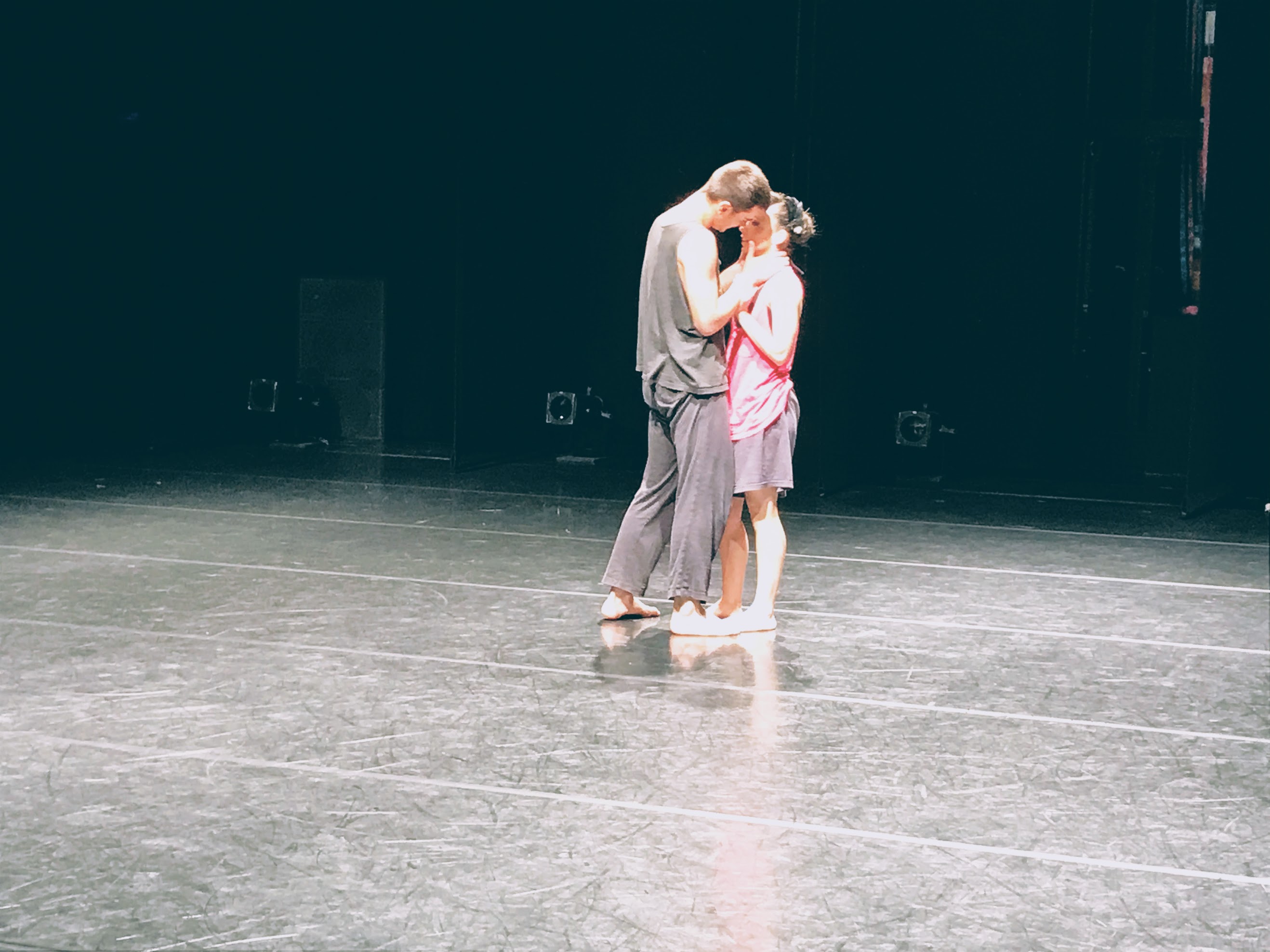
Photo: Gianmarco and Jennifer from the Opus Ballet Compagnia rehearsing in Porto, June 2017

References: T.S. Eliot, Four Quartets, Burnt Norton (1935)