
Two things we must therefore root out: fear of distress in the future and the memory of distress in the past. The one concerns me no longer. The other concerns me not yet.
Seneca
Made with Gemini
Two things we must therefore root out: fear of distress in the future and the memory of distress in the past. The one concerns me no longer. The other concerns me not yet.
Seneca
Made with Gemini
The World is a Beautiful Place by Lawrence Ferlinghetti
The world is a beautiful place
to be born into
if you don’t mind happiness
not always being
so very much fun
if you don’t mind a touch of hell
now and then
just when everything is fine
because even in heaven
they don’t sing
all the time
The world is a beautiful place
to be born into
if you don’t mind some people dying
all the time
or maybe only starving
some of the time
which isn’t half so bad
if it isn’t you
Oh the world is a beautiful place
to be born into
if you don’t much mind
a few dead minds
in the higher places
or a bomb or two
now and then
in your upturned faces
or such other improprieties
as our Name Brand society
is prey to
with its men of distinction
and its men of extinction
and its priests
and other patrolmen
and its various segregations
and congressional investigations
and other constipations
that our fool flesh
is heir to
Yes the world is the best place of all
for a lot of such things as
making the fun scene
and making the love scene
and making the sad scene
and singing low songs of having
inspirations
and walking around
looking at everything
and smelling flowers
and goosing statues
and even thinking
and kissing people and
making babies and wearing pants
and waving hats and
dancing
and going swimming in rivers
on picnics
in the middle of the summer
and just generally
‘living it up’
Yes
but then right in the middle of it
comes the smiling
mortician
Not quitting started feeling as a plan.
He scribbles some in prose and verse,
And now and then he prints it;
He paints a little, — gathers some
Of Nature’s gold and mints it.
He plays a little, sings a song,
Acts tragic roles, or funny;
He does, because his love is strong,
But not, oh, not for money!
He studies almost everything
From social art to science;
A thirsty mind, a flowing spring,
Demand and swift compliance.
He looms above the sordid crowd—
At least through friendly lenses;
While his mamma looks pleased and proud,
And kindly pays expenses.
The Dilettante: A Modern Type by Paul Laurence Dunbar
I do pay all my own expenses
Fierce
Bright
Emotional
Hypersensitive
Volatile
Dilettante
Passionate
Detached
Elegant
Regal
Unapologetic
Unapproachable
Big hearted
Generous
Impulsive
Daydreamer
Blunt
Fair
Melancholic
A good person
Serious
Elegant
Shy
Boring
Sarcastic
The meaning of my existence is that life has addressed a question to me. Or, conversely, I myself am a question which is addressed to the world, and I must communicate my answer, for otherwise I am dependent upon the world’s answer.
C. G. Jung, Memories, dreams, reflections
‘tis a lie, I am no ague-proof
References
William Shakespeare, King Lear
Followed by
what have you done
any form of question that requires planning of personal time
questions that require spreadsheets to be answered
where do you see yourself in five years
what do you want out of life
what would you like for your birthday
do you want me to go with you
I’m sure there’s long list of other questions I hate being asked but it would be tiresome to go over all of them.
Dear Nadine,
I haven’t written letters in so long that I’m not quite sure how to do this.
If you have made it as far into the future, I suppose you have managed to survive the anxiety and anger you were feeling when everything around you defied a logical explanation. Maybe you have learned that things are not as extreme as you perceive them. Although, being a Leo, I’m intrigued how you have managed to curb your tendency to overreact.
If you have made it as far into the future, I hope you have outgrown therapy or, at least, have found a therapist that does not seem to need help more than you do and, managed to open up and allowed yourself to be helped.
If you have made it as far into the future, I hope you danced as much and often as you could and that you have managed to read all the books you wanted to read and kept your to read pile always high.
If you made it as far into the future, I hope you have understood how to deal with the pain of losing loved ones and that you have kept your friends close by. I hope that living alone has not been too much of a burden and that you have enjoyed your freedom.
If you made it this far into the future, I guess you have mastered your horrible tendency to procrastinate. Maybe you followed through with all your plans and are now living in some Greek island surrounded by blue.
I hope you have always carried with you all the songs that have helped life make sense and that your inner soundtrack keeps growing.
I hope you have not gotten lost inside yourself. I hope you still remember.
I hope you have kept the passion and that you have not become indifferent to people, to beauty. I hope you still believe that elegance is a form of resistance.
I hope you have never stayed quiet in the face of injustice, that you have helped others and, that your world is much better than the one right now. I hope you haven’t given in.
I hope you have owned your choices and that you have always insisted on being the Sun and never a black hole.
Even if you do not look like the AI projected version of yourself, I hope your eyes keep showing that your name is Hope instead of impossible.
I hope you still like poetry even if you have never managed to write a single line of verse.
Dear future self
By JP Howard

If  I should ever forget you,
this is my love note to you

You were loved
You were somebody’s lover
You were loving
You held parts of all the women you loved,
somewhere deep in your generous heart

You were heartbroken
You were a heartbreaker too, girl
Sometimes you were heartache
Your heart never grew heavy though,
I remember that about you

You were silly
You were giggles
You were somebody’s Mama
You always wanted to be a Mama
Mama was the greatest title you ever had

You were jealous as fuck
You were selfish
You were sad
You held other folks’ sadness,
especially Mama’s sadness
You buried that deep in our heart

You were swag girl
Leo charm and confidence
Couldn’t nobody crack you up
as much as yourself

You were cute and you were vain
You wore lipstick under your mask
during a pandemic
because you were cute and you were vain

You loved your family
Your lover loved you for decades
Sometimes you would ask yourself,
How I get so lucky, girl?

You loved people
You were at home on a stage in front of a mic,
sitting with community in a circle,
or talking one on one with a friend
for hours on end in a coffee shop

You were a poet
You are a poet
This is your love poem to yourself, Juliet
References
Henry the V, Act 2, scene 4
Dream Song 14
BY JOHN BERRYMAN


Life, friends, is boring. We must not say so.
After all, the sky flashes, the great sea yearns,
we ourselves flash and yearn,
and moreover my mother told me as a boy
(repeatingly) ‘Ever to confess you’re bored
means you have no

Inner Resources.’ I conclude now I have no
inner resources, because I am heavy bored.
Peoples bore me,
literature bores me, especially great literature,
Henry bores me, with his plights & gripes
as bad as achilles,

who loves people and valiant art, which bores me.
And the tranquil hills, & gin, look like a drag
and somehow a dog
has taken itself & its tail considerably away
into mountains or sea or sky, leaving
behind: me, wag.
What bores you?
Numbers bore me, data bores me. People complaining about their comfortable lives bore me to death. The lack of consistency between words and actions both bores me and infuriates me. My lack of discipline bores me and, sometimes, my indifference frustrates and scares me.
On Saturday I went to see Pablo Larraín’s Maria with a a friend. My friend cried at the end of the movie. Surprisingly ( to me), I didn’t. I am not quite sure I liked it. Angelina Jolie presumably excels as the tragic Diva; Massimo Cantini Parrini’s costume design was impeccable, as it should, since the source material was already extraordinary as he acknowledges in this interview to Harper’s Bazaar:
Working on the costumes for Maria Callas was not that difficult in terms of finding or drawing inspiration, as Maria Callas was a diva and she had been interviewed and photographed by so many different journalists and people. But beyond the most iconic photographs that we had all seen sooner or later of Maria Callas, I was also able to dig deeper and deeper in my research to find other pictures of where she was portrayed at homes of friends, dining out—a number of events that were not typically those linked to her professional life. That was a great inspiration, and it allowed me to imagine and create her wardrobe, which spans throughout the ’50s, ’60s, and ’70s.
Costume design in María not only transforms Jolie into La Divina, it also serves as a visual metaphor for the film’s meditation on artistry, identity, and transformation. Through María Callas’ wardrobe, Larraín and Massimo Cantini Parrini articulate the tension between art as a living, breathing force and art as a frozen, ornamental relic
Callas was an artist shaped by both her voice and her image. Her costumes reflect this duality. Onstage, she is adorned in grand, operatic gowns. These gowns are heavy with history, as if carrying the weight of her own myth. These pieces emphasize how she became an icon, a living masterpiece. But offstage, her wardrobe shifts to softer, more intimate attire, revealing the woman beneath the legend. The contrast suggests that while the world sees only the diva, Callas herself wrestles with her own identity beyond the stage.
In her later years, Callas’ wardrobe takes on a different role. The extravagant fashion—high collars, structured silhouettes, luxurious fabrics—becomes almost like a museum exhibit. It serves as a way of preserving an identity that is slipping away. Even as her voice fades, her costumes remain striking. They seem like the last remnants of the persona she spent a lifetime constructing.
As Callas grapples with the loss of her voice, her costumes become more muted, understated—less fireworks, more elegy. The colors may darken, the embellishments may soften, mirroring the internal shift from performance to reflection.
A very long introduction to answer that if I could be someone else for a day, I would choose to be this kind of genius. Not the one shown in the movie. While not everyone knows what it’s like to command an opera house or possess extraordinary talent, we all know and experience, in very different measures, the personal side of decline.
To be able to experience for one day what it would feel like having lightning running through your veins, knowing that every note you produce is pure artistic truth. The sheer physical and emotional power required to project that voice, to inhabit roles like Tosca or Norma so completely that the boundary between performance and reality almost disappears…
To know not adoration but to live with the certainty that your extraordinary gift has made a difference in the world through beauty.
Now, I am the same age as Callas was when she died and realize that I really wished I could be myself everyday even if there are so many more spectacular lives than my own.
The unexamined life is surely worth living, but is the unlived life worth examining?
I think Stanley Kubrick actually captured something similar when he said “The truth of a thing is in the feel of it, not the think of it.”
While Socrates emphasized reflection as crucial to a meaningful life, there needs to be something substantive to reflect upon. Pure contemplation without lived experience could become a kind of hollow philosophical exercise.
There’s a point where self-reflection can spiral into a kind of paralytic introspection or self-commiseration.
When examination turns into rumination, we find ourselves in an echo chamber of our own thoughts. This detaches us from the vitality of direct experience. Excessive self-examination can also drain experiences of their natural meaning and immediacy.
Yet, I wonder if the issue isn’t with examination itself, but with its nature and purpose. There’s a difference between examination that enriches our engagement with life – helping us understand our patterns, make better choices, appreciate moments more fully – and examination that becomes a form of self-absorbed withdrawal from life.
A little more sun – I’d have been embers,
A little more blue – I’d have been beyond.
To reach it, I lacked the stroke of wings…
If only I had stayed beneath…

Wonder or peace? In vain… All faded
In a vast, deceitful sea of foam;
And the grand dream awakened in mist,
The grand dream – oh pain! – almost lived…

Almost love, almost triumph and flame,
Almost the beginning and end – almost expansion…
But in my soul, everything spills out…
And yet nothing was mere illusion!

Everything had a start… and all went astray…
– Oh, the pain of being – almost, endless pain…
I failed others, failed myself,
A wing that entwined but didn’t fly…

Moments of soul that I squandered…
Temples where I never raised an altar…
Rivers I lost without leading to the sea…
Yearnings that passed but I never held…

If I wander, I find only traces…
Gothic arches toward the sun – I see them closed;
And hands of heroes, without faith, cowardly,
Set bars over the precipices…

In a diffuse impulse of despair,
I began everything and possessed nothing…
Today, of me, only disillusion remains,
Of the things I kissed but never lived…

A little more sun – and I’d have been embers,
A little more blue – and I’d have been beyond.
To reach it, I lacked the stroke of wings…
If only I had stayed beneath…

(AI translation)

Here's the original poem, Quase by Mário de Sá Carneiro:


Um pouco mais de sol – eu era brasa,
Um pouco mais de azul – eu era além.
Para atingir, faltou-me um golpe de asa…
Se ao menos eu permanecesse aquém…

Assombro ou paz? Em vão… Tudo esvaído
Num grande mar enganador de espuma;
E o grande sonho despertado em bruma,
O grande sonho – ó dor! – quase vivido…

Quase o amor, quase o triunfo e a chama,
Quase o princípio e o fim – quase a expansão…
Mas na minh’alma tudo se derrama…
Entanto nada foi só ilusão!

De tudo houve um começo … e tudo errou…
– Ai a dor de ser – quase, dor sem fim…
Eu falhei-me entre os mais, falhei em mim,
Asa que se enlaçou mas não voou…

Momentos de alma que, desbaratei…
Templos aonde nunca pus um altar…
Rios que perdi sem os levar ao mar…
Ânsias que foram mas que não fixei…

Se me vagueio, encontro só indícios…
Ogivas para o sol – vejo-as cerradas;
E mãos de herói, sem fé, acobardadas,
Puseram grades sobre os precipícios…

Num ímpeto difuso de quebranto,
Tudo encetei e nada possuí…
Hoje, de mim, só resta o desencanto
Das coisas que beijei mas não vivi…

Um pouco mais de sol – e fora brasa,
Um pouco mais de azul – e fora além.
Para atingir faltou-me um golpe de asa…
Se ao menos eu permanecesse aquém…
Yes, that “agony of the almost” is the heart of what makes this poem so powerful and painful. Sá-Carneiro captures something uniquely torturous about consciousness – not just the pain of failure, but the specific suffering that comes from knowing you came close and fell short. All the intention was there – just not the final decisive action. It’s the difference between never having talent and having talent you squandered.
There’s also something especially modern about this kind of suffering. In earlier times, one’s path might have been more predetermined by circumstances. But now, we face a growing burden of choice and possibility. This makes the failure to realize potential feel like a personal shortcoming instead of an external limitation.
And, again, the same question, is the unlived life worth examining? Awareness itself can be a curse. As Sá-Carneiro, we don’t just lament missed opportunities, but also knowing about them – and wish we “had stayed beneath.” Self-reflection does have a potential to become self-commiseration – when awareness of what could have been overwhelms and paralyzes rather than motivates. And we stay trapped between worlds – neither fully engaged in life nor able to transcend it (“To reach it, I lacked the stroke of wings…”)
If, as Joan Didion wrote “We are well advised to keep on nodding terms with the people we used to be, whether we find them attractive company or not”, we might as well learn how to come to terms with the people we did not become.
References
Adam Phillips, Missing Out: In Praise of the Unlived Life
The illusion of fearlessness often manifests as a kind of psychological armor – we convince ourselves we’re beyond fear, untouchable. But this supposed fearlessness can actually be a defense mechanism, a way of avoiding the vulnerability that comes with truly engaging with life. True courage doesn’t seem to be so much about being fearless – it’s about acknowledging our fears and moving forward despite them.
The fear of living itself is particularly paradoxical. It can manifest as a reluctance to fully engage with life’s experiences, to take risks, to open ourselves to both joy and pain, while not being afraid of what might be physically dangerous. This fear might lead us to live in a kind of half-state – physically alive but emotionally and spiritually withdrawn. We might avoid deep relationships, challenging opportunities, or meaningful changes because they require us to be vulnerable and face potential loss or failure.
The relationship between these two concepts – the illusion of fearlessness and the fear of living – is especially intriguing. Sometimes, those who project the strongest image of fearlessness are actually the most afraid of truly living. Their apparent fearlessness becomes a cage, preventing them from experiencing the full spectrum of human experience, including the fears that make us human.
What makes this dynamic even more complex is that some degree of fear is not just natural but necessary for meaningful living. Fear can be an indicator of what we truly care about, what matters to us. The person who claims to fear nothing might also love nothing, risk nothing, and ultimately live nothing.
There’s a particular kind of emptiness that comes not from feeling sad, but from feeling nothing at all. It’s a state many of us find ourselves in, though we rarely talk about it. We exist in a fortress of our own making – safe, perhaps, but isolated from the very experiences that make life vibrant and meaningful.
I’ve come to understand this state as emotional inertia. It’s not depression exactly, nor is it simple apathy. It’s more like being trapped in a glass box, watching life happen around you but feeling fundamentally disconnected from it. The most insidious part? Sometimes we convince ourselves this is preferable to the alternative.
“It’s not worth it,” we tell ourselves. “I wouldn’t know how to engage anyway.” These aren’t just excuses – they’re reflections of a deeper truth: somewhere along the way, many of us lost or never developed the emotional muscles needed for deep engagement with life. It’s as if we’re standing at the edge of a pool, knowing we should jump in, but feeling paralyzed by both the uncertainty of how to enter and a profound passivity that makes even taking that first step seem impossibly demanding.
The cruel paradox is that the person who claims to fear nothing might also love nothing, risk nothing, and ultimately live nothing. We build these walls of numbness thinking they’ll protect us from pain, but they end up protecting us from everything – joy, connection, growth, and yes, even the ability to feel fear itself.
This isn’t just about lack of motivation. It’s about a fundamental disconnect between knowing intellectually that life could be more and feeling capable of actually reaching for it. The challenge becomes self-reinforcing: the less we engage, the more foreign engagement feels, and the more insurmountable it appears.
But perhaps there’s another way to think about this. What if, instead of seeing engagement as an all-or-nothing proposition, we viewed it as a series of tiny experiments? Maybe it starts with allowing ourselves to feel mild interest in something small – a song that catches our attention, the taste of a new food, a moment of sunrise. No pressure to feel more than that. No expectation of transformation. Just small moments of allowing ourselves to experience rather than observe.
The path out of emotional inertia isn’t about suddenly becoming fearless or forcing ourselves to feel everything at once. It’s about gentle recognition – acknowledging where we are without judgment, understanding that this state of being likely served a purpose at some point in our lives, and accepting that change, if we want it, can begin with the smallest of steps.
To those standing at the edge of their own pools, watching others swim while feeling unable to join in: you’re not alone in this. The very fact that you can recognize this state in yourself is already a form of engagement. Sometimes, acknowledging the glass box is the first step toward finding its door.
Note to self and to whomever might need this: the goal isn’t to suddenly feel everything. It’s to slowly, gradually allow ourselves the possibility of feeling anything at all. And maybe, just maybe, that’s enough of a start
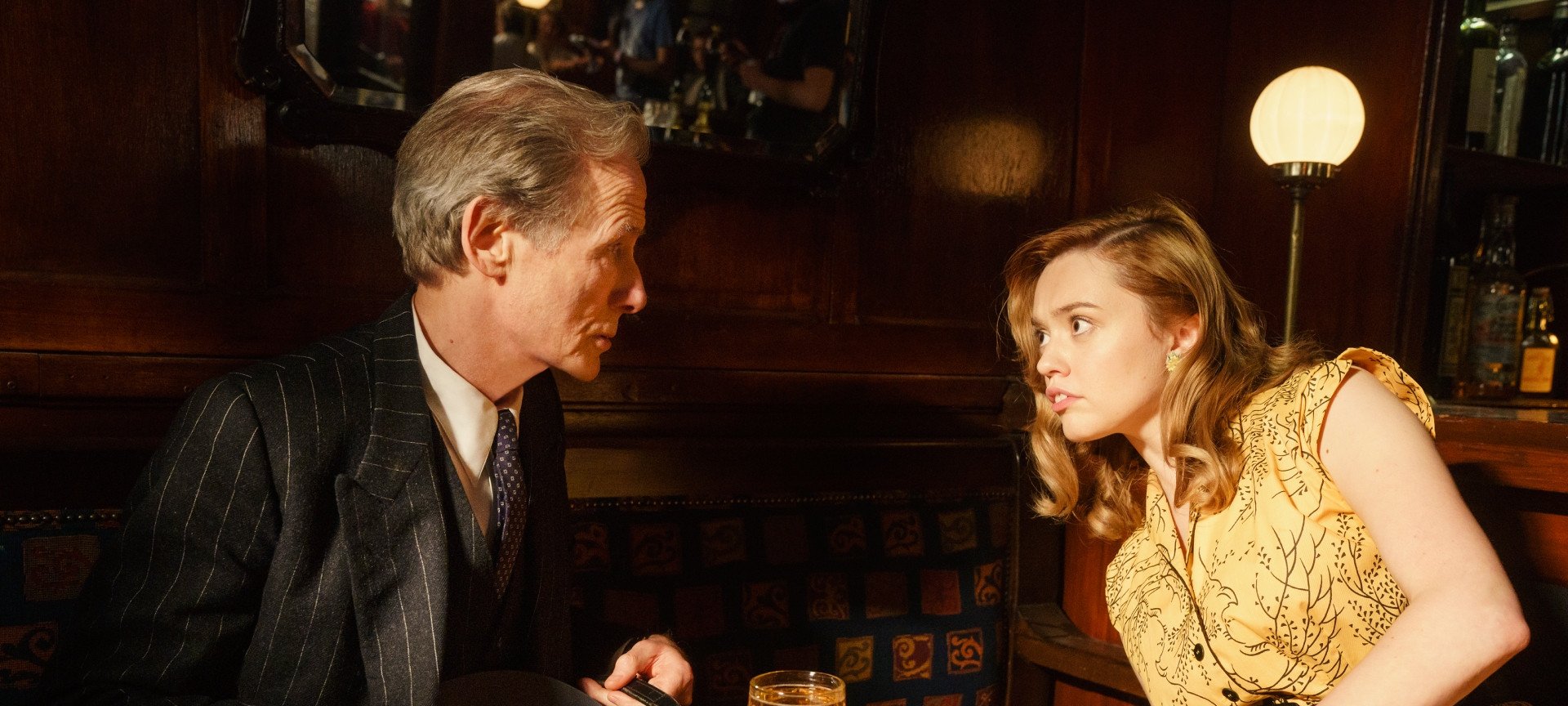
In Oliver Hermanus’s “Living” (2022), we witness a remarkable cultural translation that spans continents and decades. The film, starring Bill Nighy in a masterfully restrained performance, reimagines Akira Kurosawa’s 1952 masterpiece “Ikiru,” itself inspired by Leo Tolstoy’s “The Death of Ivan Ilyich.” This layered adaptation creates a fascinating meditation on bureaucracy, mortality, and the search for meaning in one’s life.
I watched this movie last Monday, January 6, and since I couldn’t come up with any New Year’s resolutions, I figured I’d use this movie as a bit of a wake-up call during that time of year when SAD usually kicks in, leaving me feeling as bare as a dormant tree. It will serve as a reminder that there is more to life than killing time and adjusting your reactions to whatever is thrown at you.


The film transposes Kurosawa’s narrative from post-war Tokyo to 1950s London with remarkable precision. The setting shift illuminates fascinating parallels between Japanese and British societies – both deeply hierarchical, bound by tradition, and struggling with the weight of their own formalities. Where Kurosawa’s film depicted Japanese bureaucracy through the lens of post-war reconstruction, Hermanus explores British civil service during the dawn of the welfare state.
The film’s portrayal of working life in 1950s London is meticulously crafted. The film’s opening credits sequence serves as a masterful visual overture to its themes of conformity and class structure. Shot from above, we witness a mesmerizing choreography of dark-suited men crossing London Bridge, their bowler hats creating a hypnotic pattern of black circles moving in mechanical precision. This aerial view transforms individual civil servants into an abstract pattern – a visual metaphor for the system’s absorption of individual identity.
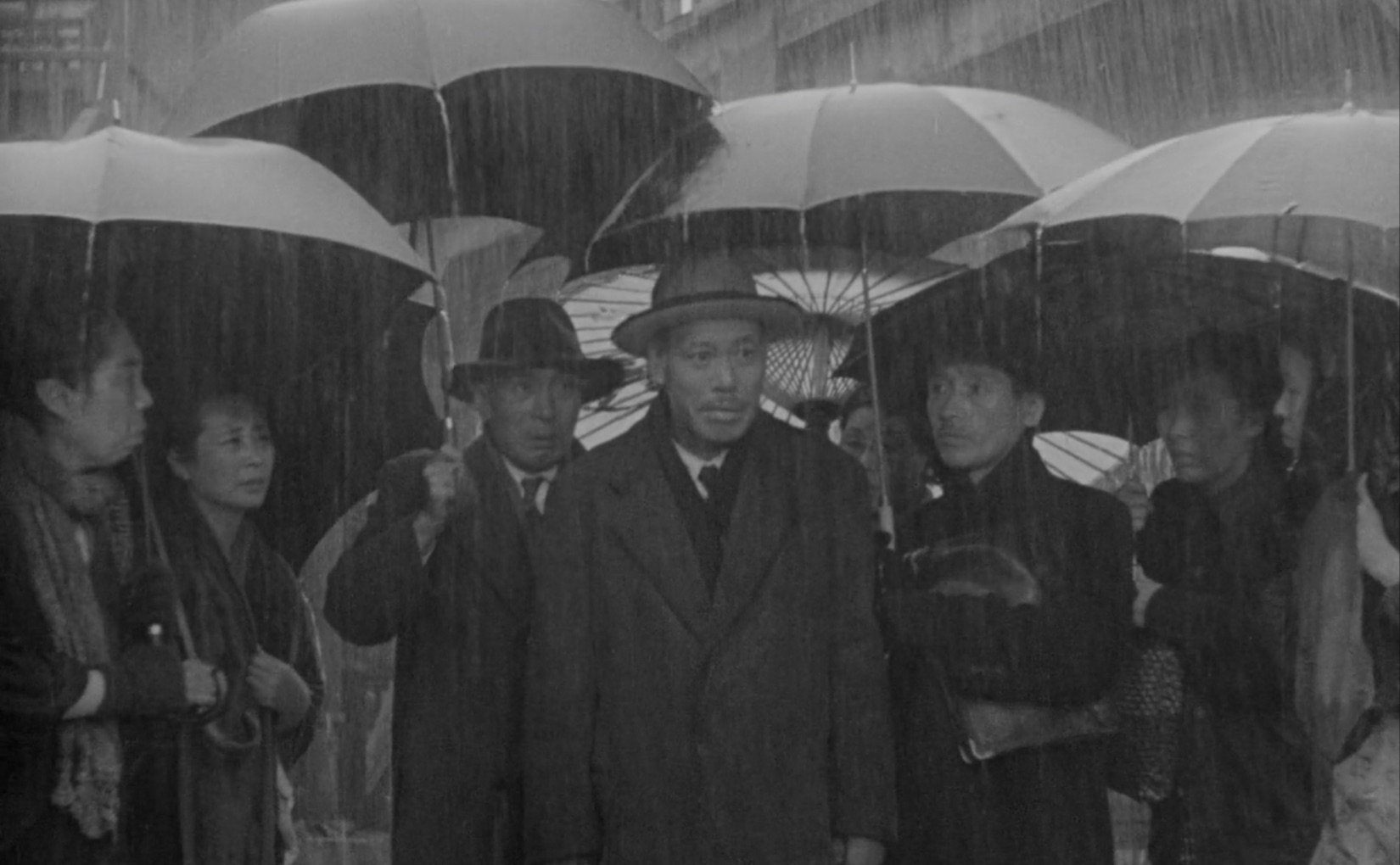
The sequence pays homage to the famous “Umbrella Scene” in Kurosawa’s “Ikiru,” but recontextualizes it for 1950s London. Where Kurosawa used umbrellas to suggest the anonymity of bureaucratic life, Hermanus employs the bowler hat – a quintessentially British symbol of middle-class respectability. The camera’s careful composition turns these hats into a kind of musical notation, with the men’s movements creating a visual rhythm that echoes the mechanical nature of their working lives.
The credits themselves, appearing in a clean, period-appropriate typeface, float above this sea of conformity. Their precise placement and timing work in concert with the movement below, creating a multi-layered opening that establishes both the film’s aesthetic restraint and its concern with systems and structures.
As the sequence progresses, we begin to distinguish Mr. Williams among the crowd – a feat that becomes significant only in retrospect, as we watch him gradually break free from this uniformity throughout the film. The way he emerges from this abstract pattern of hats and suits foreshadows his journey from anonymity to individuality.
The Public Works department where Mr. Williams (Nighy) serves as a senior civil servant becomes a microcosm of British society. The carefully arranged desks, the ritualistic shuffling of papers, and the precise adherence to tea times all speak to a system where order masks stagnation.

Costume designer Sandy Powell crafts a visual hierarchy that speaks volumes about social status and personal transformation. The film opens with a sea of identical bowler hats and dark suits flooding London Bridge – a powerful image of conformity within the civil service. Mr. Williams’s bowler hat serves as a symbol of his position and the rigid system he inhabits. When illness forces him to leave it behind, its absence marks the beginning of his transformation.
The subsequent adoption of a Borsalino hat represents more than a mere change in headwear. The Italian-made fedora, with its softer lines and continental associations, symbolizes Mr. Williams’s gradual liberation from the constraints of his former life. This subtle costume change speaks to a broader rebellion against the suffocating propriety of British bureaucracy.

The precision in costume extends beyond headwear. The gradual loosening of Mr. Williams’s tie, the eventual unbuttoning of his collar, and even the slight dishevelment of his usually impeccable suit all chart his journey from rigid conformity to a more authentic existence. These changes are particularly striking against the unchanged appearance of his colleagues, who remain locked in their sartorial prison.
Wearing Existence: Costume as Existential Metaphor
The costume design in both “Ikiru” and “Living” serves as a powerful visual metaphor for the existential journey that Tolstoy first explored in “The Death of Ivan Ilyich.” Each film uses clothing to express both the weight of social conformity and the gradual awakening to authentic existence, though they do so through distinctly different cultural vocabularies.

The Uniform of Non-Existence
In both films, the protagonists’ initial costumes represent what Tolstoy called a life lived “most ordinarily” – a form of spiritual death disguised as propriety:
– Watanabe’s dark suits and hat in “Ikiru” reflect the standardization of post-war Japanese bureaucracy, where Western business attire represented both modernization and loss of traditional identity
– Mr. Williams’s bowler hat and precisely tailored suit in “Living” embody the British civil service’s rigid hierarchy and emotional suppression
These initial costumes serve as armor against life itself, much as Ivan Ilyich’s dedication to propriety served as a shield against authentic experience.

The Gradual Undressing of the Soul
Both films use subtle changes in costume to chart their protagonists’ awakening:
In “Ikiru”:
– Watanabe’s gradual dishevelment mirrors his breaking free from social constraints
– His hat, initially perfectly positioned, begins to sit askew
– The loosening of his tie reflects his loosening grip on social conventions
– His final appearance in the swing scene, where his clothing moves freely in the snow, suggests a return to childlike authenticity
In “Living”:
– The loss of the bowler hat marks the first crack in Mr. Williams’s facade
– The Borsalino hat represents not just rebellion but a conscious choice of a new identity
– The subtle relaxing of his suit’s precision mirrors his internal liberation
– His final outfit maintains dignity while suggesting comfort in his own skin
The way each film handles this sartorial journey reflects deep cultural differences:
– Watanabe’s transformation involves a more complete dishevelment, reflecting Japanese culture’s understanding of liberation as a form of surrender
– Mr. Williams’s changes are more subtle, suggesting the British capacity for rebellion within conformity
– Both contrast with Tolstoy’s Ivan Ilyich, whose physical deterioration serves as the primary metaphor for his spiritual transformation
Class, Clothing, and Authenticity
Each film uses costume to explore how class structures inhibit authentic existence:
In “Ikiru”:
– The contrast between bureaucrats’ Western suits and the working-class traditional clothing

– The young office girl’s modern dress representing post-war freedom
– Watanabe’s final dishevelment as a rejection of class-based propriety
In “Living”:
– The precise gradations of suit quality marking civil service ranks

– The young woman’s colorful clothing suggesting life outside the system
– Mr. Williams’s Borsalino as a subtle sign of continental sophistication challenging British class rigidity
The Final Garment
Both films end with powerful costume statements:
– Watanabe dies in his loosened, snow-covered clothing, suggesting a final liberation from social constraints
– Mr. Williams’s final appearance shows him in his modified uniform – the Borsalino replacing the bowler – indicating that true liberation can occur within, rather than in rejection of, one’s social role
These costume choices echo Tolstoy’s message that awareness of death can lead to authentic life, but they do so through carefully chosen cultural idioms. The Japanese dishevelment and the British modified propriety represent different paths to the same truth: that genuine existence requires shedding, or at least transforming, the uniforms society demands we wear.
Beyond the Physical
In all three works, clothing serves as a metaphor for what Tolstoy called the “fictional life” – the life lived according to external expectations rather than internal truth. Both films use costume design to visualize what Tolstoy could only describe: the gradual awakening from this fiction to authenticity.

The genius of both adaptations lies in recognizing that this universal journey must be expressed through particular cultural languages of dress and deportment. In doing so, they make Tolstoy’s abstract existential concerns tangible and immediate, showing how the great questions of existence play out in the minute details of how we present ourselves to the world.
The Existential Thread: From Tolstoy to Kurosawa to Hermanus
At the heart of “The Death of Ivan Ilyich,” Tolstoy poses a devastating question: “What if my whole life has been wrong?” This existential inquiry echoes through both “Ikiru” and “Living,” each adaptation finding its own cultural language to explore this universal concern. The visual grammar of both films serves this central question, though they approach it through distinctly different cultural prisms.
Tolstoy’s novella examined this question through the lens of 19th-century Russian society, where Orthodox Christianity and aristocratic values shaped the understanding of a “proper life.” Kurosawa translated this inquiry into post-war Japanese society, where questions of purpose became particularly acute amid reconstruction and changing values. Hermanus relocates it to 1950s Britain, where class structures and emotional restraint created their own form of spiritual imprisonment.
In each iteration, the protagonist’s awakening to life’s true meaning is preceded by a recognition of social performance. Ivan Ilyich realizes his life has been lived “most simply and most ordinarily and therefore most terribly.” Kurosawa’s Watanabe finds that his decades of stamping papers have produced nothing of value. Mr. Williams discovers that his perfect embodiment of civil service propriety has been a form of living death.
Visual Languages of Awakening
Where Tolstoy used precise prose to dissect his protagonist’s spiritual crisis, both films employ careful visual strategies to externalize this internal journey:
– Kurosawa uses stark contrast and dramatic weather to reflect Watanabe’s emotional states, with snow and rain serving as powerful metaphors for cleansing and renewal.
– Hermanus employs the gradual softening of visual rigidity – from the geometric patterns of bowler hats to the free-flowing movement of children in the playground – to show Mr. Williams’s liberation from social constraints.
Both films share a crucial understanding: that the answer to Tolstoy’s terrible question lies not in grand gestures but in small, meaningful actions. Watanabe’s playground and Mr. Williams’s park represent more than public works projects – they are physical manifestations of their creators’ breakthrough to authentic living.
The Weight of Time
All three works deal poignantly with time’s passage:
– Tolstoy’s Ivan Ilyich realizes too late that his life has been misspent
– Kurosawa’s Watanabe races against time to complete his playground
– Mr. Williams’s measured transformation suggests that even a brief period of authentic living can redeem a lifetime of conformity
Cultural Translations of Truth
What makes both film adaptations remarkable is how they maintain Tolstoy’s essential truth while speaking through their own cultural idioms:
– Kurosawa expresses it through the lens of giri (duty) transformed into meaningful action
– Hermanus finds it in the British capacity for quiet revolution within seemingly rigid structures
Legacy and Memory
Each work concludes by examining how others remember the protagonist:
– Tolstoy’s mourners are primarily concerned with promotion opportunities
– Kurosawa’s bureaucrats briefly celebrate Watanabe before returning to their old ways
– Hermanus’s colleagues maintain their reserve, but with a new understanding glimpsed through their constrained emotions
Yet in all three versions, there’s a small group who truly understand the transformation they witnessed. This understanding becomes a kind of torch, passed from Tolstoy’s pages through Kurosawa’s lens to Hermanus’s camera – the possibility that one life, properly lived even for a short time, can illuminate the way for others.
In the end, “Living” accomplishes something remarkable: it takes Tolstoy’s existential question and Kurosawa’s humanist answer and filters them through the precise visual language of British society, creating something both culturally specific and universally resonant. Through its careful attention to visual detail – from the geometric patterns of bowler hats to the free movement of the final scenes – it shows how the great questions of existence can be explored through the smallest details of human behavior and social custom.
The film reminds us that the search for meaning, while universal, is always experienced through the particular – through specific hats and suits, through precise ways of moving through space, through culturally determined ways of showing or hiding emotion. In doing so, it achieves what great art should: it makes the universal deeply personal, and the personal universally understood, making you question (again) what is after all the purpose of living.
References and stills
Scene by Green Ikiru
Scene by Green Living

The Death of Ivan Ilyich (full text via University of Minnesota Twin Cities)
Learning about Movies episode 78
131 days ago life took a weird, sharp turn after a few months of my driving it erratically in and out of course. Because I am prone to think of my life as a movie or perhaps as a series of pilot episodes in shows that never get aired, I failed to realize that maybe real life was happening. And I have a problem with this. My mind anticipates all kinds of scenarios, dramatic dialogues and plot twists, failing to see what’s right in front of me, failing to hear Caetano‘s warning that life is after all real and skewed. I insist on other melodies, I insist on not getting tired of hoping that one day I will get to be everything.
My homeless heart
Wants to keep the world
In me
131 days ago we coincided in space and time; he told me I was making him travel, I didn’t realize he was making me come home. For once, life was not about being the rebel in a made up cause, it was not about coming up with the perfect character for the occasion, it was not about trying to be perfect, it was not about packing and going somewhere trying to find whatever is needed at the moment to feel more alive. It was about staying. I didn’t know that to stay took a special kind of courage. I have spent well over seven thousand days of my adult life being adventurously brave, going everywhere, doing everything, preferably on my own. Along the way I collected all the clichés of falling madly, deeply and foolishly in love, of getting married and divorced, of hurting and getting hurt and feeling that I have committed the worse sin my twelve years of Catholic, yet somewhat liberal, education helped me identify, I have wasted my time and have, of course, ended up being wasted by it. Staying, in the same way as getting older, is not for the faint of heart. Staying means you have to face life as it is not as you think it was meant to be.
131 days ago I begun to understand what years of fictional manipulation have done to me, how they have created the most unrealistic expectations and contributed to an almost complete emotional disarrangement. In the midst of my inability to deal with what was happening, I have read these wise words:
Your deepest beliefs about seduction were carefully crafted by high-capitalist strategists. Lust and fantasy are opiates of the masses, easily manipulated into shapes that human animals fall for, over and over again.
I have never really taken advice columns very seriously, probably because I tend to be a bit of a snob, but every single word Heather Havrilesky poured into her column of February 28, struck a chord and I understood that yes, it was really about surrendering to reality with no futile embellishments. And still, 131 days were not enough to learn that the assumptions one makes about one self and others are also created by all the nonsense around you and that they are not real. For 131 days I have promised myself, almost everyday, that I was not going to fall in that trap, I was going to let life get real because it might not be the most glamorous or exciting place to be but you have at least a chance of not seeing life disappear without getting to live it. But, self-sabotage is a powerful force, “a way of avoiding that moment of showing up, of facing potential loss, of being strong enough and courageous enough to surrender to the unknown — but also, to surrender to the goodness of ordinary human beings.” 131 days ago, getting hurt living my fictional life was easy enough to deal with because fictional feelings tend to be overtly dramatic but shallow.
Getting hurt in real life gets you broken.
References
Caetano Veloso, O quereres, Coração Vagabundo
William Shakespeare, Richard II

A smile that blinds with blitheness, overspending
Upon this gasping sightless round of fun …
Das Karussell, Jardin du Luxembourg, Rainer Maria Rilke
Photo: San Diego, 2014
Remembrance of things past is not necessarily the remembrance of things as they were
I have spent the last couple of weeks trying to account for every month of 2017. I needed to go through all the photos in my phone to be able to do this. It seems that without them it would not have been possible for me to recall what I have lived. 2017 was not an easy year for me and for those around me. I broke someone’s heart and got badly bruised by someone else. Some sort of cosmic retribution I would say, if I was inclined to believe in a such thing.
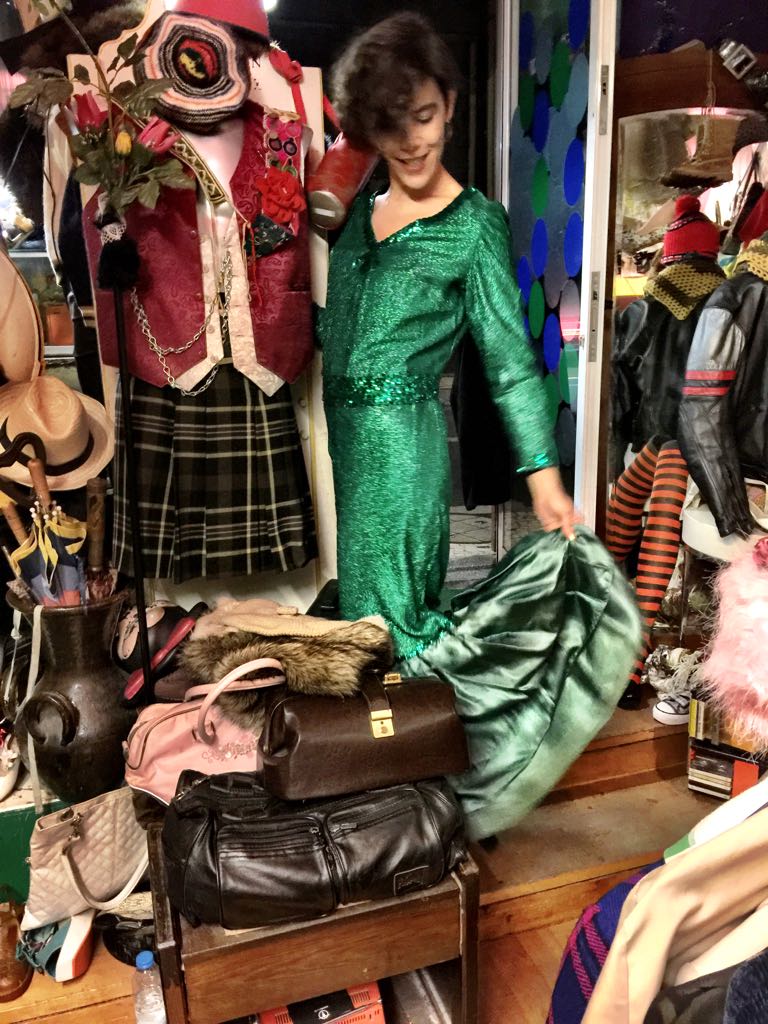
I don’t remember much happening in January 2017. I remember that I did not celebrate New Years, I went to bed before midnight. For the past eleven years I lived with someone who did not “believe in that sort of thing” and accommodated. I do believe in starting over, either on January 1st or whenever there is a need to do so. The best of January 2017 was hoping for something better to come along during the rest of the eleven months ahead. Daydreaming has always seemed to me another form of making plans. I did play dress up at Fatima‘s which seems to be my favourite form of therapy and was happy to find my Mozambique travel diary.
Why, what’s the matter,
That you have such a February face,
So full of frost, of storm and cloudiness?
I particularly dislike the first three months of every year. They are normally cold and grey and wet and February does feel like paradoxically long most of the times, but this one I actually remember it as being a happy month, celebrating Futurism and Almada in the voice of talented friends and art exhibitions, going back to Fatima’s for a somewhat surreal fashion shoot, having my hair cut and feeling incredibly cool and authentic as a tomboy, getting on stage for Flamenco tangos and fandangos and being busy with costumes and make up backstage.

March was also surprisingly good: Filipe Catto doing Variações, finding the life of strangers inside second-hand books, commuting in Lisbon with people that have no end, as Almada would say, those are the best people; seeing friends’ dreams come to life, Anna Karenina remixed at TNSJ (How she dies) and finally gaining momentum to read it all, page after page, without spiking details, Olivier Saillard‘s manifesto, waiting around for friends who are always late, going back in time, Macbeth’s open rehearsal and being reminded of the absolute privilege of hearing António M. Feijó
April came and it was not the cruelest month. Going away, enjoying bad habits at cool smokers lounges, arriving in Sarajevo, the sun, the snow, the coffee, new Friends, their stories, the history, the drive to Mostar, long conversations on everything and nothing, swan lake reloaded, the beauty, hanging out over drinks and photos and dance, “come what sorrow can it cannot countervail the exchange of joy”. Sarajevo might not have changed my life but has changed something inside me forever in the way I am able to relate and feel immense love for other people and to the moments we shared. Realizing I live somewhere in musical schizophrenia, absolutely loving two of the best concerts of the year between Heavy Metal and Fado, and that this actually helps. Every day.

May walked backwards: going back to the roots that sometimes still clutch, being back in Siena in great company, getting lost in museums, being silly enough to play La Niña de Fuego, going back to the music that once made sense

June chasing angels and finding them: Loft living in DTLA, getting an education at Los Feliz, unexpected gifts, falling in love with a bookstore, the kind and dapper gentlemen at Clifton’s, old school partying, the Los Angeles Athletic Club, being back at the MOCA, stars that never fade, hanging out with some of the coolest Ladies I know, feeling in heaven at the Way we Wore, feeling at home at LACMA, “The city is named for the angels, And its angels are easy to find”, on Beauty and Consolation, Shakespeare, being called Hope and the freedom of learning by heart, feeling at peace in Porto, clowning around on stage.
When to the sessions of sweet silent thought
I summon up remembrance of things past,
I sigh the lack of many a thing I sought,
And with old woes new wail my dear time’s waste:
Then can I drown an eye, unus’d to flow,
For precious friends hid in death’s dateless night,
And weep afresh love’s long since cancell’d woe,
And moan th’ expense of many a vanish’d sight;
Then can I grieve at grievances foregone,
And heavily from woe to woe tell o’er
The sad account of fore-bemoaned moan,
Which I new pay as if not paid before.
But if the while I think on thee, dear friend,
All losses are restor’d, and sorrows end.
July “I believe I read most of it with my eyes shut” Spring’s Awakening, Summer sunsets, flamingo shoes, walking on sunshine, flirting with writing machines and getting no answers, seeing the fog clear; “life is a matter of taste”.
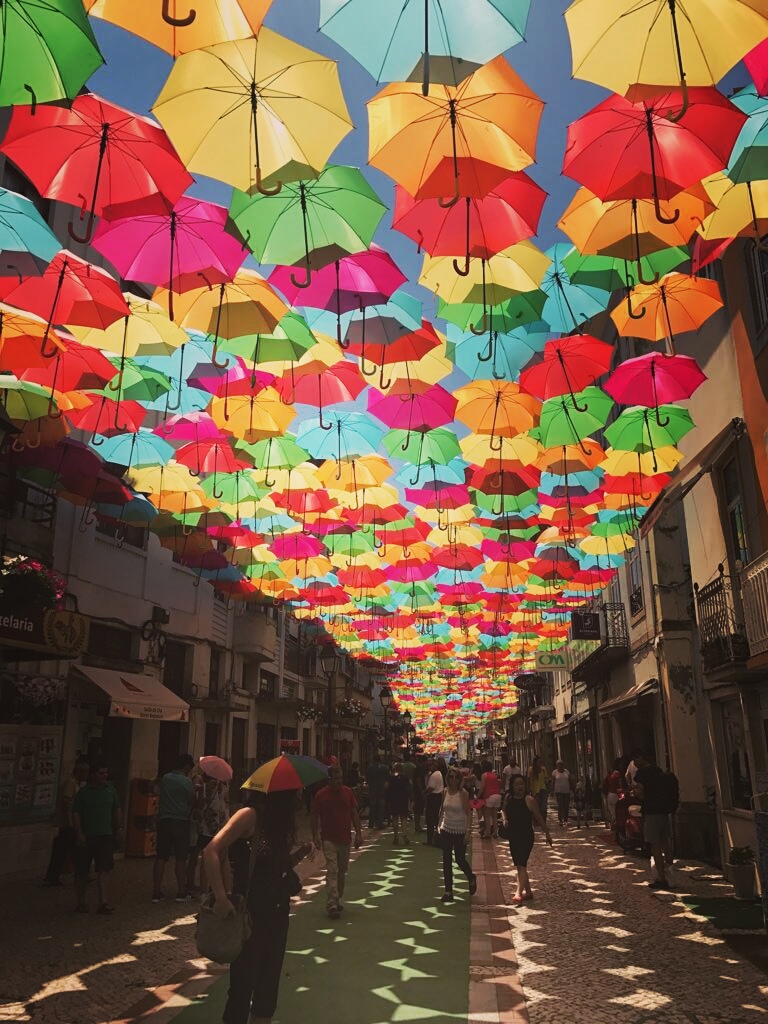
August getting older and none the wiser: Chance encounters have consequences too, birthday surprises, finally returning to Mérida and making it to the classical theater festival, between a rock and a hard place, checking works of art walk by, music does save your mortal soul (writing letters might not). Fátima moved to Braga and I almost did as well.

September “Music melts all the separate parts of our bodies together.” Going kitsch, Being hugged by strangers, getting closer, Rosalía e Raül Refree at Theatro Circo, Revisiting Viana and more talented friends, realizing that nothing lives there anymore, Lisbon stories por buleria, reconnecting with Luis after having met in Boston, Still writing letters (with a pen), Jazz with a view, bumping into Lola Lola, Book fairs and pulp fictions, Being somewhat afraid of Virginia Woolf, meta coincidences, Being teletransported to The Zap via Ian’s syndrome, Revisiting Mr. Vertigo’s last (together) space, Being disarmed by words, bedtime stories and playlists feeling like goodnight kisses, Between lived words and word games, Street poets on the verge of insanity. Facing the truth and having it added to my pillow book.
I wasted time, and now doth time waste me
October “There is nothing in the dark that isn’t there when the lights are on.” A road trip through a black hole, Spiraling into someone else’s talent, Seeing George and Martha come to life, The apparent insight and kindness of strangers, Getting it wrong, learning where not to go, learning to let go, forgetting the door was open and letting chance walk right in (again), the Safety of favourite places and favourite people, Walls quoting Sartre, Lisbon stories, Healing noises, Wonder walks, wonder walls and the best guide in town, Black cats and English eccentrics, Bad concerts with cool friends, Reaching Point Omega, Making peace with Virginia Woolf through Orlando, “To put it in a nutshell, he was afflicted with a love of literature. It was the fatal nature of this disease to substitute a phantom for reality.” I have fallen in love with words. The ones I wanted to read, the one’s the poet on the other side knew were the right ones.

November “O bom é ser inteligente e não entender. É uma benção estranha, como ter loucura sem ser doida.” (The good thing is to be intelligent and not to understand. It’s a strange blessing, like having madness without being crazy.) In love with Josef Isräels‘ Mijmering, Stendhal syndrome episodes, Daydreaming and insomnia, Fictional love affairs through jet lag induced illusions – such is the power of words: they make you see things that aren’t there. Teenaging in Yichang, getting to know Frida who met at me at the airport wanting to know if my name really meant hope, hanging out with Cathy, Being a lucky charm, Getting Lost in translation and still feeling better than Charlotte, Tai Chi classes on airplanes, the sunset in Xangai and the sunrise in Amsterdam, Dark Porto, Lisbon stories on disappointment and being a spoiled brat, Life according to George Costanza, Flying solo, Getting it (so incredibly) wrong and trying to take the high road, Lisbon stories – the cold shoulder episode, saved by the happiness of strangers and a wise beyond her years long distance friend, Chasing walls, 3 a.m. dinners and the warmth of platonic love, Boots, Songs about boots, Good concerts with the same cool friends and some more, Drafting fictional memories, “For once the disease of reading has laid upon the system it weakens so that it falls an easy prey to that other scourge which dwells in the ink pot and festers in the quill. The wretch takes to writing. ” Flying high and falling hard: Considering emotional exile, Soap bubbles as reality filter

December “São tudo fantasias que o cinema projectou no meu olhar” (They are all fantasies that the cinema projected in my gaze): Letting someone else’s clothes and music do the talking; Being called a pearl farmer and realizing that every once in a while casting pearls to swine is no big deal; I’ll still have plenty left. The circus, moments of pure joy, remembering my Grandparents, because they were the ones who used to take me when I was a kid, Sharing heartbreak stories during the storm with a name, pretending to be Mia Wallace and then dreaming of being Vivian Rutledge, better yet, Florence Carala (there was enough mist for that), If only I was Jackie Demaistre, Facing lost possibilities, Befriending misfits while drinking coffee and talking for an hour at gas stations, Going back to the classroom and considering that I might actually enjoy teaching, Midnight strolls during Sagittarius birthdays, Playing diva with the Diva, Holly Golightly gifts for breakfast, Christmas Day at the movies, making up gangster stories at Turkish restaurants, Bumping into Pedro from school and being 9 again, ivory colored letters in real envelopes with real stamps, feeling connected while trying to disconnect, Synthesizer freaks, being Alice but not in the city, time lapsing, picking up where we left off, So many ways to be (“no olvides que solo eres real cuando tocas y te tocan“), the Clear Insight, Incredible Patience, Undivided Attention and Unconditional Love of old Friends. Braga doing more for my sanity this year than any shrink could have ever done. “And the rest is rust and stardust.”
I can only note that the past is beautiful because one never realises an emotion at the time. It expands later, and thus we don’t have complete emotions about the present, only about the past
I think this is the first time I try to write some kind of “memory”. I am not very good at describing events, everything that has happened seems to have only a translation in how places, books, movies, plays, poems, music, little details, events, actions and the words of others have made me feel. And, in 2017, most of them have hurt me deeply. This year, I celebrated New Year, for two whole days. On December 30 I went to a punk rock show and decided not to move away from the mosh pit as some sort of “shock therapy” and it felt good. I spent New Years Eve with my best friend and his family and even though we had not thought of going out, we did and danced the night away until morning. And all this might not solve anything, but just giving myself away to music makes me feel both hugged by the world and ready to restart.
The appeal of inebriating oneself.
The appeal of the dance and of the shout,
the appeal of the colorful ball,
the appeal of Kant and of poetry,
all of them . . . and none of them resolves things
Today (January 1st) I went back to the circus and felt like crying during Duo eMotion‘s act. Real life is never this perfect. Or beautiful. And then, sometimes it happens. I went for coffee at my favorite place in Porto and wished by favorite waiter a Happy New Year and he just called me my love and kissed me. These little details end up, in a way, making up for a lot of the mistakes and disappointments of the previous year.
Unspoken feelings are unforgettable
If you set them free by writing unnecessarily long posts they might just go away.

References:
Vladimir Nabokov, Marcel Proust, William Shakespeare, Clarice Lispector, Virginia Woolf Anais Nin, Samuel Beckett, Carlos Drummod de Andrade, Andre Tarkovsky, António Variações, The Twilight Zone

are inseparable. Appreciating their interconnectedness is the gateway to understanding
Lao Tzu
Rounded path at Ciutat de les Arts I les Ciències (Valencia, 2016)







 Stories from A Closet of Errors