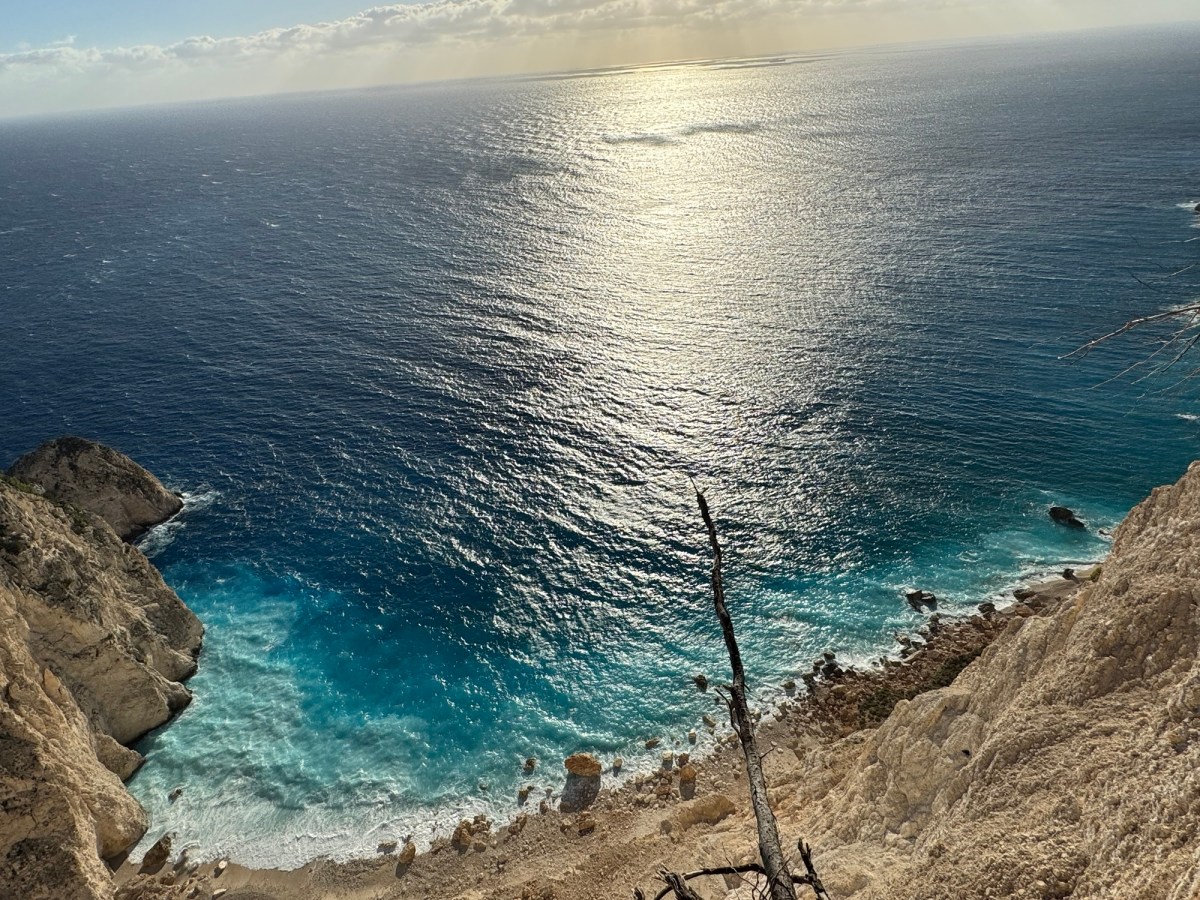
I would quit my job, sell my house and set out for Ithaka because I think I belong to that sea
If I were guaranteed not to fail… I think I’d attempt to be honest with myself. To understand why certain songs make me cry, what wound keeps resurfacing in different masks, what version of myself I’m most afraid to become.
Maybe the fear isn’t really about failing, but about what succeeding would mean. About choosing the untethered life over the anchored one.
As you set out for Ithaka hope your road is a long one, full of adventure, full of discovery. Laistrygonians, Cyclops, angry Poseidon—don’t be afraid of them: you’ll never find things like that on your way as long as you keep your thoughts raised high, as long as a rare excitement stirs your spirit and your body. Laistrygonians, Cyclops, wild Poseidon—you won’t encounter them unless you bring them along inside your soul, unless your soul sets them up in front of you.
Hope your road is a long one. May there be many summer mornings when, with what pleasure, what joy, you enter harbors you’re seeing for the first time; may you stop at Phoenician trading stations to buy fine things, mother of pearl and coral, amber and ebony, sensual perfume of every kind— as many sensual perfumes as you can; and may you visit many Egyptian cities to learn and go on learning from their scholars.
Keep Ithaka always in your mind. Arriving there is what you’re destined for. But don’t hurry the journey at all. Better if it lasts for years, so you’re old by the time you reach the island, wealthy with all you’ve gained on the way, not expecting Ithaka to make you rich.
Ithaka gave you the marvelous journey. Without her you wouldn't have set out. She has nothing left to give you now.
And if you find her poor, Ithaka won’t have fooled you. Wise as you will have become, so full of experience, you’ll have understood by then what these Ithakas mean
I can whistle almost the whole of the Fifth Symphony, all four movements, and with it I have solaced many a whining hour to sleep. It answers all my questions, the noble, mighty thing, it is “green pastures and still waters” to my soul. Indeed, without music I should wish to die.
Edna St. Vincent Millay letter to Allan Ross MacDougall
To imagine existence without music might be biologically possible but it would be emotionally smaller. Music operates on a frequency that bypasses the intellect and speaks directly to something primal within us. Unlike spoken language, which divides us into linguistic communities, music creates a universal grammar of emotion. A minor key can evoke melancholy in a child who has never learned the word “sadness.” A triumphant major chord can lift spirits across cultures, generations, and personal circumstances. This universality suggests that music doesn’t merely accompany human experience—it is woven into the fabric of consciousness itself.
Music, uniquely among the arts, is both completely abstract and profoundly emotional. It has no power to represent anything particular or external, but it has a unique power to express inner states or feelings. Music can pierce the heart directly; it needs no mediation. One does not have to know anything about Dido and Aeneas to be moved by her lament for him; anyone who has ever lost someone knows what Dido is expressing. And there is, finally, a deep and mysterious paradox here, for while such music makes one experience pain and grief more intensely, it brings solace and consolation at the same time. (Oliver Sacks, Musicophilia: Tales of Music and the Brain )
When we consider a world stripped of this universal language, we imagine not just silence, but a profound disconnection from our own emotional landscape.
First dances, lullabies, funeral hymns, graduation marches—these melodies become the soundtrack to our most significant moments. They don’t merely accompany these experiences; they preserve them in a form more vivid than photographs, more immediate than written words. A few notes can transport us instantly across decades, reconstructing not just the memory but the emotion of a moment with startling clarity.
Without music, our memories would lose this dimensional quality, the emotional peaks and valleys of our lives would lack their soundtrack, making the landscape of personal history less navigable, less meaningful.
Even beyond its role in significant moments, music provides the rhythm that makes daily existence bearable, even beautiful. Work songs have existed in every culture because they transform labor from mere drudgery into something approaching art. The person who whistles Beethoven during difficult hours understands that music doesn’t change circumstances—it changes our relationship to circumstances. It provides the cadence that makes the unbearable bearable, the monotonous meaningful.
Consider the silence that would replace this constant, subtle soundtrack.
That life without music would not be worth living might initially seem hyperbolic. However, it points to a deeper truth about being human, we don’t merely survive on bread alone—we require beauty, meaning, connection, and transcendence. Music provides all of these simultaneously. It is the art form that most directly addresses our need for both individual expression and communal belonging, for both intellectual stimulation and emotional release.
Life may be technically possible without music, but it would be missing a profound transformation: the ability to turn time into beauty. Music does not change the fact that hours pass, that we suffer, or that we long for what is lost. But it alters how we inhabit those hours, how we carry that suffering, and how we hold on to memory. In this way, music does not merely decorate time — it redeems it. And in that redemption lies its deepest necessity.
If I should ever die, God forbid, let this be my epitaph: THE ONLY PROOF HE NEEDED FOR THE EXISTENCE OF GOD WAS MUSIC
Kurt Vonnegut, A Man Without a Country
P.S. I read this today:
As a graduate student, I cared for my grandmother, who was a big fan of Ozzy’s band Black Sabbath herself. Any time we went anywhere, we put on our playlist and sang along. When, during the Covid-19 pandemic, I cut off part of my fingertip and lost access to my campus library, I had Ozzy in my ear for much-needed heavy metal pep talks as I took my PhD qualifying exams.
And when I lost both my grandmother and my California home the following year, I still had Ozzy. His music was the score as I finished my dissertation from my parents’ basement and landed my dream job at Iowa Wesleyan University. Through the submission of my dissertation and driving nearly 1,200 miles across the country to start my new job, I listened to the Blizzard of Ozz album.
Picture this: It’s 1990, and the Scorpions are belting out “Winds of Change” to massive crowds across a transforming Europe. Just a year earlier, people around the world had woken up to the impossible news that the Berlin Wall was actually falling—that the concrete symbol of Cold War division was being torn apart by ordinary people with hammers and hope.
For those who were 19 in 1990, watching this unfold, the song became more than just a power ballad. It was an anthem of hope that seemed, for a while at least, to materialize into genuine possibilities. The world felt suddenly malleable in a way it hadn’t for decades. Meanwhile, in academic circles, scholars were beginning to re-examine how fear has shaped our world, while Norman Rockwell’s 1943 painting “Freedom from Fear” continued to hang in museums and some collective memories as a reminder of what we’re all supposedly working toward.
What connects these seemingly disparate cultural moments? They all grapple with the same fundamental question: How does fear drive human transformation?
In the future days, which we seek to make secure, we look forward to a world founded upon four essential human freedoms.
The first is freedom of speech and expression–everywhere in the world. The second is freedom of every person to worship God in his own way–everywhere in the world.
The third is freedom from want–which, translated into world terms, means economic understandings which will secure to every nation a healthy peacetime life for its inhabitants-everywhere in the world.
The fourth is freedom from fear–which, translated into world terms, means a world-wide reduction of armaments to such a point and in such a thorough fashion that no nation will be in a position to commit an act of physical aggression against any neighbor–anywhere in the world
Franklin D. Roosevelt Annual Message to Congress, January 6, 1941; Records of the United States Senate; SEN 77A-H1; Record Group 46; National Archives.
I have started reading Robert Peckham’s “Fear: An Alternative History of the World”which reads like a detective story where the criminal and the hero are the same person. Starting with the Black Death in the 14th century, Peckham traces fear’s dual role throughout history—sometimes as a tool of oppression, sometimes as a catalyst for progress.
His central insight is provocative: fear has served “both a coercive tool of power and as a catalyst for social change.” Think about it. The same emotion that allows dictators to control populations also drives revolutionary movements. The fear of injustice motivates protests. The fear of environmental collapse spurs climate action. The fear of authoritarianism strengthens democratic institutions.
Peckham’s “shadow history” approach reveals how our most transformative moments—from the Renaissance to the Civil Rights Movement—often emerged from confronting our deepest collective anxieties rather than avoiding them.
Now flip to Norman Rockwell’s “Freedom from Fear.” Painted during World War II, it shows parents tucking their kids into bed while war headlines lurk in the background. It’s pure Americana—the suburban dream of safety, stability, and sleeping soundly despite the chaos outside.
But here’s what makes it powerful: Rockwell wasn’t just painting propaganda. He was painting aspiration. The image says, “This is what we’re fighting for—not just victory, but the right to live without constant anxiety.”
The painting represents the endpoint that Peckham’s historical analysis points toward: societies stable enough that families can exist in protective bubbles of normalcy, even when the world burns around them.
Which brings us to the Scorpions’ “Winds of Change.” Released in 1990, the song became an unofficial anthem for the end of the Cold War—but more than that, it captured something profound about generational hope. For those who were teenagers and young adults watching the impossible become possible, the song wasn’t just about political change. It was about the sudden realization that the world was far more malleable than anyone had imagined.
Whatever one might think about the song’s musical merits, it became a soundtrack for hope that, for a while, seemed to materialize into real possibilities. The fear that had held Europe in a stranglehold for decades—fear of nuclear war, of permanent division, of unchangeable systems—suddenly transformed into collective action and unprecedented change.
The song works because it embodies Peckham’s thesis in three-and-a-half minutes of soaring guitar solos. The fear that had held Europe in a stranglehold for decades became the very force that motivated people to tear down walls and demand change. The “winds” weren’t just meteorological—they were the accumulated anxieties of generations finally finding release.
Like Rockwell’s painting, the song also represents an aspirational moment—the belief that we could move from a world defined by fear to one defined by possibility.
We’re living through our own “Winds of Change” moment. Collective anxieties about technology, climate change, political polarization, and social inequality are reaching tipping points around the world. The question isn’t whether these fears are justified—Peckham’s analysis suggests that’s the wrong question entirely.
The real question is: Will we let fear paralyze us, or will we harness it as a force for positive transformation?
Peckham’s historical analysis gives us the intellectual framework to understand fear’s complexity. We need to recognize when fear is being weaponized against us and when it’s signaling genuine problems that require action.
Rockwell’s vision reminds us what we’re aiming for: societies where people can sleep peacefully, secure in their freedom from existential anxiety.
And the Scorpions? Well, they remind us that transformation is possible—that the walls we think are permanent can come tumbling down when enough people decide they’ve had enough of living in fear. For those who lived through 1989-1990, watching seemingly impossible changes unfold in real time, the song captured not just a political moment but a feeling of generational possibility that the world could actually be different.
That sense of hope materializing into reality—however briefly—offers a template for how accumulated fears can reach tipping points and transform into collective action.
I was ten when my mum gave me that glossy brown journal—Marie Antoinette’s young face gazing from the cover, complete with a tiny lock and key to guard my secrets. I wrote constantly in those early days. Daily events, conversations, how words made me feel, news that somehow seemed to matter to my small world. But mostly, I wrote to figure out who I was.
Childhood comparisons had done their damage early. I’d grown used to being measured against other kids, which sent me down a particular path: constantly crafting personas that might be more palatable, more admirable, simply *better* than whoever I actually was. Looking back at those early diaries now, they read like character studies—as if I was unconsciously preparing for a writing career that never materialized, disappointing what seemed to be my father’s brightest hopes for me.
Decades later, I still turn to writing for the same reason: to make sense of myself. Getting older, it turns out, didn’t automatically make me more adjusted to the world. If anything, the questions have gotten more complex, the contradictions more pronounced. The temptation to reinvent myself—to create yet another, better version—remains surprisingly strong.
I know what you’re thinking. *Have you tried therapy?* Yes, I’m in therapy. Not with a particularly strong sense of purpose or dramatic results, but I’m there, showing up, trying to untangle the same threads I’ve been pulling at since I was ten years old with a locked diary.
There’s something both comforting and unsettling about this consistency—that the fundamental questions haven’t changed, only deepened. Who am I when I’m not performing? What parts of myself am I still hiding, even from me? And perhaps most importantly: Is the search itself the point, or am I still waiting to arrive at some final, polished version of myself?
The journal pages don’t keep filling up anymore. I mostly struggle to find the time and the energy. What still keeps me connected to writing is the mechanics and tools. I still enjoy handwriting and pens.
There is no greater agony than bearing an untold story inside you.
I lose track of time—not just the hours in a day, but the architecture of time itself. Days blur into weeks, weeks into months, and suddenly I’m looking back at years that feel like they happened to someone else, in some other lifetime I can barely access. It’s not simply forgetting; it’s a deeper disorientation, an inability to place the events of my life on any coherent timeline.
This temporal blindness has been building gradually, like fog rolling in so slowly you don’t notice until the familiar landmarks of memory have disappeared. Most of my days feel interchangeable now, lacking the distinct markers that once helped me navigate the story of my own life. Without these anchors, time becomes elastic and strange—months can feel like weeks, years like months, and recent events feel ancient while distant memories seem immediate.
But some moments still cut through the haze with startling clarity. Travel creates these temporal anchors naturally—the sensory richness of new places, disrupted routines, the way my brain has to pay attention when everything is unfamiliar. So do moments of intense freedom and comfort, those rare times when I feel most myself, when social expectations fall away and I’m doing exactly what I want without compromise. And certain people, too, become markers in time—those who draw out different parts of me or create space for conversations that feel like they matter.
What strikes me about these clear moments is their common thread: they’re all times when I feel fully alive and present, when I’m engaged rather than going through motions. They represent pockets of authentic experience in an otherwise routine existence. The tragedy isn’t that I can’t remember what happened—it’s that so much of what happens doesn’t feel worth remembering.
Perhaps the gradual erosion of temporal landmarks isn’t just about aging or the sameness imposed by modern life. Maybe it’s about how rarely we allow ourselves to be fully present, how infrequently we create conditions for the kind of aliveness that makes moments stick. Time may not actually be speeding up—we might just be sleepwalking through most of it, leaving behind a wake of forgettable days that our minds, quite reasonably, choose not to preserve.
The solution isn’t necessarily to manufacture constant novelty or drama. But recognizing what makes certain moments memorable—travel, freedom, meaningful connection—might offer clues about what our minds need to start forming temporal anchors again. Even small acts of presence and intention might help distinguish one day from another. They create the kind of memories that come with their time signatures intact.
Summer, 1992. I was leaving my boyfriend’s house to head home. The night air held that particular warmth of early summer evenings—the kind that makes you believe everything is possible. I imagine I was thinking about England, where I’d soon be studying. Perhaps I was daydreaming about the perfect life that seemed to be unfolding before me. It was full of love. I was utterly in love.
And then, nothing.
The next moment in my memory is waking up in a hospital bed, looking at a woman I couldn’t recognize—my own mother. They tell me I flew 80 meters across the street when the car hit me. The driver never stopped. Never looked back to see the aftermath of their impact, both the physical body they’d broken and the future they’d altered.
I’ve had to reconstruct this night through police reports and courtroom testimonies. Witnesses described what I cannot remember. It’s disorienting to have such a significant moment of your life exist only in the accounts of strangers. It’s as if the narrative of my life has a tear in it, edges that don’t quite meet.
This was the summer before England. Before university. Before what should have been the beginning of everything.
What followed was not the perfect life I had meticulously planned. Looking back now, I see how that night became the first domino in a long sequence of self-destruction. The person who flew across that street never quite landed. Or perhaps she landed as someone else entirely.
I’ve spent years trying to understand why surviving led to destroying. Was it the traumatic brain injury altering something fundamental in my decision-making? Was it the brush with mortality that made me reckless? Or was it simpler than that—the realization that control is an illusion, that perfect lives don’t exist, that plans are just elaborate wishes?
The driver who hit me took many things. My memories of that night. My sense of safety. My trajectory. But perhaps the most significant thing they took was my belief in the orderly progression of life—that good choices lead to good outcomes, that we are the architects of our futures.
I’ve come to understand something else in the years since. That perfect life I thought I was destroying after the accident? It was never real. It was never possible. It existed only in the mind of a young woman who hadn’t yet learned that life isn’t a straight line but a series of collisions—some literal, some figurative—that push us in unexpected directions.
Sometimes I wonder who I would have become without that night. Would the perfect life have unfolded as planned? Or would some other moment have become my pivot point?
These questions have no answers. There is only this life—the one that began again in a hospital bed, looking at a mother I couldn’t recognize, piecing together a new understanding of myself from the fragments that remained.
It wasn’t the summer I expected. It wasn’t the life I planned. No bones were broken but something else was shattered.
Hit and run
More than silence was needed, what was needed was at least a screaming fit, a nervous breakdown, a fire, doors slamming, a rushing about. But you said nothing, you wanted to cry, but first you had to straighten up your hair, you asked me the time, it was 3 p.m., I don’t remember now which day, maybe a day when it was I who was dying, a day that had begun badly, I had left the keys in the lock on the inside of the door, and now there you were, dead (dead and even looking dead!), gazing up at me in silence stretched out on the road, and no one asked a thing and no one spoke aloud.
I first found this poem while browsing books at a FNAC store in downtown Porto. It stuck with me because, while in high school, a colleague was run over. Another girl and I called a friend who lived near her family (pre-cell phone era). He went to get her mum and meet us at the hospital. When they finally arrived, this boy was furious. The girl’s mother had told him to wait while she did her hair and makeup.
Art has long been regarded as a vessel for truth, transcending mere aesthetics to probe the depths of human experience. For Hegel, art is a stage in the unfolding of the Absolute Spirit, rendering abstract truths sensuously intelligible. Harold Bloom, in Take Arms Against a Sea of Troubles, positions poetry as a shield against existential despair, a means of self-creation in the face of chaos. This essay explores how poetry, as an art form, bridges Hegel’s universal truth and Bloom’s individual salvation, arguing that poetry uniquely mediates between collective human consciousness and personal revelation.
Hegel’s philosophy situates art within the dialectical journey of the Absolute Spirit toward self-realization. In his Lectures on Aesthetics, he posits that art’s purpose is to “unfold the truth” by embodying spiritual ideals in material forms. Unlike philosophy, which abstracts truth into concepts, art makes truth palpable through imagery, sound, and narrative. Poetry, as the highest form of verbal art, synthesizes the concrete and the abstract, using language to evoke both emotion and intellect. For Hegel, great poetry—such as Greek tragedy or Shakespearean drama—captures the spirit of its age, reflecting societal values and conflicts. The truth here is historical and collective, a manifestation of humanity’s evolving self-awareness.
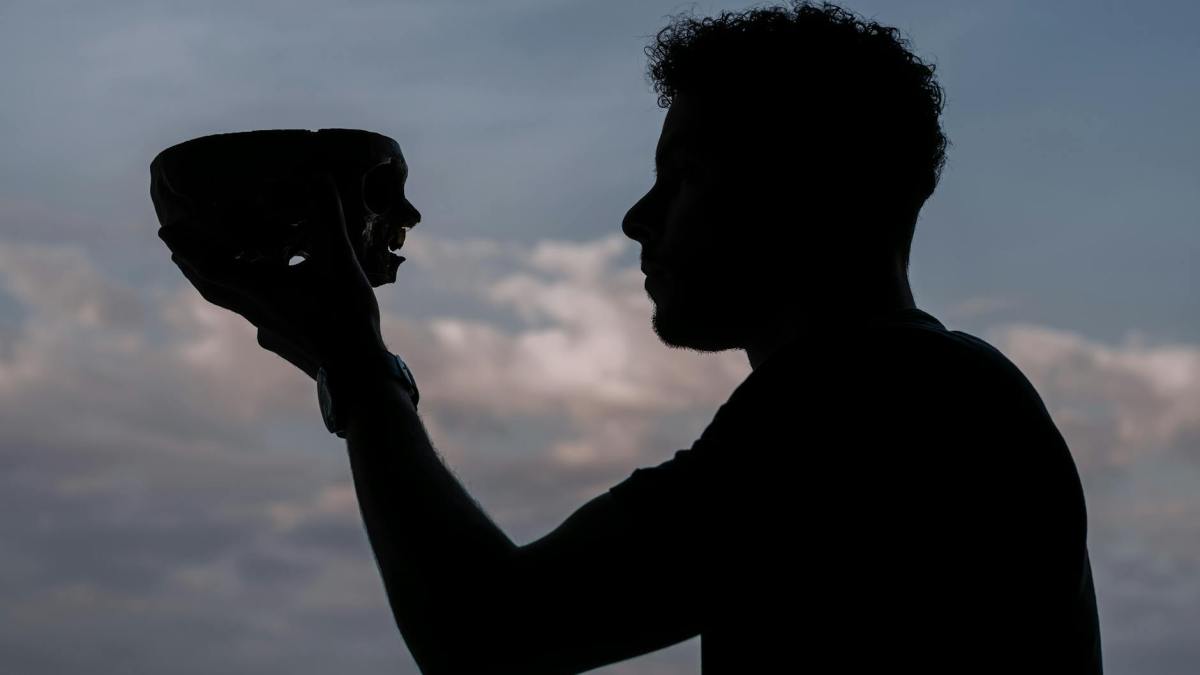
Bloom’s Take Arms Against a Sea of Troubles shifts the focus inward, framing poetry as a tool for individual survival. Drawing on Shakespeare’s Hamlet (“take arms against a sea of troubles”), Bloom argues that poetry equips readers to confront suffering and mortality. Through close engagement with canonical poets—from Milton to Whitman—readers forge their own identities, resisting the “anxiety of influence” by internalizing and reinterpreting poetic voices. For Bloom, truth is not universal but existential; it emerges in the interplay between reader and text, offering solace and self-knowledge. Poetry becomes a “mirror turned lamp,” illuminating the reader’s inner world while reflecting shared human struggles.
Hegel and Bloom converge in their belief that art reveals truths inaccessible to pure reason, but they diverge in scope. Hegel’s truth is teleological, part of humanity’s collective march toward freedom. Bloom’s is intimate, a dialogue between solitary reader and text. Yet poetry bridges these realms. Consider Wordsworth’s Tintern Abbey: Hegel might laud its embodiment of Romanticism’s spirit, while Bloom would emphasize its therapeutic role in reconciling memory and loss. Similarly, Emily Dickinson’s condensed verses distill metaphysical inquiries into personal lyricism, satisfying Hegel’s demand for sensuous form and Bloom’s call for existential courage.
Poetry’s power lies in its duality. It transforms abstract truths (Hegel’s “Absolute”) into visceral imagery, while inviting readers to project their lived experiences onto its language (Bloom’s “self-creation”). A Shakespearean sonnet about time’s passage speaks both to Renaissance cosmology and a modern reader’s fear of mortality. This duality ensures poetry’s endurance: it is both a cultural artifact and a personal companion.
Hegel and Bloom, though separated by centuries and aims, collectively affirm poetry’s role as a mediator of truth. For Hegel, it is a historical force; for Bloom, a lifeline. Together, they illustrate how poetry transcends its form to become a space where universal and personal truths coexist. In an age of fragmentation, poetry remains vital—not merely as a relic of the spirit’s journey, but as a living dialogue between the self and the sublime. As long as humans seek meaning in chaos, poetry will endure as both witness and weapon, unfolding truths that philosophy cannot touch and solace that history cannot provide.
Disclaimer: not really jotting down the first thing that comes to mind, practicing for a speech next week
Other than The Stranger by Albert Camus that I have first read when I was 12 and had to re-read years later, for obvious reasons, I do not tend to return to books I’ve already read unless I’m reading for work.
Published in 1999, this prescient work examines themes that have only grown more relevant: the fragility of memory, the construction of identity, and our desperate attempts to escape emotional pain.
The unnamed protagonist works as a traveling salesman for a corporation that manufactures and distributes memory-erasing drugs. He traverses a near-future landscape of international cities—Tokyo, Barcelona, Los Angeles—selling his wares to those desperate to forget traumas, heartbreaks, and regrets. As he helps others erase their pasts, he increasingly samples his own product, gradually eroding his own identity in the process.
What makes Loriga’s narrative particularly compelling is how it positions memory erasure not as science fiction but as a logical extension of our pharmaceutical culture. The protagonist doesn’t view himself as peddling something extraordinary, but rather as providing a service comparable to antidepressants or sleep aids—just another chemical solution to human suffering.
The novel poses a profound question: If we are, essentially, the sum of our memories, what happens when we selectively delete parts of our past? The protagonist’s steady deterioration as he abuses memory-erasing drugs illustrates the devastating consequences. Without the anchoring force of his personal history, he drifts through existence as a hollow shell, unable to form meaningful connections or understand his own desires and fears. Loriga’s spare prose mirrors the protagonist’s fractured psyche, leaving readers to question: If we erase our pain, what remains of our humanity?
At its core, Tokyo Doesn’t Love Us Anymore is a meditation on memory’s role in shaping identity. Loriga asks: Are we more than the sum of our experiences? The novel’s dystopia isn’t ruled by tyrants but by a collective yearning to numb the soul. Memorama, the drug, becomes a metaphor for modern escapes—social media, substances, consumerism—that promise freedom but deliver alienation.
Tokyo is both setting and symbol. Loriga paints it as a glittering ghost town, where skyscrapers pulse with artificial light but human connection flickers out. The protagonist wanders through love hotels, karaoke bars, and rain-soaked alleyways, each locale steeped in loneliness. Unlike the chaotic vitality of real-world Tokyo, this city feels like a screensaver—vivid yet void. It’s a backdrop that recalls Blade Runner’s dystopia but feels eerily adjacent to our tech-saturated present.
Our salesman is no hero. He’s a hollow man, a mirror for the reader’s complicity in systems of escape. His internal monologue—terse, fragmented—reveals a soul gasping for meaning. When he muses, “I sell what I need most,” we glimpse Loriga’s critique of capitalism’s cycle of creation and consumption. The character’s anonymity amplifies his universality: he could be anyone, anywhere, trading fragments of self for fleeting peace.
In 2025, as AI filters our realities and “digital detox” enters the lexicon, Tokyo Doesn’t Love Us Anymore reads like a prophecy. It challenges us to ask: What do we lose when we prioritize comfort over growth? The novel doesn’t offer answers but lingers like a phantom limb, reminding us that pain and joy are inseparable threads in the fabric of self.
Ray Loriga’s book is not a love letter to Tokyo but a requiem for the modern soul. It’s a slim, sharp novel that cuts deeper with each read, leaving readers to wonder: Would I take the pill? As you close the book, Tokyo’s neon fades, but the question remains, glowing in the dark.
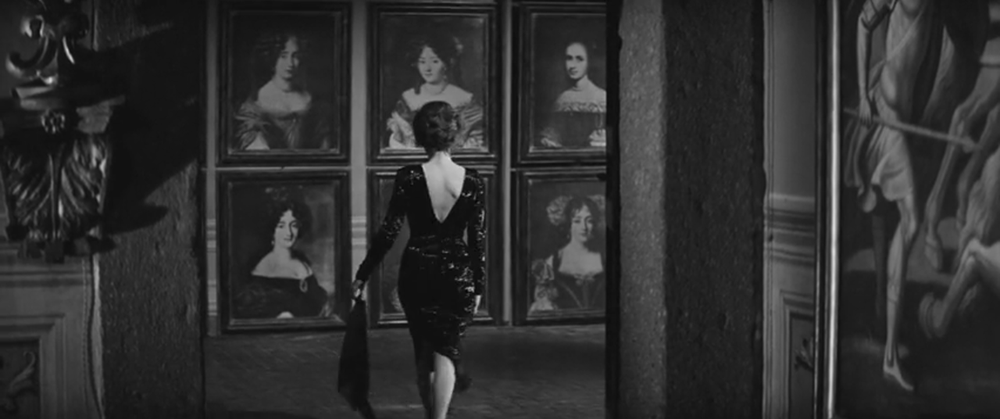
In Federico Fellini’s masterpiece “La Dolce Vita” (1960), the protagonist Marcello Rubini wanders through a decadent Rome, encountering various women who represent different facets of desire, connection, and modern existence. Among these characters, two stand in fascinating contrast to each other: Sylvia, the exuberant American starlet, and Maddalena, the wealthy, world-weary heiress.
Sylvia, portrayed with iconic flair by Anita Ekberg, embodies pure enthusiasm for life. Her character arrives in Rome like a force of nature, commanding attention and transforming the ancient city into her personal playground. The famous Trevi Fountain scene captures her essence perfectly—wading into the water with childlike wonder while fully dressed in an evening gown, beckoning Marcello to join her in this spontaneous celebration of being alive.
What makes Sylvia so captivating is her unfiltered joy. She moves through the world with an almost supernatural confidence, unconcerned with social conventions or consequences. When she climbs the stairs of St. Peter’s Basilica, dances in nightclubs, or pets kittens in an empty apartment, she does so with complete presence in the moment. She represents a kind of freedom that seems increasingly elusive in modern society—the freedom to experience pleasure without cynicism.
Sylvia’s appeal is immediate, visceral, and larger than life. She is the embodiment of spectacle in a film that is itself concerned with spectacle. Yet her character remains somewhat untouchable, a fantasy that can be approached but never fully possessed.
In stark contrast stands Maddalena, played with nuanced perfection by Anouk Aimée. Where Sylvia bursts with emotion, Maddalena presents a cool, composed exterior. Her elegance isn’t performative but ingrained—the natural result of someone who has seen all there is to see in Rome’s high society and found it wanting.
Maddalena navigates the night with a detached awareness that makes her all the more alluring. She’s not impressed by the trappings of wealth and fame because they are her everyday reality. Instead, she seeks authentic connection in a world of artifice, most memorably in the scene where she and Marcello communicate through the echo chambers of a flooded basement in a ruined aristocratic villa—a perfect metaphor for the distance that exists even in their moments of intimacy.
Her world-weariness isn’t simply cynicism but a form of wisdom. She understands the hollowness of “la dolce vita” because she has lived it fully. This knowing perspective gives her character depth and complexity that contrasts with Sylvia’s more straightforward exuberance.
The appeal of both characters creates an internal conflict familiar to many of us. Do we embrace life with Sylvia’s abandon, diving headfirst into experiences without reservation? Or do we move through the world with Maddalena’s sophisticated detachment, protecting ourselves from disappointment while seeking deeper meaning?
Fellini doesn’t present one approach as superior to the other. Instead, he uses these characters to illustrate the tensions of modern existence. Marcello is pulled between these poles throughout the film—between passion and detachment, innocence and experience, spontaneity and reflection. He does seem to reject flat out the emotional stability offered by Emma whose “sticky, maternal love” he despises.
What makes these characters so enduring is that they represent more than just different types of feminine appeal. They embody different philosophies of living, different responses to a world that simultaneously offers too much and not enough. Sylvia’s enthusiasm and Maddalena’s coolness aren’t just personality traits but strategies for navigating a changing society.
I would be Sylvia in the days I want to live as a fleeting dream, a force of nature that dazzles but never truly belongs. This is, I suppose, the luxury of anonymity. When we are the foreigner, no one really has any reference on how and who we are. Therefore, they have no idea on how we are supposed to be.
While Sylvia is the unattainable fantasy, Maddalena mirrors Marcello’s existential drift. She’s just as lost, but with a sharper self-awareness. A proud and typical GenX I, and most probably a lot of others reared on post punk and goth influences, resonate with depth, complexity, and the ache of searching for meaning in a world that feels hollow and could, thus, more easily be Maddalena.
Anouk Aimée plays her with this devastating coolness—luxury draped over emptiness. She craves love but sabotages ii. She’s too disillusioned to hope, yet too alive to stop searching. Fellini frames her suffering with such deliberate elegance that her loneliness becomes inseparable from her glamour. But this isn’t mere vanity—it’s a survival tactic, a way to exert control over the void.
Sylvia: Life as spectacle, pure dolce vita (the Trevi Fountain scene = ecstatic but fleeting).
Maddalena: Life as introspection, the aftermath of indulgence. She’s what happens when the party ends.
Fellini’s Contrast: Sylvia is myth; Maddalena is reality. One is adored, the other understood (sort of)—which is more tragic?
Ah, the young girl at the beach—Fellini’s silent, enigmatic coda to La Dolce Vita. She’s the film’s great unanswered question, a glimmer of purity in a world of exhausted decadence. A waitress from the seaside café (played by Valeria Ciangottini), unnamed, barely speaking. Marcello meets her earlier when she shyly asks for his autograph. Unlike the jaded socialites and performers, she’s untouched by Rome’s corruption. Her white dress mirrors Sylvia’s, but without the erotic charge—it’s virginal, almost angelic.
She waves, but it’s ambiguous—is it farewell, or an invitation? The sea (a classic symbol of renewal) separates them. She calls to him across the water, but he can’t hear her (or won’t). Her words are lost in the wind—Fellini’s metaphor for Marcello’s spiritual deafness. She is the irreversible loss of one’s own innocence, not through fate, but through a thousand small surrenders.
Some people enter a room like a storm; others radiate calm. Their “frequency” alters the space around them.
Do you rush? Linger? Dance while cooking? Your cadence reveals inner worlds.
The words you choose
Favorite phrases, slang, or even silences—words betray your history, humor, and heart.
How you frame experiences—a scientist might describe love as chemistry; a poet, as a wildfire. The specific vocabulary, phrases, and metaphors someone gravitates toward creates a verbal fingerprint. I’ve noticed how certain people have signature expressions or ways of framing ideas that immediately identify them, even in writing
How you treat others
The small kindnesses or thoughtlessness, who we make time for, how we respond to vulnerability or need – these interactions form patterns that define us. Some people consistently elevate others, while some drain energy from every room.
Your memory
It’s not just what we remember, but how we remember, what we forget, and how those memories reshape us over time. As Oliver Sacks said “Memory is dialogic and arises not only from direct experience but from the intercourse of many minds. […] It is a form of storytelling that goes on in the mind and never stops. […] Our memories are, in the end, a shifting, vanishing, mutating thing, a mirage of unreliable glimpses.” We don’t just have memories; we curate them, unconsciously editing our past to make sense of our present.
Your contradictions
Some people manage to be elegant yet unsettling, cool yet chaotic, polished but always a little off.
Each of us is an entire society, a whole neighborhood of Mystery; it is fitting that we at least make the life of this neighborhood elegant and distinguished, that in the celebrations of our sensations there be refinement and decorum, and that, because it is sober, there be courtesy in the banquets of our thoughts.
They turn the water off, so I live without water, they build walls higher, so I live without treetops, they paint the windows black, so I live without sunshine, they lock my cage, so I live without going anywhere, they take each last tear I have, I live without tears, they take my heart and rip it open, I live without heart, they take my life and crush it, so I live without a future, they say I am beastly and fiendish, so I have no friends, they stop up each hope, so I have no passage out of hell, they give me pain, so I live with pain, they give me hate, so I live with my hate, they have changed me, and I am not the same man, they give me no shower, so I live with my smell, they separate me from my brothers, so I live without brothers, who understands me when I say this is beautiful? who understands me when I say I have found other freedoms?
I cannot fly or make something appear in my hand, I cannot make the heavens open or the earth tremble, I can live with myself, and I am amazed at myself, my love, my beauty, I am taken by my failures, astounded by my fears, I am stubborn and childish, in the midst of this wreckage of life they incurred, I practice being myself, and I have found parts of myself never dreamed of by me, they were goaded out from under rocks in my heart when the walls were built higher, when the water was turned off and the windows painted black. I followed these signs like an old tracker and followed the tracks deep into myself, followed the blood-spotted path, deeper into dangerous regions, and found so many parts of myself, who taught me water is not everything, and gave me new eyes to see through walls, and when they spoke, sunlight came out of their mouths, and I was laughing at me with them, we laughed like children and made pacts to always be loyal, who understands me when I say this is beautiful?
Most people, and I am, obviously, most people as well, don’t fully understand how much their perception of reality is shaped by their own emotions, biases, and past experiences. The line between “knowing” and “feeling” is far blurrier than we often acknowledge. Much of what we consider “knowledge” is deeply entangled with emotion, intuition, and social conditioning. This is why debates over facts can feel so personal. They can even seem existential.
Accepting that much of what we “know” is provisional, socially shaped, or emotionally charged is the first step toward clearer thinking. But, at times, taking this first step just feels too much of an effort.
The first principle is that you must not fool yourself—and you are the easiest person to fool.
131 days ago life took a weird, sharp turn after a few months of my driving it erratically in and out of course. Because I am prone to think of my life as a movie or perhaps as a series of pilot episodes in shows that never get aired, I failed to realize that maybe real life was happening. And I have a problem with this. My mind anticipates all kinds of scenarios, dramatic dialogues and plot twists, failing to see what’s right in front of me, failing to hear Caetano‘s warning that life is after all real and skewed. I insist on other melodies, I insist on not getting tired of hoping that one day I will get to be everything.
My homeless heart Wants to keep the world In me
131 days ago we coincided in space and time; he told me I was making him travel, I didn’t realize he was making me come home. For once, life was not about being the rebel in a made up cause, it was not about coming up with the perfect character for the occasion, it was not about trying to be perfect, it was not about packing and going somewhere trying to find whatever is needed at the moment to feel more alive. It was about staying. I didn’t know that to stay took a special kind of courage. I have spent well over seven thousand days of my adult life being adventurously brave, going everywhere, doing everything, preferably on my own. Along the way I collected all the clichés of falling madly, deeply and foolishly in love, of getting married and divorced, of hurting and getting hurt and feeling that I have committed the worse sin my twelve years of Catholic, yet somewhat liberal, education helped me identify, I have wasted my time and have, of course, ended up being wasted by it. Staying, in the same way as getting older, is not for the faint of heart. Staying means you have to face life as it is not as you think it was meant to be.
131 days ago I begun to understand what years of fictional manipulation have done to me, how they have created the most unrealistic expectations and contributed to an almost complete emotional disarrangement. In the midst of my inability to deal with what was happening, I have read these wise words:
Your deepest beliefs about seduction were carefully crafted by high-capitalist strategists. Lust and fantasy are opiates of the masses, easily manipulated into shapes that human animals fall for, over and over again.
I have never really taken advice columns very seriously, probably because I tend to be a bit of a snob, but every single word Heather Havrilesky poured into her column of February 28, struck a chord and I understood that yes, it was really about surrendering to reality with no futile embellishments. And still, 131 days were not enough to learn that the assumptions one makes about one self and others are also created by all the nonsense around you and that they are not real. For 131 days I have promised myself, almost everyday, that I was not going to fall in that trap, I was going to let life get real because it might not be the most glamorous or exciting place to be but you have at least a chance of not seeing life disappear without getting to live it. But, self-sabotage is a powerful force, “a way of avoiding that moment of showing up, of facing potential loss, of being strong enough and courageous enough to surrender to the unknown — but also, to surrender to the goodness of ordinary human beings.” 131 days ago, getting hurt living my fictional life was easy enough to deal with because fictional feelings tend to be overtly dramatic but shallow.
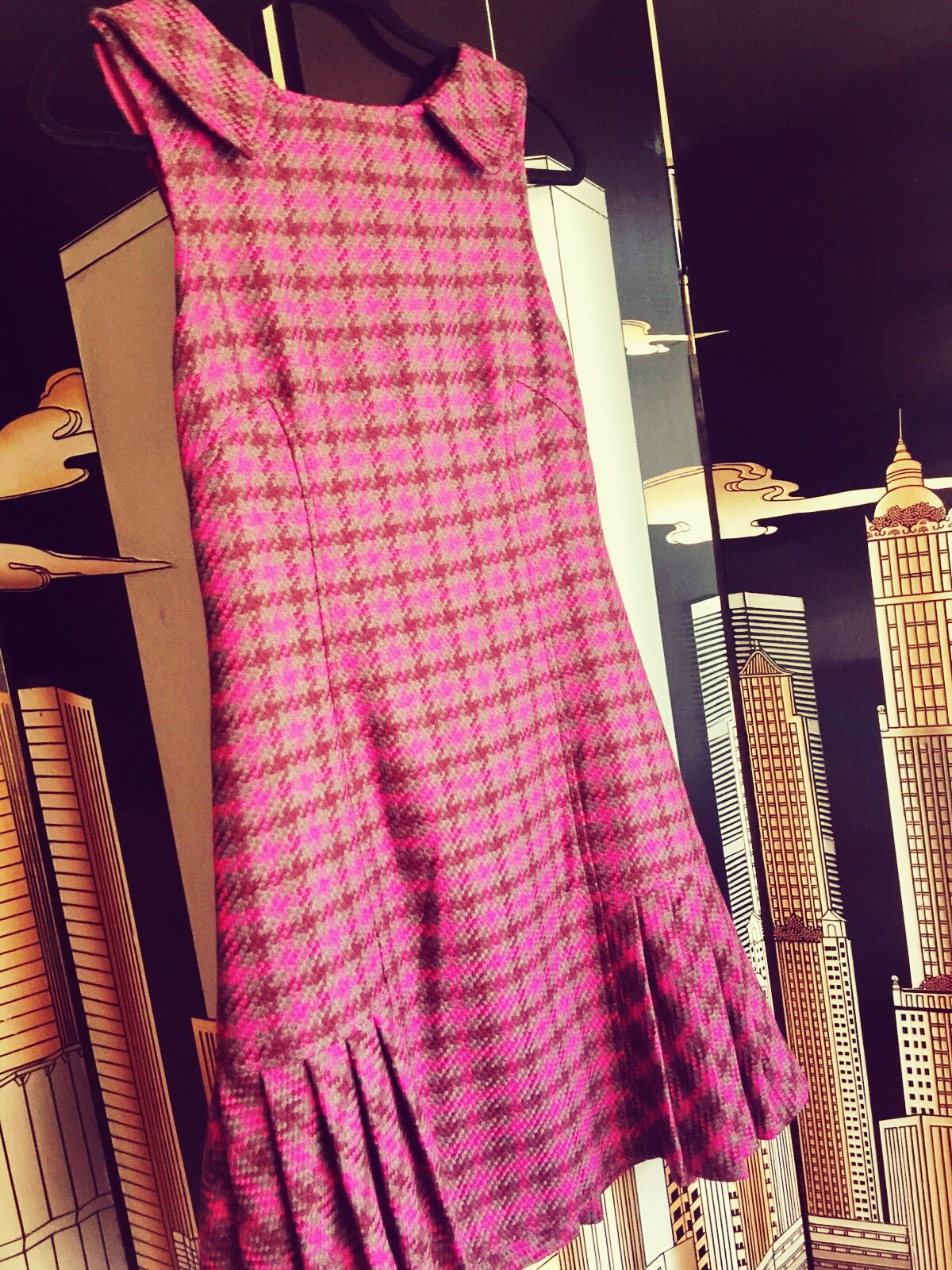
I wore this dress on Monday and the whole day I felt as if was in disguise. I thought I looked like a twenty first century flapper when I checked myself in the mirror before leaving the house, but the minute I got to work I looked as if I had borrowed the last available dress left in someone else’s closet. And that someone definitely didn’t have a lot in common with me. I didn’t buy this dress. It was a gift from my mum who probably never abandoned the hope that, in the right outfit, I would look like a pretty girl. This dress is too pink for me, it’s either too short for me or I’m too tall for it, I am also too old to pull something like this off. Not being a mother myself, I am left with a daughter’s perspective on this strange relationship that sometimes infantilizes me in order to, so it seems, avoid confronting the inevitability of time.
Mondays are never easy and I have a horrible cold and the medication is making me feel like I’m living underwater and the weight of every single thought is too much to even consider taking any kind of action.
TUESDAY
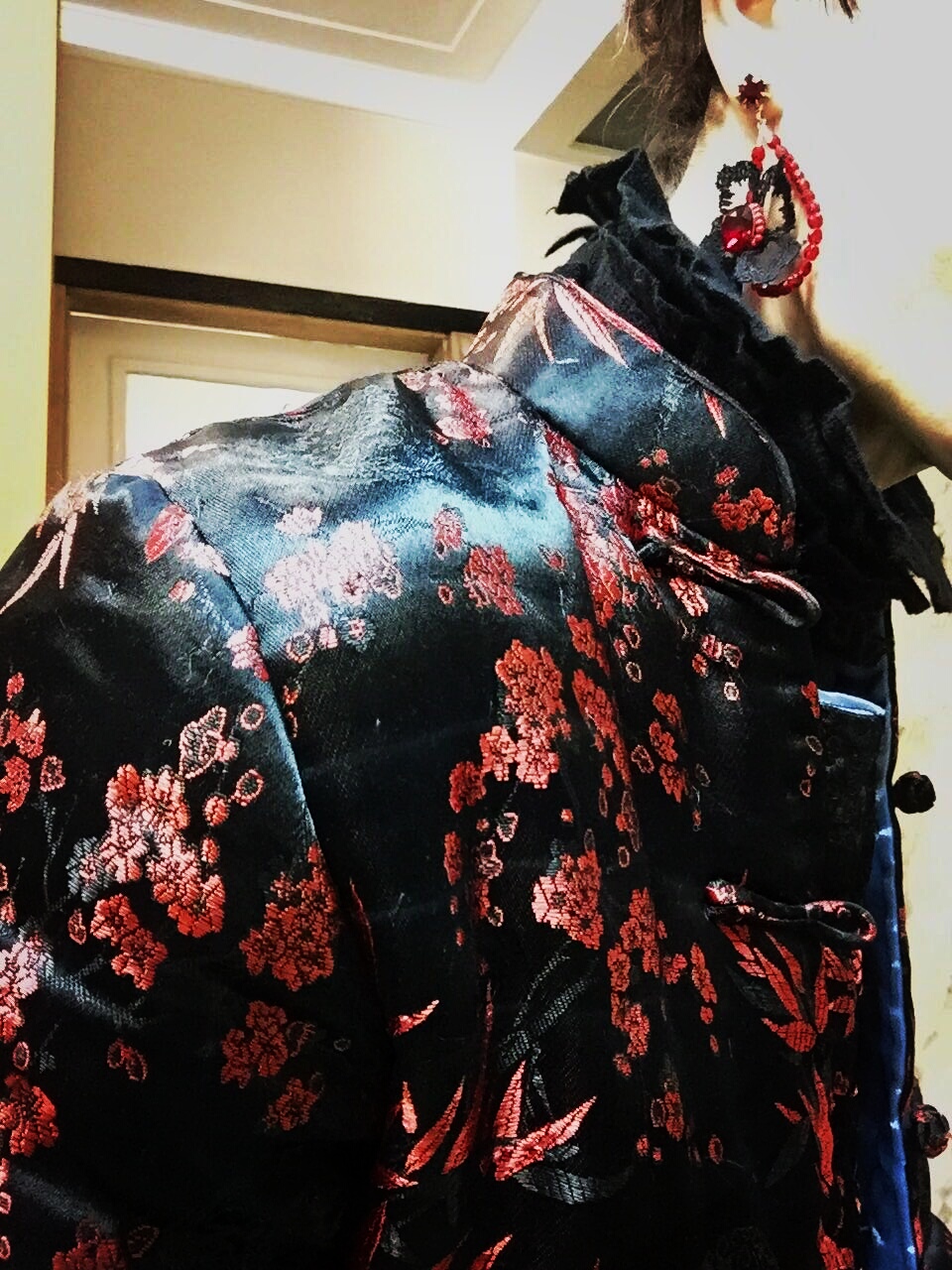
I bought this jacket in Vietnam in November 2014. A text message received while I was in Hanoi let me know that my great aunt had died. I was there for work and alone and while I can’t really say that I have always depended on the kindness of strangers, I have found that sometimes, strangers make the best friends and know exactly what to do and how to help.
Stray people brought together by chance
WEDNESDAY
I have a weak spot for chinoiserie and I absolutely adore these pants. I think I bought them some twenty years ago and they have never made it to the error category.
I felt a lot better today. After work we went to Java, the usual hang out before theater, for dinner. The TV was showing the aftermath of the Westminster attack. The coffee shop was crowded and we are all seating at an uncomfortable closeness. The gentleman next to me is wearing a brown jacket and turns his head often in my direction. Maybe he’s getting irritated at the proximity. No, he starts talking about the news. I try not to engage. I studied political science and I have no idea how to comment on the historical, sociological, or political contexts of what we are staring at. I find it difficult to rationalize barbarity. He’s British. He goes on about foreigners and political correctness. For twelve years he served in the Royal Navy, like his father before him. His eyesight started failing. He’s now a civilian. He was born in Cornwall and grew up in Scotland, now he lives in Manchester because he can’t afford to live in London. He’s been in Portugal for two weeks on vacation, this was his last night. He’s wearing a black t-shirt with some very graphic expression of discontent written in Afrikaans. I’ve never been a big fan of clothes that are too explicit in doing your talking for you. We have to go, the play starts at 9. He says goodbye kissing our hands and thanking us for the company and patience. Whatever was said, I realize I missed that accent and the blue eyed frankness I have lived with for four or so years of my life.
The play is a Portuguese – Belgian co-production spoken in French, Portuguese and Flemish with subtitles in English and Portuguese. I like the set and love the wardrobe when Anna Karenina is the woman inhabiting them and their actions. Still, it’s difficult to focus on anything either than the text. Forty years apart in Lisbon and Antwerp two couples fall out of love, question the normal life people manage to live and read Anna Karenina in French. One of the characters hasn’t read it. He actually thought about reading War and Peace but there were too many pages.
How she dies. It’s not supposed to be about this particular written death but about how literature changes or makes us change our lives. So the author says in a number of interviews.
But she did not take her eyes from the wheels of the second car. And exactly at the moment when the midpoint between the wheels drew level with her, she threw away the red bag, and drawing her head back into her shoulders, fell on her hands under the car, and with a light movement, as though she would rise immediately, dropped on her knees. And at the instant she was terror-stricken at what she was doing. ‘Where am I? What am I doing? What for?’ She tried to get up, to throw herself back; but something huge and merciless struck her on the head and dragged her down on her back
THURSDAY
Last week there was a promise of an early Summer that has vanished during this week as temperatures dropped some twenty degrees and the news reported closed schools because of the snow. Not in Porto. I miss my second ballet class of the week and go to a conference on culture and citizenship. Friends and experts come together to pay tribute to the Poet. To Poetry. There’s a painting exhibition in the room. There’s this painting, A homage to Gaugin, it’s called, and there’s this amazing figure of a woman that could also be a man painted in the warm colours that live in Tahiti. It keeps me from listening to most of what is being said.
FRIDAY
A lavender morning turned into a cold rainy afternoon. I took half the day off to seat at a open rehearsal of Macbeth at the national theater. They only started rehearsals on Monday so this is still the table-work phase of reading and exploring the text and the characters. There’s an English literature professor and expert in Shakespeare who has been invited to talk about the play, and the text, and the differences between the English original and the Portuguese translation. And there he was, academia at it’s very best, rethorical mighty with all its seductive power. And the words go on for five hours and I don’t feel tired or bored. There’s nothing more fascinating than being the witness to personal passions. Not to me, at least. The catastrophe of getting exactly what you want in life. Those who choose to loose everything and those who do. The fantasy of being whole and the prison it creates. And Sartre who could be very pedantic but also very intelligent.
We are left alone, without excuse. That is what I mean when I say that man is condemned to be free. Condemned, because he did not create himself, yet is nevertheless at liberty, and from the moment that he is thrown into this world he is responsible for everything he does.
In 2012 I did a course on Shakespeare at the University of Oxford. This was how I fell in love with Macbeth. My final essay was on the question of agency. My somewhat lazy conclusion stated that “Macbeth’s hamartia is not his ambition, as this is a character flaw, but his miscalculation of the personal consequences of assassinating Duncan and the inner torment that leads him on a murdering spree in the frantic desire for peace of mind. It is this tragic error that ultimately transforms his life in an empty mockery”. I’m often surprised and ashamed when reading what I have written.
SATURDAY
On Saturday I decided to revisit the rive gauche intellectual in me, ratty cashmere sweater and all.
Saturday is flamenco class day. I decided not to miss this one and take me and my cold for another session of trying to emulate Lola. It is not an easy, if at all possible, task to be a Lola. Either a fictional or a real one.
The rest of my Saturday is spent doing adult stuff, washing, and supermarket shopping, and other uninteresting errands. I sold a white Betty Barclay jacket. It’s going to Boise, Idaho. At the end of all this I go and see Ana present a book on American cuisine. I’m only there for moral support. Cookbooks are basically useless at my house.
It took five songs of the weird (I like to think about it as eclectic but I suspect it’s just weird) driving playlist on my iPod to drive home:
I suspect rive gauche intellectuals didn’t care much for glitter ballet flats. Shoes off. I’m not going out, I decide that watching This Property is Condemned on TV is a much better option.
SUNDAY
Daylight saving time began at 1 AM. Outside it still looks like Winter.
I go to the only cinema we have downtown, one of the two movie theaters that is not a multiplex. Popcorn free zone, what a bliss. The movie is Aquarius with Sonia Braga. Two and half hours lost, gone forever. Such a grand actress deserved a much better movie. Great soundtrack, though.
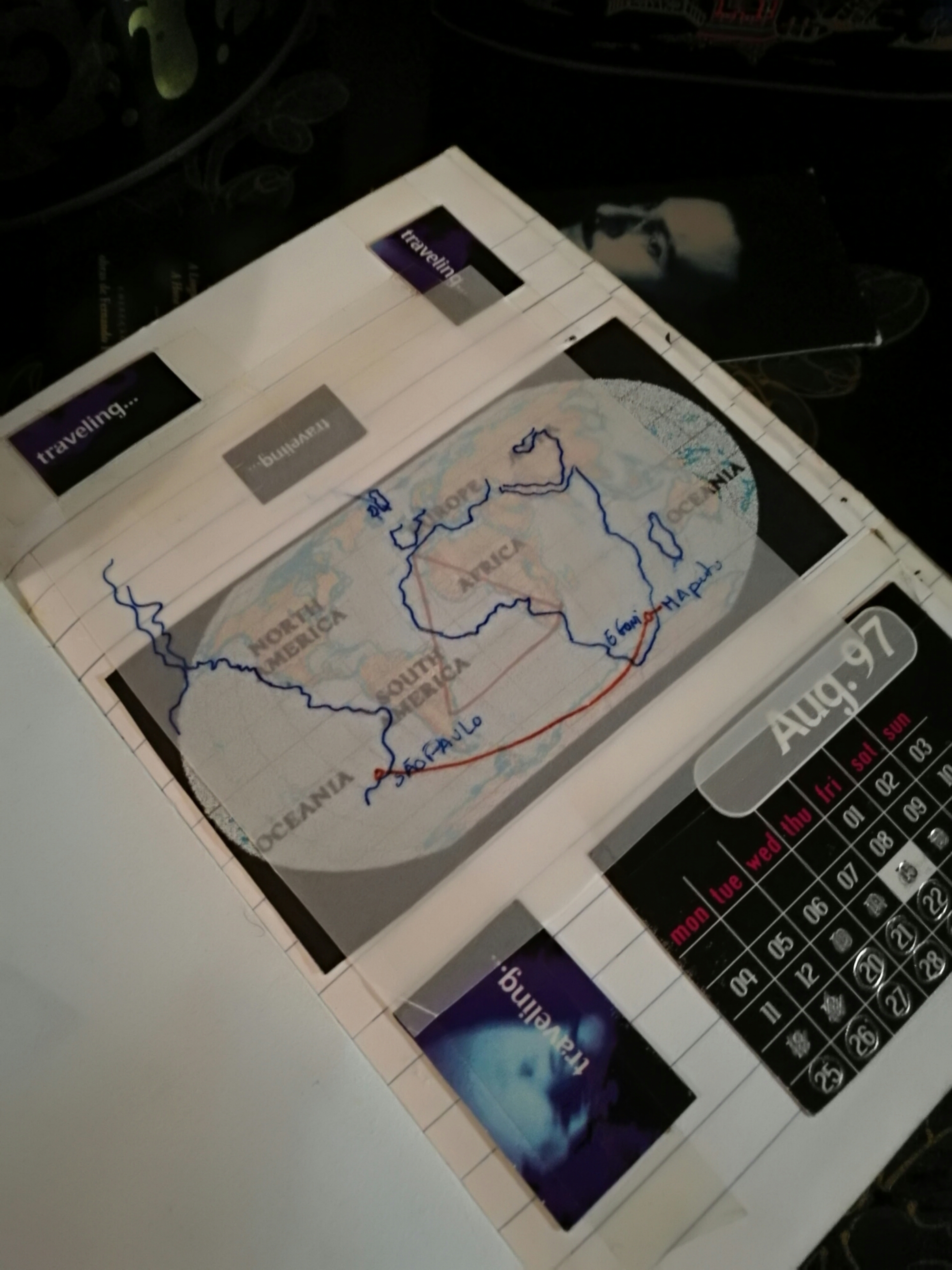
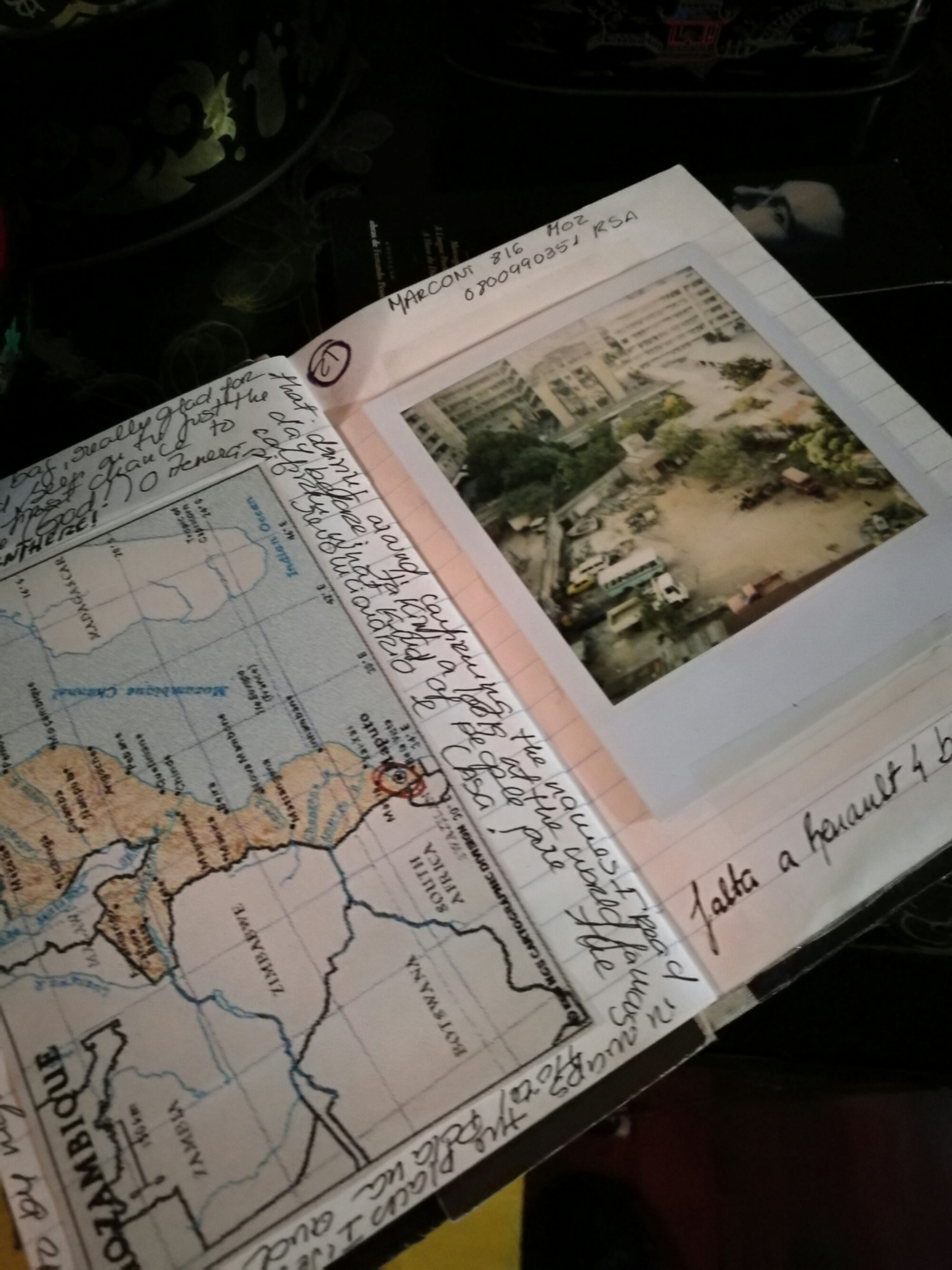
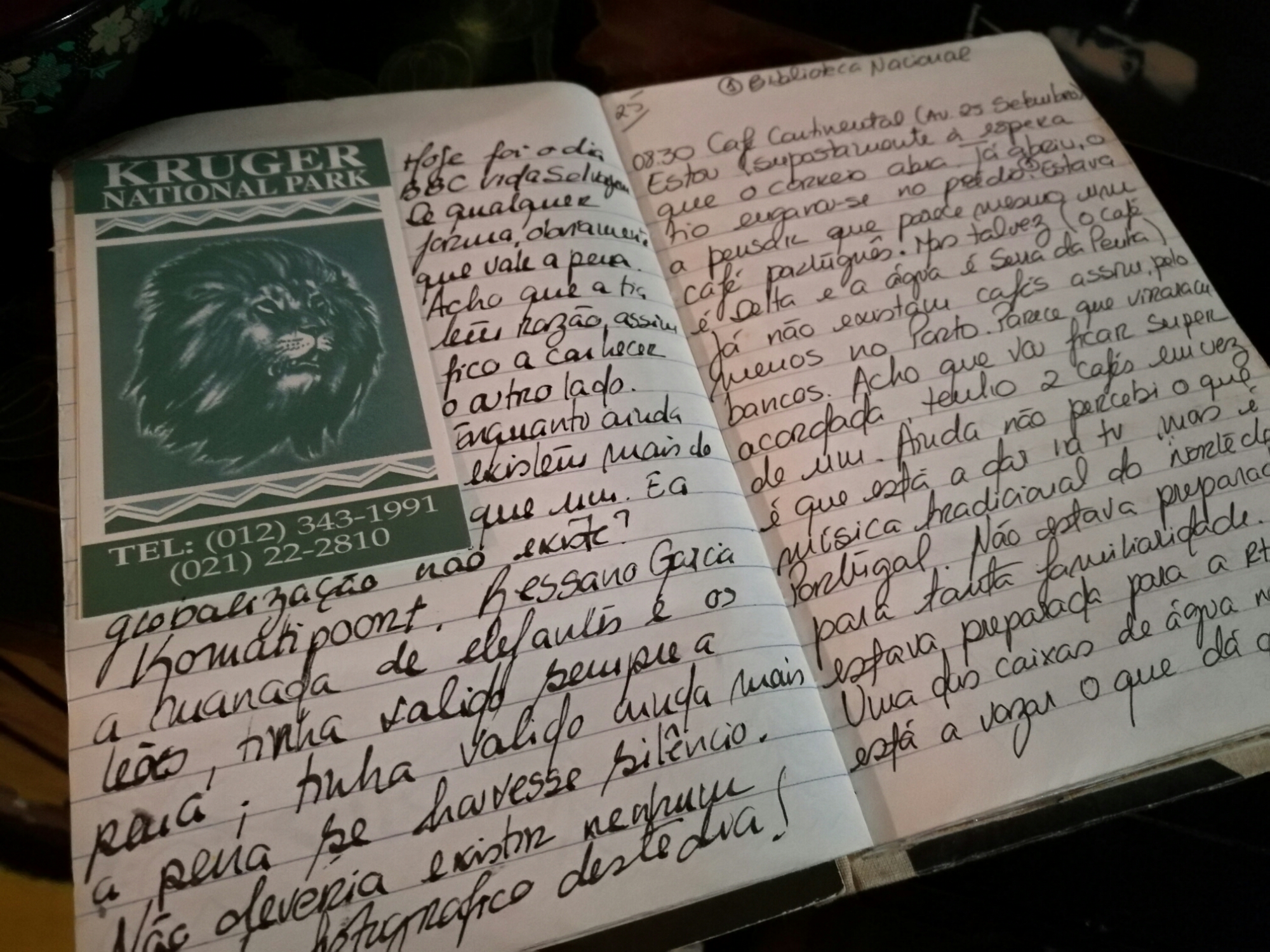
In August 1997 I travelled from Brazil, where I was on vacation with my parents, to Maputo where I stayed for a while with an uncle who was working there at the time. These are pages from my travel diary.
After six days in Porto Alegre, a city I was quite familiar with during my teens and early twenties, I flew to São Paulo to get on the flight to Beijing which had its first stop in Johannesburg.
At Guarulhos I waited, trying to read Raygun magazine’s special issue on Cinema and Music.
I think my mistake was that I thought you could live the things that you acted. But I realized that that wasn’t the case. Then I realized that I would be better suited to try to do that but without an audience. To pretend I was in the movies all the time, basically. And to try to create a narrative flow out of actions, and sequences and events.
My mum made me promise I wouldn’t get out of the airport in Johannesburg during the six-hour-long layover. I did. I took a taxi and Philly drove me downtown to Museum Africa and drove past Ponte Tower and took me to Ellis Park and the flea market in Gateway and told me I should walk around Carlton Center and I remembered that my mum used to talk about this place. There were people playing chess on a gigantic board. I was born in Johannesburg. How could I not go out?
I arrived in Maputo at night. My uncle, my aunt and my cousin picked me up and drove me home, a big apartment in Avenida Albert Lutuli, overlooking the Aga Khan foundation from the living room and the car park on the Polaroid from my bedroom.
I went to Mozambique to do research on forced labour migration. Most of my first weeks were spent at the library of the Provincial Culture Centre in Rua do Bagamoyo, former Rua do Araújo in the also former “red light district” of the former Lourenço Marques.
The long balcony of the former brothel was where I spent my smoking breaks. Across the street there was a Pensão (I suppose a hostel by now) and the life of the Dutch couple staying there became also some sort of voyeuristic break. Under the balcony, every day, the same lady selling matchboxes danced to her own rhythmic section when she got bored.
This how research turned mostly into contemplation of life by the Indian Ocean.
Every morning I would pretend to be a morning person and go downtown at 6.30, have coffee at the Scala or the Continental and wait for the library to open while marvelling at the long line of men and women getting their shoes polished. We are proud of our shoes, Professor C. tells me. Most of us only have one pair, most probably handed down, we have to keep them looking new.
Before my aunt and my cousin go back to Portugal we go to Nelspruit to do some supermarket shopping. It felt like the old ritual of crossing the border to go to Tui or Vigo in Galicia for the same purpose before there were “free markets” and you could buy the same sort of things on the Portuguese side at the border. We get to Ressano Garcia and there are long lines of people and cars to cross to Komatipoort. I walk around amazed at the chaos of this mythical place that I knew only from books. It’s dirty and crowded. On the other side, I don’t have to wait, my passport is South African and everyone thinks I am American because of my accent. Nelspruit looks like a giant supermarket where people buy giant tins of butter. I had never seen a tin of butter before. We spend the night at a lodge near the Kruger Park and go visit the next day. There’s no diary entry for this. There are hundreds of photos and boxes of photographic slides (!) I still can’t find the words to tell anyone what it felt like.
My aunt and cousin return to Portugal in time for the start of the school year. I stay on with my uncle and Olga who worked as a cleaner and cook at the flat and was now a single mother of two after her husband left. We had fun together. There was a fabric warehouse just around the corner from our flat and we often went to buy capulanas and play dress up. With my uncle, there were a lot of arguments about how to “behave in Africa” and how to deal with “things you know nothing about”.
Outside, there was still a whole world to be explored and a lot of bureaucracy to deal with when trying to get authorization to see archives. The upstairs neighbour who owned the liquor store in Avenida Josina Machel tells on me because she saw me walking home. It’s not appropriate. Apparently.
I spend two days reading labour legislation at the Ministry. The intern there just got a scholarship to go to Holland to study for a Masters degree. He’s happy is not heading to Portugal to do that. I then move to the National Film Institute. I had an amazing two weeks in this place just watching movies and making friends.
Everywhere, I am surrounded by words and images and words and images that always have some sort of political meaning. And writers, and artists and liberation activists and foreign journalists that have stayed on after the colonial war was over. And Italians that have become African and don’t even speak Italian anymore. And generous souls that have shared pieces of their lives and changed mine.
Re-living these pages I am, sometimes, amazed at what I have written. From quotes of Ruth First and Margot Dias to somewhat futile accounts of every little detail of every walk around the city, every coffee, every encounter.
I didn’t want to risk missing a thing. I didn’t want to risk losing the memory of the place and of the people.
Re-living these pages, I am really sorry that I haven’t kept the habit of writing travel diaries. Re-reading some of these pages, I realise they are actually a script for the adventure movie of that African winter.














 Stories from A Closet of Errors