
Two things we must therefore root out: fear of distress in the future and the memory of distress in the past. The one concerns me no longer. The other concerns me not yet.
Seneca
Made with Gemini
Two things we must therefore root out: fear of distress in the future and the memory of distress in the past. The one concerns me no longer. The other concerns me not yet.
Seneca
Made with Gemini
Leucon, no one’s allowed to know his fate,
Not you, not me: don’t ask, don’t hunt for answers
In tea leaves or palms. Be patient with whatever comes.
This could be our last winter, it could be many
More, pounding the Tuscan Sea on these rocks:
Do what you must, be wise, cut your vines
And forget about hope. Time goes running, even
As we talk. Take the present, the future’s no one’s affair.
Horace, Ode I. 11, translated by Burton Raffel, from The Essential Horace
Your death must be loved this much.
You have to know the grief—now.
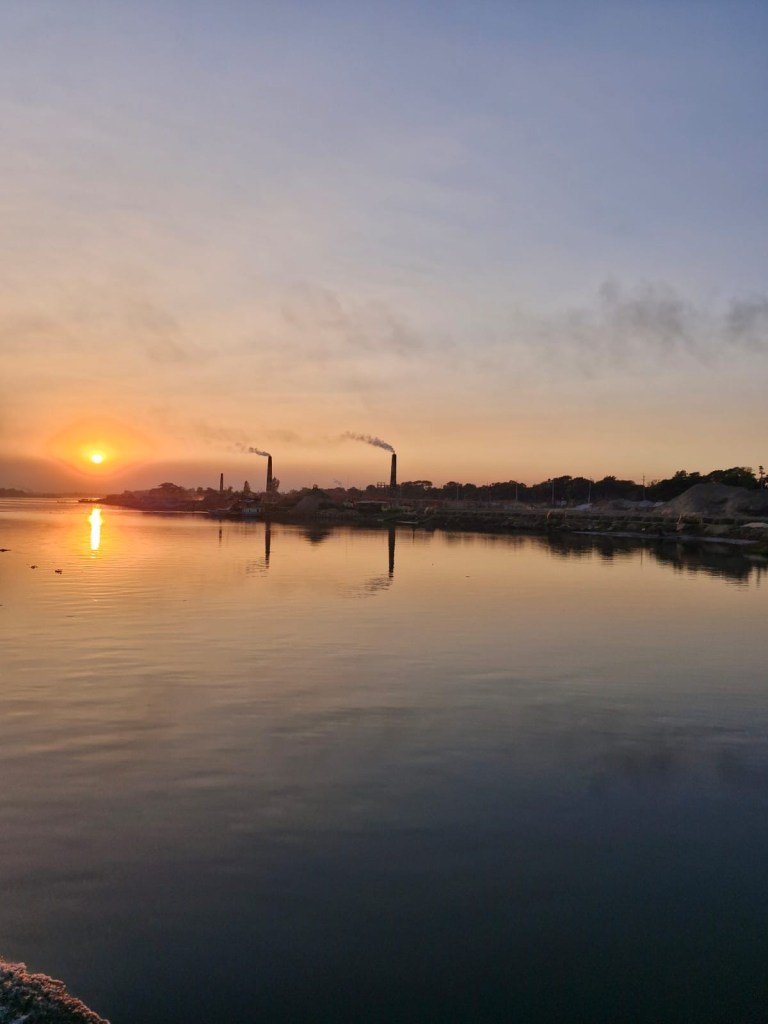
Standing by the water’s edge,
looking down at the wave
touching you. You have to lie,
stiff, arms folded, on a heap of earth
and see how far the darkness
will take you. I mean it, this, now—
before the ghost the cold leaves
in your breath, rises;
before the toes are put together
inside the shoes. There it is—the goddamn
orange-going-into-rose descending
circle of beauty and time.


You have nothing to be sad about.

(At Sunset by Jason Shinder)
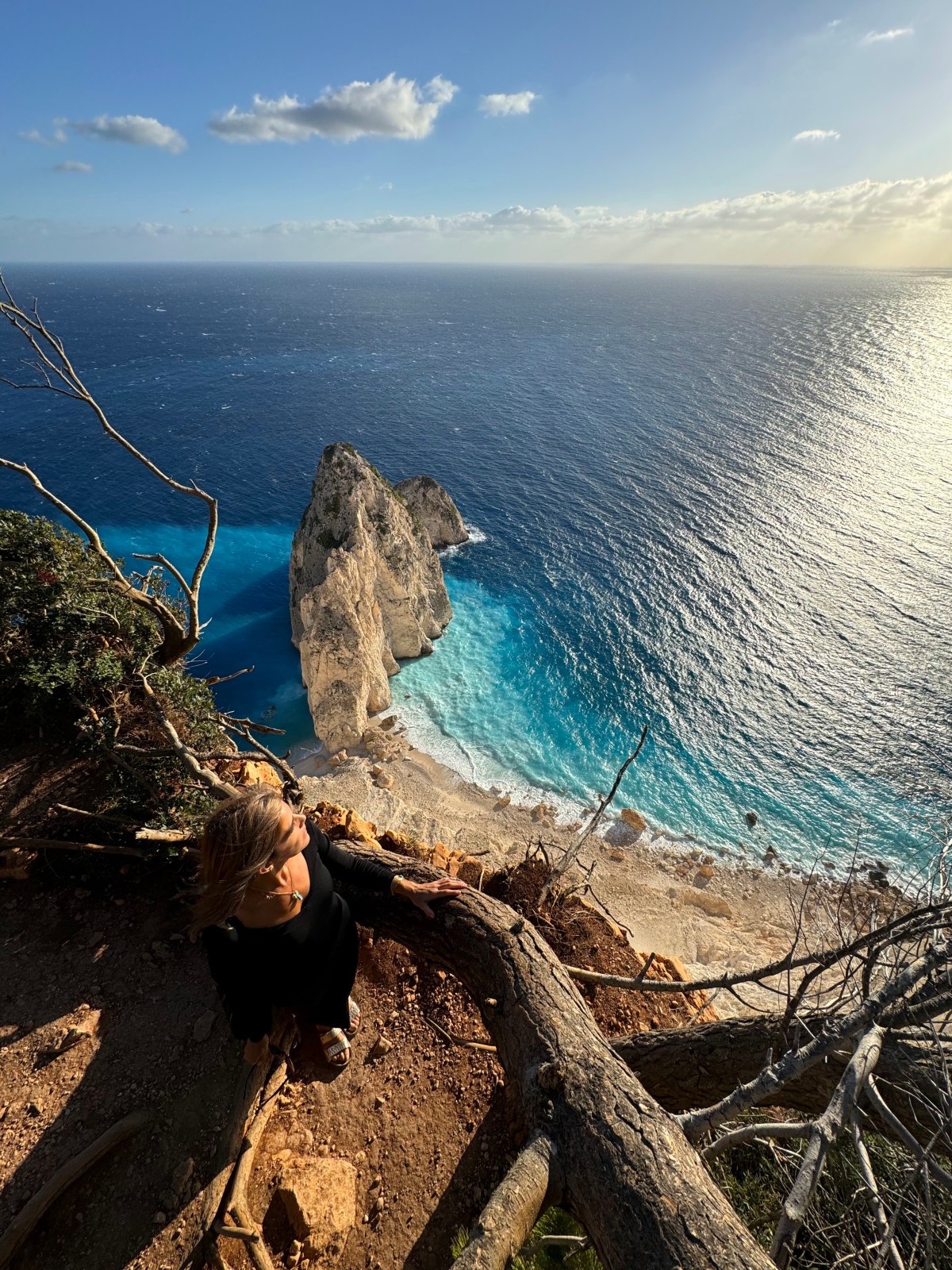
I would quit my job, sell my house and set out for Ithaka because I think I belong to that sea
If I were guaranteed not to fail… I think I’d attempt to be honest with myself. To understand why certain songs make me cry, what wound keeps resurfacing in different masks, what version of myself I’m most afraid to become.
Maybe the fear isn’t really about failing, but about what succeeding would mean. About choosing the untethered life over the anchored one.
As you set out for Ithaka
hope your road is a long one,
full of adventure, full of discovery.
Laistrygonians, Cyclops,
angry Poseidon—don’t be afraid of them:
you’ll never find things like that on your way
as long as you keep your thoughts raised high,
as long as a rare excitement
stirs your spirit and your body.
Laistrygonians, Cyclops,
wild Poseidon—you won’t encounter them
unless you bring them along inside your soul,
unless your soul sets them up in front of you.

Hope your road is a long one.
May there be many summer mornings when,
with what pleasure, what joy,
you enter harbors you’re seeing for the first time;
may you stop at Phoenician trading stations
to buy fine things,
mother of pearl and coral, amber and ebony,
sensual perfume of every kind—
as many sensual perfumes as you can;
and may you visit many Egyptian cities
to learn and go on learning from their scholars.

Keep Ithaka always in your mind.
Arriving there is what you’re destined for.
But don’t hurry the journey at all.
Better if it lasts for years,
so you’re old by the time you reach the island,
wealthy with all you’ve gained on the way,
not expecting Ithaka to make you rich.

Ithaka gave you the marvelous journey.
Without her you wouldn't have set out.
She has nothing left to give you now.

And if you find her poor, Ithaka won’t have fooled you.
Wise as you will have become, so full of experience,
you’ll have understood by then what these Ithakas mean

Ithaka By C. P. Cavafy
Sometimes the fantasy of guaranteed success lets us see what we really want, even if we have to walk toward it without guarantees.
I can whistle almost the whole of the Fifth Symphony, all four movements, and with it I have solaced many a whining hour to sleep. It answers all my questions, the noble, mighty thing, it is “green pastures and still waters” to my soul. Indeed, without music I should wish to die.
Edna St. Vincent Millay letter to Allan Ross MacDougall
To imagine existence without music might be biologically possible but it would be emotionally smaller. Music operates on a frequency that bypasses the intellect and speaks directly to something primal within us. Unlike spoken language, which divides us into linguistic communities, music creates a universal grammar of emotion. A minor key can evoke melancholy in a child who has never learned the word “sadness.” A triumphant major chord can lift spirits across cultures, generations, and personal circumstances. This universality suggests that music doesn’t merely accompany human experience—it is woven into the fabric of consciousness itself.
Music, uniquely among the arts, is both completely abstract and profoundly emotional. It has no power to represent anything particular or external, but it has a unique power to express inner states or feelings. Music can pierce the heart directly; it needs no mediation. One does not have to know anything about Dido and Aeneas to be moved by her lament for him; anyone who has ever lost someone knows what Dido is expressing. And there is, finally, a deep and mysterious paradox here, for while such music makes one experience pain and grief more intensely, it brings solace and consolation at the same time. (Oliver Sacks, Musicophilia: Tales of Music and the Brain )
When we consider a world stripped of this universal language, we imagine not just silence, but a profound disconnection from our own emotional landscape.
First dances, lullabies, funeral hymns, graduation marches—these melodies become the soundtrack to our most significant moments. They don’t merely accompany these experiences; they preserve them in a form more vivid than photographs, more immediate than written words. A few notes can transport us instantly across decades, reconstructing not just the memory but the emotion of a moment with startling clarity.
Without music, our memories would lose this dimensional quality, the emotional peaks and valleys of our lives would lack their soundtrack, making the landscape of personal history less navigable, less meaningful.
Even beyond its role in significant moments, music provides the rhythm that makes daily existence bearable, even beautiful. Work songs have existed in every culture because they transform labor from mere drudgery into something approaching art. The person who whistles Beethoven during difficult hours understands that music doesn’t change circumstances—it changes our relationship to circumstances. It provides the cadence that makes the unbearable bearable, the monotonous meaningful.
Consider the silence that would replace this constant, subtle soundtrack.
That life without music would not be worth living might initially seem hyperbolic. However, it points to a deeper truth about being human, we don’t merely survive on bread alone—we require beauty, meaning, connection, and transcendence. Music provides all of these simultaneously. It is the art form that most directly addresses our need for both individual expression and communal belonging, for both intellectual stimulation and emotional release.
Life may be technically possible without music, but it would be missing a profound transformation: the ability to turn time into beauty. Music does not change the fact that hours pass, that we suffer, or that we long for what is lost. But it alters how we inhabit those hours, how we carry that suffering, and how we hold on to memory. In this way, music does not merely decorate time — it redeems it. And in that redemption lies its deepest necessity.
If I should ever die, God forbid, let this be my epitaph:
THE ONLY PROOF HE NEEDED
FOR THE EXISTENCE OF GOD
WAS MUSICKurt Vonnegut, A Man Without a Country
P.S. I read this today:
As a graduate student, I cared for my grandmother, who was a big fan of Ozzy’s band Black Sabbath herself. Any time we went anywhere, we put on our playlist and sang along. When, during the Covid-19 pandemic, I cut off part of my fingertip and lost access to my campus library, I had Ozzy in my ear for much-needed heavy metal pep talks as I took my PhD qualifying exams.
And when I lost both my grandmother and my California home the following year, I still had Ozzy. His music was the score as I finished my dissertation from my parents’ basement and landed my dream job at Iowa Wesleyan University. Through the submission of my dissertation and driving nearly 1,200 miles across the country to start my new job, I listened to the Blizzard of Ozz album.
Picture this: It’s 1990, and the Scorpions are belting out “Winds of Change” to massive crowds across a transforming Europe. Just a year earlier, people around the world had woken up to the impossible news that the Berlin Wall was actually falling—that the concrete symbol of Cold War division was being torn apart by ordinary people with hammers and hope.
For those who were 19 in 1990, watching this unfold, the song became more than just a power ballad. It was an anthem of hope that seemed, for a while at least, to materialize into genuine possibilities. The world felt suddenly malleable in a way it hadn’t for decades. Meanwhile, in academic circles, scholars were beginning to re-examine how fear has shaped our world, while Norman Rockwell’s 1943 painting “Freedom from Fear” continued to hang in museums and some collective memories as a reminder of what we’re all supposedly working toward.
What connects these seemingly disparate cultural moments? They all grapple with the same fundamental question: How does fear drive human transformation?
In the future days, which we seek to make secure, we look forward to a world founded upon four essential human freedoms.
Franklin D. Roosevelt Annual Message to Congress, January 6, 1941; Records of the United States Senate; SEN 77A-H1; Record Group 46; National Archives.
The first is freedom of speech and expression–everywhere in the world.
The second is freedom of every person to worship God in his own way–everywhere in the world.
The third is freedom from want–which, translated into world terms, means economic understandings which will secure to every nation a healthy peacetime life for its inhabitants-everywhere in the world.
The fourth is freedom from fear–which, translated into world terms, means a world-wide reduction of armaments to such a point and in such a thorough fashion that no nation will be in a position to commit an act of physical aggression against any neighbor–anywhere in the world
I have started reading Robert Peckham’s “Fear: An Alternative History of the World”which reads like a detective story where the criminal and the hero are the same person. Starting with the Black Death in the 14th century, Peckham traces fear’s dual role throughout history—sometimes as a tool of oppression, sometimes as a catalyst for progress.
His central insight is provocative: fear has served “both a coercive tool of power and as a catalyst for social change.” Think about it. The same emotion that allows dictators to control populations also drives revolutionary movements. The fear of injustice motivates protests. The fear of environmental collapse spurs climate action. The fear of authoritarianism strengthens democratic institutions.
Peckham’s “shadow history” approach reveals how our most transformative moments—from the Renaissance to the Civil Rights Movement—often emerged from confronting our deepest collective anxieties rather than avoiding them.
Now flip to Norman Rockwell’s “Freedom from Fear.” Painted during World War II, it shows parents tucking their kids into bed while war headlines lurk in the background. It’s pure Americana—the suburban dream of safety, stability, and sleeping soundly despite the chaos outside.
But here’s what makes it powerful: Rockwell wasn’t just painting propaganda. He was painting aspiration. The image says, “This is what we’re fighting for—not just victory, but the right to live without constant anxiety.”
The painting represents the endpoint that Peckham’s historical analysis points toward: societies stable enough that families can exist in protective bubbles of normalcy, even when the world burns around them.
Which brings us to the Scorpions’ “Winds of Change.” Released in 1990, the song became an unofficial anthem for the end of the Cold War—but more than that, it captured something profound about generational hope. For those who were teenagers and young adults watching the impossible become possible, the song wasn’t just about political change. It was about the sudden realization that the world was far more malleable than anyone had imagined.
Whatever one might think about the song’s musical merits, it became a soundtrack for hope that, for a while, seemed to materialize into real possibilities. The fear that had held Europe in a stranglehold for decades—fear of nuclear war, of permanent division, of unchangeable systems—suddenly transformed into collective action and unprecedented change.
The song works because it embodies Peckham’s thesis in three-and-a-half minutes of soaring guitar solos. The fear that had held Europe in a stranglehold for decades became the very force that motivated people to tear down walls and demand change. The “winds” weren’t just meteorological—they were the accumulated anxieties of generations finally finding release.
Like Rockwell’s painting, the song also represents an aspirational moment—the belief that we could move from a world defined by fear to one defined by possibility.
We’re living through our own “Winds of Change” moment. Collective anxieties about technology, climate change, political polarization, and social inequality are reaching tipping points around the world. The question isn’t whether these fears are justified—Peckham’s analysis suggests that’s the wrong question entirely.
The real question is: Will we let fear paralyze us, or will we harness it as a force for positive transformation?
Peckham’s historical analysis gives us the intellectual framework to understand fear’s complexity. We need to recognize when fear is being weaponized against us and when it’s signaling genuine problems that require action.
Rockwell’s vision reminds us what we’re aiming for: societies where people can sleep peacefully, secure in their freedom from existential anxiety.
And the Scorpions? Well, they remind us that transformation is possible—that the walls we think are permanent can come tumbling down when enough people decide they’ve had enough of living in fear. For those who lived through 1989-1990, watching seemingly impossible changes unfold in real time, the song captured not just a political moment but a feeling of generational possibility that the world could actually be different.
That sense of hope materializing into reality—however briefly—offers a template for how accumulated fears can reach tipping points and transform into collective action.
The track of time
I lose track of time—not just the hours in a day, but the architecture of time itself. Days blur into weeks, weeks into months, and suddenly I’m looking back at years that feel like they happened to someone else, in some other lifetime I can barely access. It’s not simply forgetting; it’s a deeper disorientation, an inability to place the events of my life on any coherent timeline.
This temporal blindness has been building gradually, like fog rolling in so slowly you don’t notice until the familiar landmarks of memory have disappeared. Most of my days feel interchangeable now, lacking the distinct markers that once helped me navigate the story of my own life. Without these anchors, time becomes elastic and strange—months can feel like weeks, years like months, and recent events feel ancient while distant memories seem immediate.
But some moments still cut through the haze with startling clarity. Travel creates these temporal anchors naturally—the sensory richness of new places, disrupted routines, the way my brain has to pay attention when everything is unfamiliar. So do moments of intense freedom and comfort, those rare times when I feel most myself, when social expectations fall away and I’m doing exactly what I want without compromise. And certain people, too, become markers in time—those who draw out different parts of me or create space for conversations that feel like they matter.
What strikes me about these clear moments is their common thread: they’re all times when I feel fully alive and present, when I’m engaged rather than going through motions. They represent pockets of authentic experience in an otherwise routine existence. The tragedy isn’t that I can’t remember what happened—it’s that so much of what happens doesn’t feel worth remembering.
Perhaps the gradual erosion of temporal landmarks isn’t just about aging or the sameness imposed by modern life. Maybe it’s about how rarely we allow ourselves to be fully present, how infrequently we create conditions for the kind of aliveness that makes moments stick. Time may not actually be speeding up—we might just be sleepwalking through most of it, leaving behind a wake of forgettable days that our minds, quite reasonably, choose not to preserve.
The solution isn’t necessarily to manufacture constant novelty or drama. But recognizing what makes certain moments memorable—travel, freedom, meaningful connection—might offer clues about what our minds need to start forming temporal anchors again. Even small acts of presence and intention might help distinguish one day from another. They create the kind of memories that come with their time signatures intact.
one lifetime,
you will have to choose.
Tree by Jane Hirshfield
It is foolish
to let a young redwood
grow next to a house.
Even in this
one lifetime,
you will have to choose.
That great calm being,
this clutter of soup pots and books—
Already the first branch-tips brush at the window.
Softly, calmly, immensity taps at your life.

I believe in legacies and memory. Just not in my own. Doing my best to carry the flame.
Summer, 1992. I was leaving my boyfriend’s house to head home. The night air held that particular warmth of early summer evenings—the kind that makes you believe everything is possible. I imagine I was thinking about England, where I’d soon be studying. Perhaps I was daydreaming about the perfect life that seemed to be unfolding before me. It was full of love. I was utterly in love.
And then, nothing.
The next moment in my memory is waking up in a hospital bed, looking at a woman I couldn’t recognize—my own mother. They tell me I flew 80 meters across the street when the car hit me. The driver never stopped. Never looked back to see the aftermath of their impact, both the physical body they’d broken and the future they’d altered.
I’ve had to reconstruct this night through police reports and courtroom testimonies. Witnesses described what I cannot remember. It’s disorienting to have such a significant moment of your life exist only in the accounts of strangers. It’s as if the narrative of my life has a tear in it, edges that don’t quite meet.
This was the summer before England. Before university. Before what should have been the beginning of everything.
What followed was not the perfect life I had meticulously planned. Looking back now, I see how that night became the first domino in a long sequence of self-destruction. The person who flew across that street never quite landed. Or perhaps she landed as someone else entirely.
I’ve spent years trying to understand why surviving led to destroying. Was it the traumatic brain injury altering something fundamental in my decision-making? Was it the brush with mortality that made me reckless? Or was it simpler than that—the realization that control is an illusion, that perfect lives don’t exist, that plans are just elaborate wishes?
The driver who hit me took many things. My memories of that night. My sense of safety. My trajectory. But perhaps the most significant thing they took was my belief in the orderly progression of life—that good choices lead to good outcomes, that we are the architects of our futures.
I’ve come to understand something else in the years since. That perfect life I thought I was destroying after the accident? It was never real. It was never possible. It existed only in the mind of a young woman who hadn’t yet learned that life isn’t a straight line but a series of collisions—some literal, some figurative—that push us in unexpected directions.
Sometimes I wonder who I would have become without that night. Would the perfect life have unfolded as planned? Or would some other moment have become my pivot point?
These questions have no answers. There is only this life—the one that began again in a hospital bed, looking at a mother I couldn’t recognize, piecing together a new understanding of myself from the fragments that remained.
It wasn’t the summer I expected. It wasn’t the life I planned. No bones were broken but something else was shattered.
More than silence was needed,
what was needed was at least a screaming fit,
a nervous breakdown, a fire,
doors slamming, a rushing about.
But you said nothing,
you wanted to cry, but first you had to straighten up your hair,
you asked me the time, it was 3 p.m.,
I don’t remember now which day, maybe a day
when it was I who was dying,
a day that had begun badly, I had left
the keys in the lock on the inside of the door,
and now there you were, dead (dead and even
looking dead!), gazing up at me in silence stretched out on the road,
and no one asked a thing and no one spoke aloud.
Manuel António Pina, translated by Alexis Levitin
I first found this poem while browsing books at a FNAC store in downtown Porto. It stuck with me because, while in high school, a colleague was run over. Another girl and I called a friend who lived near her family (pre-cell phone era). He went to get her mum and meet us at the hospital. When they finally arrived, this boy was furious. The girl’s mother had told him to wait while she did her hair and makeup.
Not quitting started feeling as a plan.
He scribbles some in prose and verse,
And now and then he prints it;
He paints a little, — gathers some
Of Nature’s gold and mints it.
He plays a little, sings a song,
Acts tragic roles, or funny;
He does, because his love is strong,
But not, oh, not for money!
He studies almost everything
From social art to science;
A thirsty mind, a flowing spring,
Demand and swift compliance.
He looms above the sordid crowd—
At least through friendly lenses;
While his mamma looks pleased and proud,
And kindly pays expenses.
The Dilettante: A Modern Type by Paul Laurence Dunbar
I do pay all my own expenses
How you move through the world
A stride, a gesture, the tilt of your head;
Some people enter a room like a storm; others radiate calm. Their “frequency” alters the space around them.
Do you rush? Linger? Dance while cooking? Your cadence reveals inner worlds.
The words you choose
Favorite phrases, slang, or even silences—words betray your history, humor, and heart.
How you frame experiences—a scientist might describe love as chemistry; a poet, as a wildfire. The specific vocabulary, phrases, and metaphors someone gravitates toward creates a verbal fingerprint. I’ve noticed how certain people have signature expressions or ways of framing ideas that immediately identify them, even in writing
How you treat others
The small kindnesses or thoughtlessness, who we make time for, how we respond to vulnerability or need – these interactions form patterns that define us. Some people consistently elevate others, while some drain energy from every room.
Your memory
It’s not just what we remember, but how we remember, what we forget, and how those memories reshape us over time. As Oliver Sacks said “Memory is dialogic and arises not only from direct experience but from the intercourse of many minds. […] It is a form of storytelling that goes on in the mind and never stops. […] Our memories are, in the end, a shifting, vanishing, mutating thing, a mirage of unreliable glimpses.” We don’t just have memories; we curate them, unconsciously editing our past to make sense of our present.
Your contradictions
Some people manage to be elegant yet unsettling, cool yet chaotic, polished but always a little off.
Each of us is an entire society, a whole neighborhood of Mystery; it is fitting that we at least make the life of this neighborhood elegant and distinguished, that in the celebrations of our sensations there be refinement and decorum, and that, because it is sober, there be courtesy in the banquets of our thoughts.
The Only Me
By Pat Mora
Spinning through space for eons,
our earth—oceans, rivers, mountains,
glaciers, tigers, parrots, redwoods—
evolving wonders.
And our vast array, generations
of humans—all shapes, colors, languages.
Can I be the only me?
Our earth: so much beauty, hate,
goodness, greed.
“Study. Cool the climate,” advises my teacher.
“Grow peace.”
Can I be the only me,
become all my unique complexity?
They turn the water off, so I live without water,
they build walls higher, so I live without treetops,
they paint the windows black, so I live without sunshine,
they lock my cage, so I live without going anywhere,
they take each last tear I have, I live without tears,
they take my heart and rip it open, I live without heart,
they take my life and crush it, so I live without a future,
they say I am beastly and fiendish, so I have no friends,
they stop up each hope, so I have no passage out of hell,
they give me pain, so I live with pain,
they give me hate, so I live with my hate,
they have changed me, and I am not the same man,
they give me no shower, so I live with my smell,
they separate me from my brothers, so I live without brothers,
who understands me when I say this is beautiful?
who understands me when I say I have found other freedoms?

I cannot fly or make something appear in my hand,
I cannot make the heavens open or the earth tremble,
I can live with myself, and I am amazed at myself, my love,
my beauty,
I am taken by my failures, astounded by my fears,
I am stubborn and childish,
in the midst of this wreckage of life they incurred,
I practice being myself,
and I have found parts of myself never dreamed of by me,
they were goaded out from under rocks in my heart
when the walls were built higher,
when the water was turned off and the windows painted black.
I followed these signs
like an old tracker and followed the tracks deep into myself,
followed the blood-spotted path,
deeper into dangerous regions, and found so many parts of myself,
who taught me water is not everything,
and gave me new eyes to see through walls,
and when they spoke, sunlight came out of their mouths,
and I was laughing at me with them,
we laughed like children and made pacts to always be loyal,
who understands me when I say this is beautiful?

Who Understands Me but Me by Jimmy Santiago Baca
Most people, and I am, obviously, most people as well, don’t fully understand how much their perception of reality is shaped by their own emotions, biases, and past experiences. The line between “knowing” and “feeling” is far blurrier than we often acknowledge. Much of what we consider “knowledge” is deeply entangled with emotion, intuition, and social conditioning. This is why debates over facts can feel so personal. They can even seem existential.
Accepting that much of what we “know” is provisional, socially shaped, or emotionally charged is the first step toward clearer thinking. But, at times, taking this first step just feels too much of an effort.
The first principle is that you must not fool yourself—and you are the easiest person to fool.
References
by RICHARD P. FEYNMAN
Some remarks on science, pseudoscience, and learning how to not fool yourself. Caltech’s 1974 commencement address.
My father who, for my 10th birthday, gave me a 500 page book on the “History of Men in the last two million years “ so I could satisfy my curiosities and go on learning.
My mother who made me believe that even with clipped wings I could fly.
My grandparents who granted me free access to every book in the house with no concern whatsoever if what I was reading was age appropriate or not.
My great aunt, the delicate, elegant and joyful lady that I did not become.
My uncle who made me admire the preciseness and perfectionism that I don’t have in me. He was also patient enough to teach me Argentinian tango.

Ms Gloria, my first grade teacher who taught a whole class of six year olds to write their first words with a fountain pen.
Sister Clara Lucia who desperately tried to have us all speak the “Queen’s English”
Teresa my high school philosophy teacher who opened the door to the infinite universe of abstract thought
Manuela my philosophical theories professor at university who, in her 60s, dressed in jeans and silk blouses with plunging necklines and no bra and showed us that sensuous and intellectual could be synonymous.
C. Vieira, professor of European studies who tried to teach us that we should never walk down the stairs. I remember this often when I’m tempted to get into arguments.
Eugenie, the French teacher who declared that life is unjust. It does tend to be.
Marthinus, who was not my professor but gave me books and, tried to make me feel as South African as he once has tried to feel Portuguese.
Orlando who sat with me for long coffees and introduced me to magic realism.
Cesário who taught me to use a photometer and to develop photos and allowed me to entertain the idea that one day I could be a new Cartier-Bresson.
Dorinho who showed me who I could be.
Robby, who saw the restlessness and from whom I learned the importance of staying defiant.
Professor Gironès an eloquent humanist whose devotion for classical culture and the Mediterranean always made me look for the common within the different.
Ivo, Diana, Ernesto and Catarina, the patient, neurotic, perfectionist and passionate dance teachers that helped me discover my dramatic persona.
Anthony, the mentor, the role model, the compass whose idea of me was way too generous. As he was. The one who unfortunately was gone too soon and left without me having the opportunity to live up to be the person he thought I was.
Virgílio, the RFI journalist who wanted me to understand that I should not speak as fast as I think. Like in dance, it is the pause that says it all.
…the calling of the teacher. There is no craft more privileged. To awaken in another human being powers, dreams beyond one’s own; to induce in others a love for that which one loves; to make of one’s inward present their future; that is a threefold adventure like no other.
George Steiner, Lessons of the Masters (The Charles Eliot Norton Lectures)
I stumbled upon this quote by Béla Tarr on A Bitter Sweet Life:
I don’t care about stories. I never did. Every story is the same. We have no new stories. We’re just repeating the same ones. I really don’t think, when you do a movie that you have to think about the story. The film isn’t the story. It’s mostly picture, sound, a lot of emotions.
And, I remembered that one of the first movies that made me feel the same was Peter Greenway’s The Pillow Book, beautiful to behold and impossible to forget. I can’t remember the story but I do remember feeling spellbound by its visual poetry and the idea of being a living book. Greenway employs multiple aspect ratios, picture-in-picture compositions, and superimposed calligraphy that transforms the screen into a living, breathing manuscript. Bodies become canvases, and ink becomes an extension of desire. The film’s approach to visual composition mimics the practice of calligraphy itself—disciplined yet sensual, structured yet flowing with emotion.

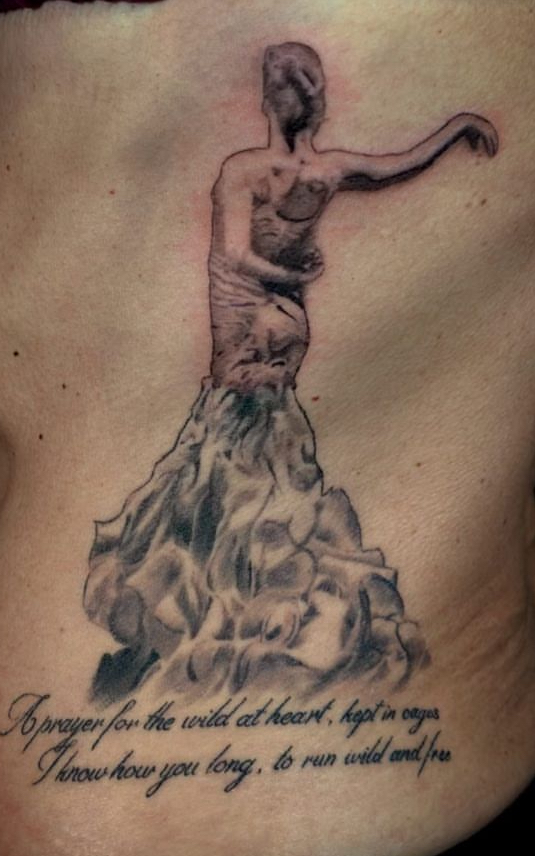

It took me another 10 years to get my first tattoo and it was not a written one. I had a leopard done in Johannesburg because I was born in South Africa and the leopard is one of the Big 5. When I finally decided to have something written, I was in San Diego in 2014. For a full 5 hours or so, someone patiently wrote Macbeth’s soliloquy in Act 5 Scene 5 on the right side of my rib cage. Surprisingly, there was no pain. The tattooer, who was very young, asked why I had chosen such a strange thing. I wanted to be constantly reminded of the fleeting nature of life and meaning, I said.
After I got divorced, Richard II was written on my right tight under the leopard. I wasted time and now doth time waste me.
My last one was done in 2024, a very common tattoo written under a flamenco dancer on my left rib cage. Tennessee Williams’ first verses of A Prayer for The Wild at Heart. The tattoo artist thought that having the whole poem would be over the top.
I wanted to show, even though they are not visible, that for me there’s nothing more important than literature. Particularly the one exploring human struggles, mortality, and the desire for freedom.
The “Pillow Book” connection made perfect sense now – like the film, I was using my body as a canvas for meaningful text. Yes, I could use paper, but text on skin becomes something more intimate and embodied than words on a page. I also see them as a way of relating my reminder’s of life’s impermanence and the tension between duty and desire to the struggles of everyone else.
I am now thinking of getting a tattoo of goddess Athena. I have to find suitable words.
There. There you are. You have just dropped a marker pin on your body, to reclaim yourself, to remind you where you are: inside yourself. Somewhere. Somewhere in there
Caitlin Moran, How to Be a Woman
The illusion of fearlessness often manifests as a kind of psychological armor – we convince ourselves we’re beyond fear, untouchable. But this supposed fearlessness can actually be a defense mechanism, a way of avoiding the vulnerability that comes with truly engaging with life. True courage doesn’t seem to be so much about being fearless – it’s about acknowledging our fears and moving forward despite them.
The fear of living itself is particularly paradoxical. It can manifest as a reluctance to fully engage with life’s experiences, to take risks, to open ourselves to both joy and pain, while not being afraid of what might be physically dangerous. This fear might lead us to live in a kind of half-state – physically alive but emotionally and spiritually withdrawn. We might avoid deep relationships, challenging opportunities, or meaningful changes because they require us to be vulnerable and face potential loss or failure.
The relationship between these two concepts – the illusion of fearlessness and the fear of living – is especially intriguing. Sometimes, those who project the strongest image of fearlessness are actually the most afraid of truly living. Their apparent fearlessness becomes a cage, preventing them from experiencing the full spectrum of human experience, including the fears that make us human.
What makes this dynamic even more complex is that some degree of fear is not just natural but necessary for meaningful living. Fear can be an indicator of what we truly care about, what matters to us. The person who claims to fear nothing might also love nothing, risk nothing, and ultimately live nothing.
There’s a particular kind of emptiness that comes not from feeling sad, but from feeling nothing at all. It’s a state many of us find ourselves in, though we rarely talk about it. We exist in a fortress of our own making – safe, perhaps, but isolated from the very experiences that make life vibrant and meaningful.
I’ve come to understand this state as emotional inertia. It’s not depression exactly, nor is it simple apathy. It’s more like being trapped in a glass box, watching life happen around you but feeling fundamentally disconnected from it. The most insidious part? Sometimes we convince ourselves this is preferable to the alternative.
“It’s not worth it,” we tell ourselves. “I wouldn’t know how to engage anyway.” These aren’t just excuses – they’re reflections of a deeper truth: somewhere along the way, many of us lost or never developed the emotional muscles needed for deep engagement with life. It’s as if we’re standing at the edge of a pool, knowing we should jump in, but feeling paralyzed by both the uncertainty of how to enter and a profound passivity that makes even taking that first step seem impossibly demanding.
The cruel paradox is that the person who claims to fear nothing might also love nothing, risk nothing, and ultimately live nothing. We build these walls of numbness thinking they’ll protect us from pain, but they end up protecting us from everything – joy, connection, growth, and yes, even the ability to feel fear itself.
This isn’t just about lack of motivation. It’s about a fundamental disconnect between knowing intellectually that life could be more and feeling capable of actually reaching for it. The challenge becomes self-reinforcing: the less we engage, the more foreign engagement feels, and the more insurmountable it appears.
But perhaps there’s another way to think about this. What if, instead of seeing engagement as an all-or-nothing proposition, we viewed it as a series of tiny experiments? Maybe it starts with allowing ourselves to feel mild interest in something small – a song that catches our attention, the taste of a new food, a moment of sunrise. No pressure to feel more than that. No expectation of transformation. Just small moments of allowing ourselves to experience rather than observe.
The path out of emotional inertia isn’t about suddenly becoming fearless or forcing ourselves to feel everything at once. It’s about gentle recognition – acknowledging where we are without judgment, understanding that this state of being likely served a purpose at some point in our lives, and accepting that change, if we want it, can begin with the smallest of steps.
To those standing at the edge of their own pools, watching others swim while feeling unable to join in: you’re not alone in this. The very fact that you can recognize this state in yourself is already a form of engagement. Sometimes, acknowledging the glass box is the first step toward finding its door.
Note to self and to whomever might need this: the goal isn’t to suddenly feel everything. It’s to slowly, gradually allow ourselves the possibility of feeling anything at all. And maybe, just maybe, that’s enough of a start









 Stories from A Closet of Errors