Not worthwhile

I can whistle almost the whole of the Fifth Symphony, all four movements, and with it I have solaced many a whining hour to sleep. It answers all my questions, the noble, mighty thing, it is “green pastures and still waters” to my soul. Indeed, without music I should wish to die. 

Edna St. Vincent Millay letter to Allan Ross MacDougall

To imagine existence without music might be biologically possible but it would be emotionally smaller. Music operates on a frequency that bypasses the intellect and speaks directly to something primal within us. Unlike spoken language, which divides us into linguistic communities, music creates a universal grammar of emotion. A minor key can evoke melancholy in a child who has never learned the word “sadness.” A triumphant major chord can lift spirits across cultures, generations, and personal circumstances. This universality suggests that music doesn’t merely accompany human experience—it is woven into the fabric of consciousness itself.

Music, uniquely among the arts, is both completely abstract and profoundly emotional. It has no power to represent anything particular or external, but it has a unique power to express inner states or feelings. Music can pierce the heart directly; it needs no mediation. One does not have to know anything about Dido and Aeneas to be moved by her lament for him; anyone who has ever lost someone knows what Dido is expressing. And there is, finally, a deep and mysterious paradox here, for while such music makes one experience pain and grief more intensely, it brings solace and consolation at the same time. (Oliver Sacks, Musicophilia: Tales of Music and the Brain )

When we consider a world stripped of this universal language, we imagine not just silence, but a profound disconnection from our own emotional landscape.

First dances, lullabies, funeral hymns, graduation marches—these melodies become the soundtrack to our most significant moments. They don’t merely accompany these experiences; they preserve them in a form more vivid than photographs, more immediate than written words. A few notes can transport us instantly across decades, reconstructing not just the memory but the emotion of a moment with startling clarity.

Without music, our memories would lose this dimensional quality, the emotional peaks and valleys of our lives would lack their soundtrack, making the landscape of personal history less navigable, less meaningful.

Even beyond its role in significant moments, music provides the rhythm that makes daily existence bearable, even beautiful. Work songs have existed in every culture because they transform labor from mere drudgery into something approaching art. The person who whistles Beethoven during difficult hours understands that music doesn’t change circumstances—it changes our relationship to circumstances. It provides the cadence that makes the unbearable bearable, the monotonous meaningful.

Consider the silence that would replace this constant, subtle soundtrack.

That life without music would not be worth living might initially seem hyperbolic. However, it points to a deeper truth about being human, we don’t merely survive on bread alone—we require beauty, meaning, connection, and transcendence. Music provides all of these simultaneously. It is the art form that most directly addresses our need for both individual expression and communal belonging, for both intellectual stimulation and emotional release.

Life may be technically possible without music, but it would be missing a profound transformation: the ability to turn time into beauty. Music does not change the fact that hours pass, that we suffer, or that we long for what is lost. But it alters how we inhabit those hours, how we carry that suffering, and how we hold on to memory. In this way, music does not merely decorate time — it redeems it. And in that redemption lies its deepest necessity.

If I should ever die, God forbid, let this be my epitaph:
THE ONLY PROOF HE NEEDED
FOR THE EXISTENCE OF GOD
WAS MUSIC

Kurt Vonnegut, A Man Without a Country

P.S. I read this today:

As a graduate student, I cared for my grandmother, who was a big fan of Ozzy’s band Black Sabbath herself. Any time we went anywhere, we put on our playlist and sang along. When, during the Covid-19 pandemic, I cut off part of my fingertip and lost access to my campus library, I had Ozzy in my ear for much-needed heavy metal pep talks as I took my PhD qualifying exams.

And when I lost both my grandmother and my California home the following year, I still had Ozzy. His music was the score as I finished my dissertation from my parents’ basement and landed my dream job at Iowa Wesleyan University. Through the submission of my dissertation and driving nearly 1,200 miles across the country to start my new job, I listened to the Blizzard of Ozz album. 

Brittany Anne Carlson

The World is a beautiful place


The world is a beautiful place
                                                           to be born into
if you don’t mind happiness
                                             not always being
                                                                        so very much fun
       if you don’t mind a touch of hell
                                                       now and then
                just when everything is fine
                                                             because even in heaven
                                they don’t sing
                                                        all the time
 
             The world is a beautiful place
                                                           to be born into
       if you don’t mind some people dying
                                                                  all the time
                        or maybe only starving
                                                           some of the time
                 which isn’t half so bad
                                                      if it isn’t you
 
      Oh the world is a beautiful place
                                                          to be born into
               if you don’t much mind
                                                   a few dead minds
                    in the higher places
                                                    or a bomb or two
                            now and then
                                                  in your upturned faces
         or such other improprieties
                                                    as our Name Brand society
                                  is prey to
                                              with its men of distinction
             and its men of extinction
                                                   and its priests
                         and other patrolmen
                                                         and its various segregations
         and congressional investigations
                                                             and other constipations
                        that our fool flesh
                                                     is heir to
 
Yes the world is the best place of all
                                                           for a lot of such things as
         making the fun scene
                                                and making the love scene
and making the sad scene
                                         and singing low songs of having
                                                                                      inspirations
and walking around
                                looking at everything
                                                                  and smelling flowers
and goosing statues
                              and even thinking
                                                         and kissing people and
     making babies and wearing pants
                                                         and waving hats and
                                     dancing
                                                and going swimming in rivers
                              on picnics
                                       in the middle of the summer
and just generally
                            ‘living it up’
 
Yes
   but then right in the middle of it
                                                    comes the smiling
                                                                                 mortician


The World is a Beautiful Place by Lawrence Ferlinghetti

Even in this   

one lifetime,

you will have to choose.


It is foolish

to let a young redwood   

grow next to a house.

Even in this   

one lifetime,

you will have to choose.

That great calm being,

this clutter of soup pots and books—

Already the first branch-tips brush at the window.   

Softly, calmly, immensity taps at your life.

Tree by Jane Hirshfield

I believe in legacies and memory. Just not in my own. Doing my best to carry the flame.

The how

How you move through the world

A stride, a gesture, the tilt of your head;

Some people enter a room like a storm; others radiate calm. Their “frequency” alters the space around them.

Do you rush? Linger? Dance while cooking? Your cadence reveals inner worlds.

The words you choose

Favorite phrases, slang, or even silences—words betray your history, humor, and heart.

How you frame experiences—a scientist might describe love as chemistry; a poet, as a wildfire. The specific vocabulary, phrases, and metaphors someone gravitates toward creates a verbal fingerprint. I’ve noticed how certain people have signature expressions or ways of framing ideas that immediately identify them, even in writing

How you treat others

The small kindnesses or thoughtlessness, who we make time for, how we respond to vulnerability or need – these interactions form patterns that define us. Some people consistently elevate others, while some drain energy from every room.

Your memory

 It’s not just what we remember, but how we remember, what we forget, and how those memories reshape us over time. As Oliver Sacks said  “Memory is dialogic and arises not only from direct experience but from the intercourse of many minds. […] It is a form of storytelling that goes on in the mind and never stops. […] Our memories are, in the end, a shifting, vanishing, mutating thing, a mirage of unreliable glimpses.” We don’t just have memories; we curate them, unconsciously editing our past to make sense of our present.

Your contradictions

Some people manage to be elegant yet unsettling, cool yet chaotic, polished but always a little off.

Each of us is an entire society, a whole neighborhood of Mystery; it is fitting that we at least make the life of this neighborhood elegant and distinguished, that in the celebrations of our sensations there be refinement and decorum, and that, because it is sober, there be courtesy in the banquets of our thoughts.

The Book of Disquiet

The Only Me
By Pat Mora

Spinning through space for eons,

our earth—oceans, rivers, mountains,

glaciers, tigers, parrots, redwoods—

        evolving wonders.


And our vast array, generations

of humans—all shapes, colors, languages.


        Can I be the only me?


Our earth: so much beauty, hate,

        goodness, greed.


“Study. Cool the climate,” advises my teacher.

                      “Grow peace.”


        Can I be the only me,

                      become all my unique complexity?

A good day

We are nothing more
than the time we have left,
walking toward the oblivion
we will become.

It's harsh, but that's the way it is.

The rest is just literature.

The best thing
is not to think about it too much:
keep walking,
drink coffee, fall in love,
watch the rain...

Karmelo C. Iribarren (my own attempted translation)

Monday poetry is late, again, so am I for most things

Whatever genius is

On Saturday I went to see Pablo Larraín’s Maria with a a friend. My friend cried at the end of the movie. Surprisingly ( to me), I didn’t. I am not quite sure I liked it. Angelina Jolie presumably excels as the tragic Diva; Massimo Cantini Parrini’s costume design was impeccable, as it should, since the source material was already extraordinary as he acknowledges in this interview to Harper’s Bazaar:

Costume design in María not only transforms Jolie into La Divina, it also serves as a visual metaphor for the film’s meditation on artistry, identity, and transformation. Through María Callas’ wardrobe, Larraín and Massimo Cantini Parrini articulate the tension between art as a living, breathing force and art as a frozen, ornamental relic

Callas was an artist shaped by both her voice and her image. Her costumes reflect this duality. Onstage, she is adorned in grand, operatic gowns. These gowns are heavy with history, as if carrying the weight of her own myth. These pieces emphasize how she became an icon, a living masterpiece. But offstage, her wardrobe shifts to softer, more intimate attire, revealing the woman beneath the legend. The contrast suggests that while the world sees only the diva, Callas herself wrestles with her own identity beyond the stage.

In her later years, Callas’ wardrobe takes on a different role. The extravagant fashion—high collars, structured silhouettes, luxurious fabrics—becomes almost like a museum exhibit. It serves as a way of preserving an identity that is slipping away. Even as her voice fades, her costumes remain striking. They seem like the last remnants of the persona she spent a lifetime constructing.

As Callas grapples with the loss of her voice, her costumes become more muted, understated—less fireworks, more elegy. The colors may darken, the embellishments may soften, mirroring the internal shift from performance to reflection.

A very long introduction to answer that if I could be someone else for a day, I would choose to be this kind of genius. Not the one shown in the movie. While not everyone knows what it’s like to command an opera house or possess extraordinary talent, we all know and experience, in very different measures, the personal side of decline.

You are born an artist or you are not. And you stay an artist, dear, even if your voice is less of a fireworks.

To be able to experience for one day what it would feel like having lightning running through your veins, knowing that every note you produce is pure artistic truth. The sheer physical and emotional power required to project that voice, to inhabit roles like Tosca or Norma so completely that the boundary between performance and reality almost disappears…

To know not adoration but to live with the certainty that your extraordinary gift has made a difference in the world through beauty.

Now, I am the same age as Callas was when she died and realize that I really wished I could be myself everyday even if there are so many more spectacular lives than my own.

Not the shadow of the past nor the shadow of the future

“Have you also learned that secret from the river; that there is no such thing as time?” That the river is everywhere at the same time, at the source and at the mouth, at the waterfall, at the ferry, at the current, in the ocean and in the mountains, everywhere and that the present only exists for it, not the shadow of the past nor the shadow of the future.

Herman Hesse, Siddhartha 

Portable magic

Do not read, as children do, to amuse yourself, or like the ambitious, for the purpose of instruction. No, read in order to live.
Gustave Flaubert

References

Stephen king

2017 Favorites

No wrong notes

piano

The notes I handle no better than many pianists. But the pauses between the notes – ah, that is where the art resides. Artur Schnabel


References:

“The piano ain’t got no wrong notes.” ― Thelonious Monk

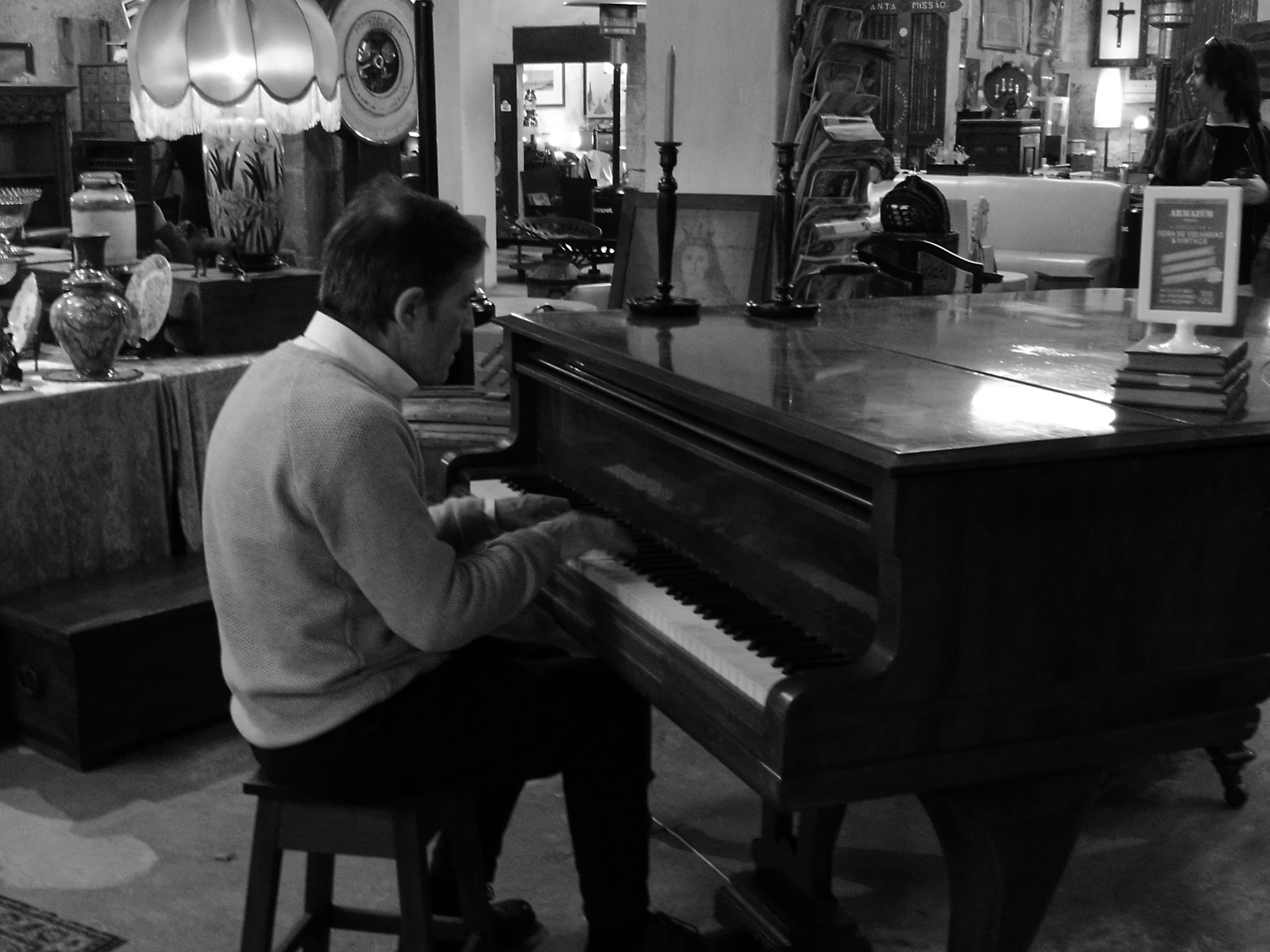
Photo: Vintage market at Armazém, Porto, November 18, 2017


Why would you walk?

fullsizeoutput_97

“But ballet itself – it’s important. Dance is important. It’s that language that everybody understands. It’s a powerful tool to open people’s minds. It’s some subconscious thing, a connection we all have. Kids dance before walking. It’s our truest nature of being. It’s true spirit.” He pauses. “And then, slowly and slowly, as we grow older, we get more and more baggage and life changes you. We are more scared of things, more fearful. So how to eliminate that? We have to go back to how we were as a kid, because that’s our truest nature. And with ballet, that is how I’m trying to come back to this state of mind. Because that’s the purest state. Tribes dance. Every country has a national dance. In the clubs we dance, we dance at weddings. Dance is a language. It’s a language that we need, like music, to survive.”

Sergei Polunin interview Another Man Magazine

If you could be dancing

Photo: Street Milonga in Porto (2013)